Commercial Water Damage: Keeping Your Business Open
The repair bill is rarely the biggest number after a commercial water loss. The closure is — and it's the one you have the most control over.
When a pipe fails in a house, the cost is the repair. When one fails in a business, the cost is the repair plus every day the doors are shut — and for most operations the second number dwarfs the first.
That reframes the whole decision set. Paying more for overnight crews stops looking expensive when you compare it to a week of lost revenue.
Dealing with this right now? We answer 24/7.
Free assessment · 60-minute emergency response · We bill your insurance carrier directly
First hour: containment before restoration
The first operational question isn't how to fix it, it's how much has to stop. A loss confined to a back-of-house area may require no closure at all if it's contained properly. The same loss allowed to spread across a sales floor closes you.
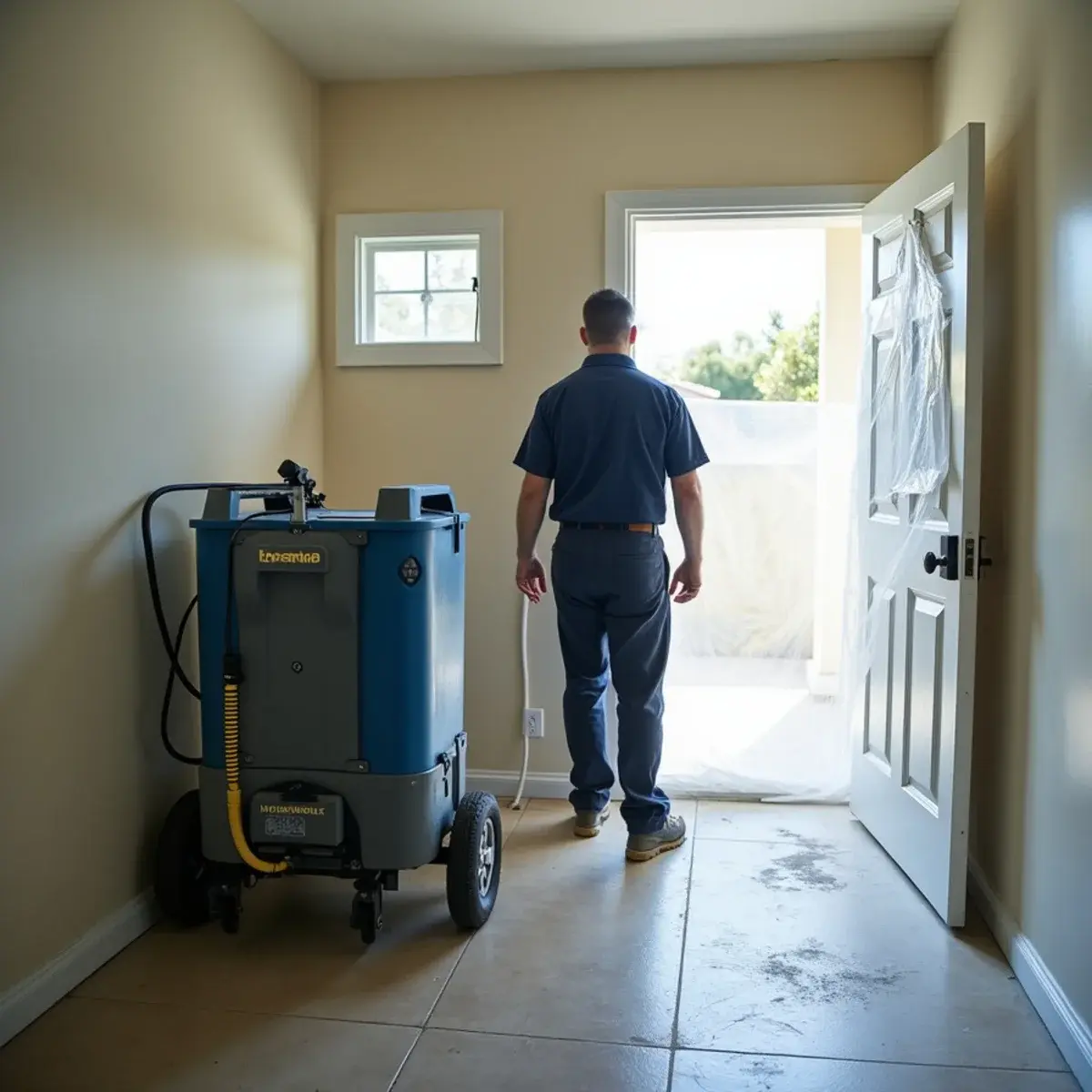
So the first move is isolation: seal the affected area with barriers, put it under negative pressure so humidity and odor don't migrate, and establish access routes that don't cross customer space.
Then extraction, immediately, because every hour of spread expands the area that has to be closed. Our commercial water damage restoration approach is built around answering the operational question first and the technical question second.
Phased and after-hours work
Most commercial spaces can stay partially operational through a restoration if the work is sequenced deliberately. Floor by floor, suite by suite, or section by section, with containment maintained between the working area and the operating one.
Overnight crews are the other half. Drying equipment runs 24 hours regardless, so the difference is when the disruptive work — demolition, material removal, reconstruction — happens. Doing it between close and open costs a premium per hour and is nearly always cheaper than the revenue foregone.
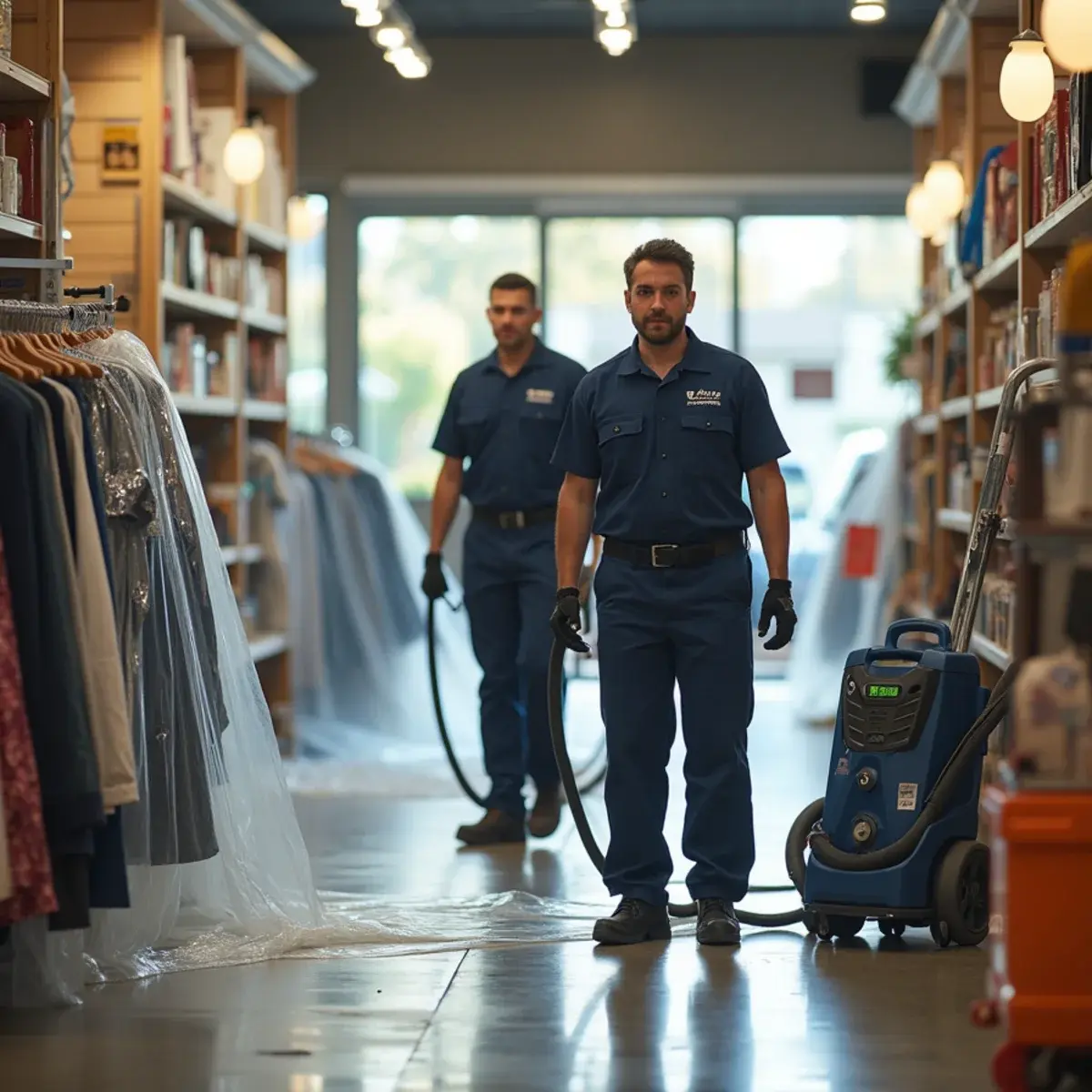
Staging matters too. Equipment and materials should be out of customer areas during operating hours, and containment should look intentional rather than like a disaster zone. Customers form impressions from what they see.
Call +1 (201) 277-9344 — 24/7 in Glendale
Free assessment · 60-minute emergency response · We bill your insurance carrier directly
Business interruption coverage
Most commercial property policies include business interruption coverage, which reimburses lost income during the period of restoration. It is one of the most underused coverages in commercial insurance, and the reason is documentation — claiming it requires evidence most businesses don't think to gather during an emergency.
What supports it: prior-period financials establishing normal revenue, records of the actual closure or reduced-operation period, evidence of the restoration timeline, and documentation of extra expenses incurred to keep operating — temporary space, expedited shipping, overtime, equipment rental.
Extra expense coverage is worth understanding separately. It covers costs incurred specifically to reduce the interruption, which means the premium you paid for overnight crews to reopen four days sooner is frequently reimbursable. That changes the calculus on how aggressively to push the schedule.
We provide the restoration-side documentation: daily logs, the timeline, and dated evidence of what was inaccessible when. Your accountant handles the financial side.
Sector-specific considerations
Restaurants and food service. Health department implications on top of restoration. Any waste-water or grease-laden loss in a food prep area needs remediation documented to a standard that supports reopening, and doing it right the first time is much faster than doing it twice.
Medical and dental. Infection control requirements, sensitive equipment, and patient scheduling that's booked weeks out. Containment standards are higher and coordination is heavier.
Retail. Inventory is often the largest loss and needs immediate triage and documentation. Appearance during the work matters more than in other sectors.
Offices with server rooms or IT infrastructure. Electronics exposed to water need specialist decontamination fast — corrosion continues after the water is gone. Don't power anything on.
Multi-tenant buildings. Cross-tenant coordination, separate documentation per suite, and the scope split between common area and tenant improvements.
What to have ready before it happens
A short list that makes a real difference at 2 a.m.:
- Know where your main water shut-off is and make sure staff on every shift know too.
- Keep a current floor plan showing plumbing runs, shut-offs and electrical panels.
- Maintain an up-to-date inventory and equipment list with values, stored off-site or in the cloud.
- Have your insurance policy, agent contact and claim procedure somewhere accessible outside the building.
- Establish a relationship with a restoration company before you need one, so the first call isn't a search.
- Know your notification obligations — landlord, tenants, health department, licensing bodies.
Multi-family and HOA properties
For apartment and condominium buildings, the operational question is displacement rather than closure. Relocating residents is expensive for owners and miserable for tenants, and it's avoidable more often than people assume.
Per-unit containment, drying schedules coordinated around residents' work hours, and clear communication about what the equipment does and when it comes out keeps most people in place through a restoration.
The claim side needs scope separation documented on day one: what's common element under the master policy, what's inside unit boundaries, and what constitutes an owner improvement. Reconstructing that argument months later with multiple carriers involved is far harder and considerably more expensive.
Frequently asked questions
The disruptive portions can. Drying equipment runs continuously regardless, but demolition, material removal and reconstruction can be scheduled between close and open with equipment staged out of the way during business hours.
We dispatch to commercial losses 24/7 with the same 60-minute target as residential. For larger events we scale crews and equipment over the following hours as the assessment defines the actual requirement.
We do. You get a single project contact who communicates with the property manager, ownership, tenants and the carrier, and provides each of them documentation in a form they can act on.
The bottom line
The repair is a known cost. The closure is the variable, and it's the one worth spending money to compress. Containment, phasing and after-hours work are how that's done — and extra expense coverage often reimburses it.
Drycore Restore handles commercial and multi-family losses across Glendale, Burbank and the surrounding area with after-hours crews. Call +1 (201) 277-9344.
Related services
- Commercial Water Damage Restoration in Glendale
- Emergency Water Extraction in Glendale
- Structural Drying & Dehumidification in Glendale