
Glendale, CA · 24/7 response
Emergency Water Extraction in Glendale, CA
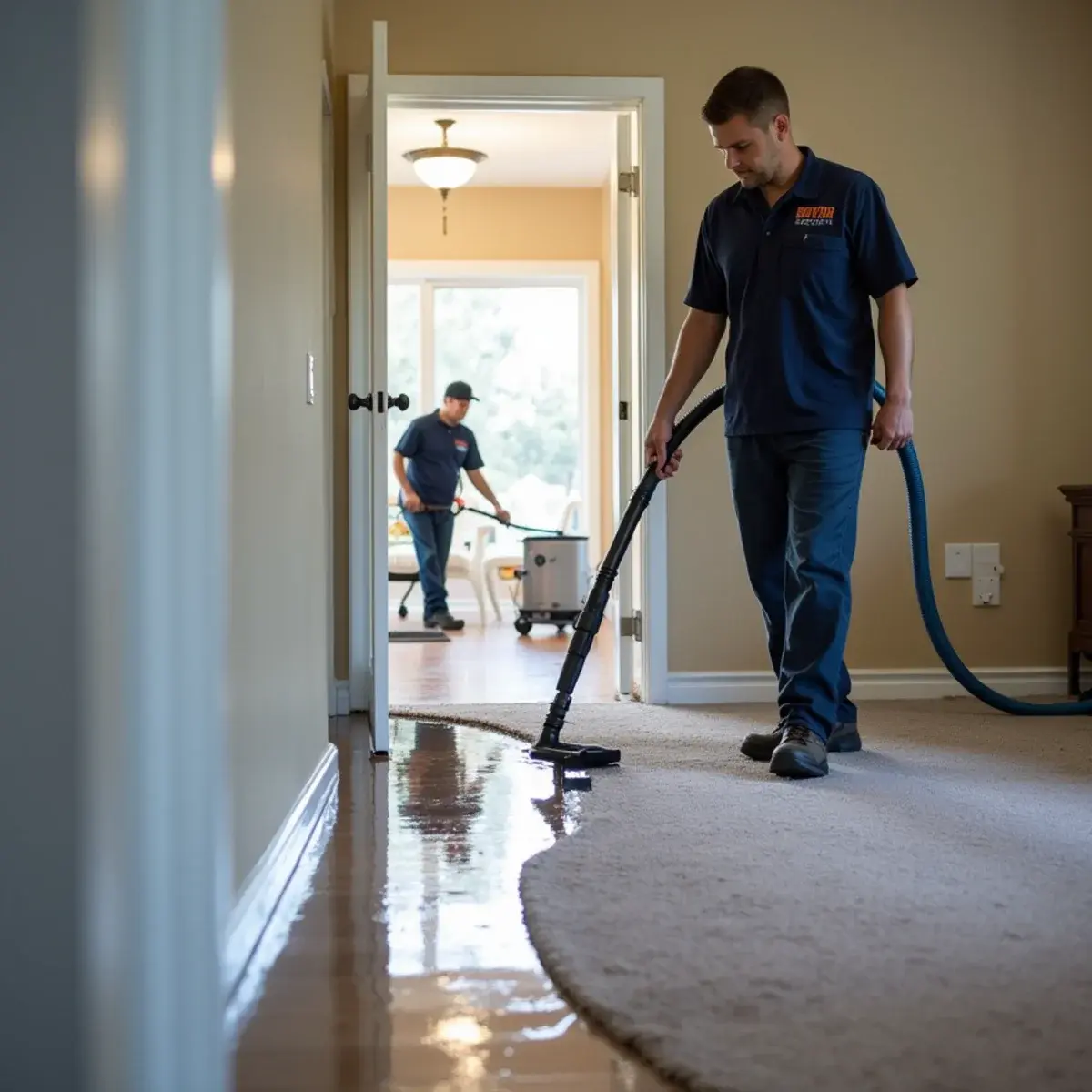
Truck-mounted units that pull hundreds of gallons an hour — the single highest-impact hour of any water loss.
- 5.0 from 3 Google reviews
- Licensed, bonded & insured
- 60-minute emergency response
24/7 emergency response
A real person answers any hour — and you get a real ETA for your address, not a number off a website. 60-minute response in Glendale.
Dry-Verified Guarantee
Equipment stays until moisture meters match your home's dry standard.
Direct insurance billing
Daily moisture logs and carrier-format estimates. Most clients pay only their deductible.
Mitigation & rebuild in-house
One company from the first gallon extracted to the last coat of paint.
Every hour that standing water sits, it moves. It wicks up drywall at roughly an inch an hour, migrates under cabinet toe-kicks where no fan will ever reach it, and soaks into the subfloor where it will quietly feed mold for weeks. Extraction is the one phase of a water loss where speed genuinely changes the outcome and the cost.
Drycore Restore runs extraction as its own emergency service. If you need water gone right now — a flooded hallway, a garage taking on runoff, an inch of water across a commercial floor — we can be on site with pumps and extractors while the rest of the plan is still being figured out.
Removing water mechanically is also enormously cheaper than removing it with dehumidifiers. Every gallon we pull with an extractor is a gallon that doesn't need days of equipment run-time to evaporate.
Need emergency water extraction in Glendale right now?
Free assessment · 60-minute emergency response · We bill your insurance carrier directly
Free on-site assessment
Tell us what's happening and we'll dispatch a emergency water extraction crew or call you straight back.
What we're looking for
Signs and problems this service solves
Visible standing water on any floor
More than a thin film of water on a hard surface means the water has already found the perimeter of the room and started moving into wall cavities. This is a same-hour call.
Carpet that releases water when you step on it
Saturated pad holds several times its weight in water. Surface drying does nothing here — the water has to be pulled through the carpet with a weighted extraction tool.
Water coming through a ceiling
Never stand under a bulging ceiling. Water pooling above drywall needs to be relieved deliberately in a controlled spot, then extracted, before the whole panel lets go.
A crawl space or garage taking on runoff
Hillside properties often see water enter at the lowest point during a storm. Sump pumps and trash pumps clear the volume; the drying plan comes after.
Water in a room with electrical outlets at floor level
If water is at or near outlet height, kill power to that circuit at the panel before entering. Tell us when you call and we'll bring the right equipment and PPE.
An overflow that ran while nobody was home
An unattended overflow means the water reached its full spread. We map the perimeter with a thermal camera rather than trusting what looks wet.
Scope of work
What emergency water extraction includes
Truck-mounted and portable extraction on the first truck
Both, every time. A truck-mount moves the most water fastest, but Glendale hillside driveways frequently will not take one close enough — so portables and 100-plus feet of hose lay ride along rather than requiring a second trip.
Solids-handling pumps for anything with sediment
Standard extractors clog instantly on silt-laden storm water. Trash pumps that pass solids come out for crawl spaces, flooded garages and any debris flow, so pumping starts immediately instead of after a return visit.
Weighted sub-surface extraction of carpet and pad
A weighted tool uses the technician's body weight to compress the pad and pull trapped water up through the carpet face. This is the step that decides whether carpet is dried in place or landfilled, and it only works inside the first several hours.
Trapped-water relief in ceilings and wall cavities
Bulging ceilings relieved deliberately at a chosen low point with catchment below, and discreet weep holes drilled behind baseboard so water standing inside a wall can drain rather than sit against the bottom plate.
Content blocking and tilting during extraction
Furniture lifted onto blocks or foil so finishes and metal glides do not bleed into wet carpet. Those stains are permanent, and preventing them costs minutes.
Volume, category and readings recorded before anything is billed
Affected area, water category, approximate volume removed and initial moisture readings — the evidence that supports every line item that follows.
How it works
Our emergency water extraction process
- 1
Make the site safe first
Power gets isolated to affected circuits, the water source gets shut off if it hasn't been, and we identify any slip, structural or contamination hazards before anyone starts working.
- 2
Bulk water removal
Submersible and trash pumps handle anything more than a couple of inches — crawl spaces, elevator pits, basements, flooded garages. Volume comes out first so we can see what we're actually dealing with.
- 3
Sub-surface extraction
For carpet and pad, weighted extraction tools use the technician's body weight to compress the pad and pull trapped water through the carpet face. On hard surfaces we use squeegee wands and, where water got under the flooring, floor mat systems that pull moisture up through the material.
- 4
Content and cavity checks
We tilt and block furniture off wet floors, pull toe-kicks and drill discreet weep holes in wall cavities where water is trapped behind finished surfaces so it can drain and dry instead of sitting.
- 5
Immediate hand-off to drying
Extraction and drying overlap. Air movers and dehumidifiers usually go in the same visit so evaporation starts while the crew is still on site.
- 6
Documentation for the claim
We record the affected area, the water category, the volume removed and the initial readings. This is the evidence that supports everything billed afterward.
Why mechanical extraction beats evaporation every time
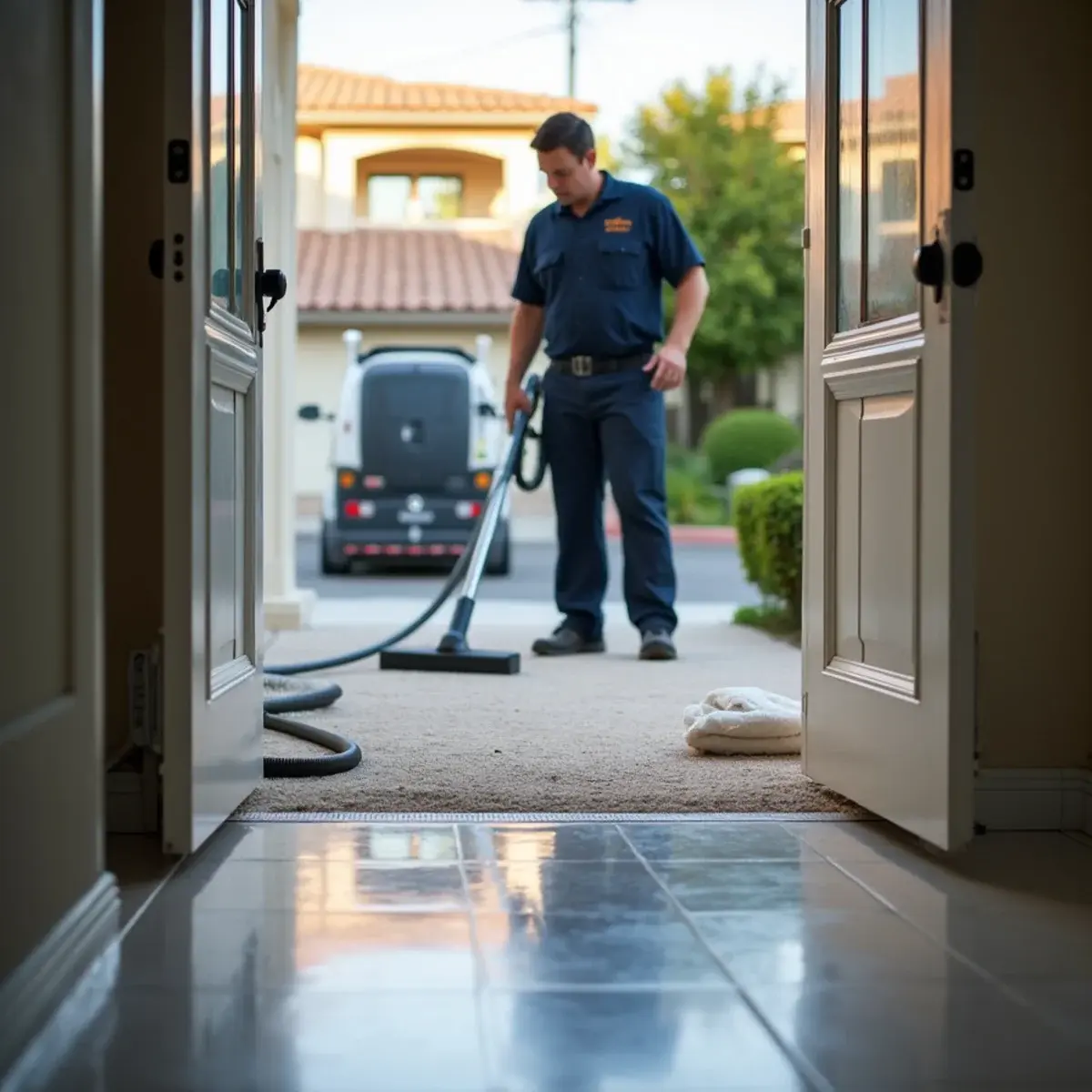
There's a rule of thumb in restoration: remove water as a liquid, not as a vapor. A commercial extractor can pull hundreds of gallons an hour. A large dehumidifier removes somewhere between 10 and 30 gallons a day. Doing the arithmetic on that gap is the whole argument for calling someone at 3 a.m. instead of waiting until morning.
It also affects what survives. Carpet that's extracted within the first several hours can often be dried in place and saved. The same carpet left to sit overnight delaminates from its backing and goes in the dumpster, along with the pad and often the tack strip. Solid hardwood extracted quickly may cup and then flatten back out as it dries; hardwood left in standing water usually has to be replaced.
What to do in the 20 minutes before we arrive
Shut off the water at the source if you can reach it safely — the angle stop under a fixture, or the main at the street side of the property. If you don't know where your main shut-off is, find it now, before you ever need it. Kill power to affected rooms at the breaker if water is anywhere near outlets or appliances.
Photograph everything before you move it. Insurance adjusters make decisions based on documentation, and the pre-cleanup photos are the ones that matter most. Then lift what you can: get shoes, books, electronics and anything with legs off the wet floor, and slide foil or plastic under furniture feet so finishes don't bleed into carpet.
What not to do: don't run a household vacuum on water, don't walk between a wet area and a dry area repeatedly in wet shoes, and don't run your central HVAC if any part of the duct system got wet — that's how a contained loss becomes a whole-house problem.
Honest cost drivers
What determines the price of this work
Volume and depth of water
Clearing two inches across a garage floor is a different job than pumping down a flooded crawl space. Depth drives pump selection and time on site.
Access to the affected area
A ground-floor room with a driveway 30 feet away is straightforward. Hillside homes where hose runs go up a staircase, or third-floor units with a long carry, take longer.
Water category
Contaminated water requires PPE, containment, and regulated disposal rather than a nearby sanitary drain. That's a real difference in labor and disposal cost.
After-hours dispatch
We run 24/7, and overnight and holiday emergency mobilization carries a standard after-hours rate — one that insurance carriers routinely accept as part of emergency mitigation.
Contents in the way
Moving and blocking furniture, electronics and stored items is part of extraction. A packed garage or a furnished basement adds handling time before extraction can even start.
Get a free, measured estimate — not a phone guess
Free assessment · 60-minute emergency response · We bill your insurance carrier directly
Why us for this
Why Glendale calls Drycore Restore for emergency water extraction
The hour that actually changes your bill
A commercial extractor pulls hundreds of gallons an hour; a large dehumidifier removes 10 to 30 gallons a day. Every gallon we take out as liquid is a gallon that never needs equipment days, which is why we treat extraction as its own emergency service rather than step one of a package.
We ask about your driveway before we dispatch
How the property meets the street, whether there is parking, how many steps. On an Adams Hill or Echo Park lot that thirty-second question decides whether extraction starts at minute five or minute fifty.
A person answers at 3 a.m.
Not a voicemail tree or an after-hours answering service that takes a message. You get someone who can tell you where your shut-off likely is and what to do before we arrive.
No charge to come out and look
On-site assessment and estimating is free, including the case where we tell you the water was clean, contained and caught early enough that you do not need us.
Questions
Emergency Water Extraction FAQs
Immediately. The IICRC treats the first 24 to 48 hours as the window before clean water begins to degrade into contaminated water and before microbial growth begins. In practice, damage escalates within hours, not days — drywall wicks about an inch per hour, and carpet backing starts delaminating overnight.
Yes. A large share of Glendale's housing sits on slopes with crawl spaces, daylight basements or downhill garages that collect runoff. We bring trash pumps for debris-laden water and can run long hose lays where truck access is limited.
Often, if we get to it early and the water was clean. We extract through the carpet, usually replace the pad, float the carpet over air movers, and verify it dry. Carpet soaked by sewage or by water that sat for days is a health issue and gets removed.
No. On-site assessment and estimating for a Glendale water loss is free. You'll know the scope and the plan before we begin billable work.
After-hours mobilisation carries a standard emergency rate, and insurance carriers routinely accept it as part of emergency mitigation. It is almost always cheaper than the spread you get from waiting until morning — drywall wicks about an inch an hour, and carpet backing delaminates overnight.
Related restoration services
Water Damage Restoration
Full-service recovery from the first gallon extracted to the last coat of paint — one crew, one invoice, one point of contact.
Read moreStructural Drying & Dehumidification
Metered, logged drying that ends when the meters say dry — not when the calendar says it's been three days.
Read moreFlood & Storm Damage Cleanup
Hillside runoff, debris flow and storm intrusion handled as the contaminated-water events they actually are.
Read more
Further reading from our crews
What To Do in the First Hour After Water Damage in Your Glendale Home
The decisions you make in the first sixty minutes decide whether this is a three-day dry-out or a six-week reconstruction. Here's the order to make them in.
Read moreHow Long Does Water Damage Drying Actually Take?
Three to five days covers most residential losses — but the number is a result, not a schedule. Here's what determines it and how dryness gets verified.
Read more
Emergency Water Extraction across our full service area
We provide this service throughout Glendale and the surrounding foothill communities. Choose your city or neighborhood for local detail.
- Glendale
- Montrose
- La Crescenta
- Verdugo Woodlands
- Rossmoyne
- Adams Hill
- Chevy Chase Canyon
- Sparr Heights
- Burbank
- Pasadena
- La Cañada Flintridge
- Eagle Rock
- Atwater Village
- Tujunga
- Sunland
- Altadena
- South Pasadena
- Silver Lake
- North Hollywood
- Toluca Lake
- Shadow Hills
- Lake View Terrace
- Sylmar
- San Fernando
- Sierra Madre
- Monrovia
- Duarte
- Azusa
- Glendora
- San Dimas
- La Verne
- Claremont
- Sun Valley
- Studio City
- Valley Village
- Sherman Oaks
- Van Nuys
- Panorama City
- Arleta
- Pacoima
- Mission Hills
- North Hills
- Encino
- Reseda
- Northridge
- Granada Hills
- Tarzana
- Winnetka
- Canoga Park
- Woodland Hills
- Chatsworth
- Glassell Park
- Cypress Park
- Highland Park
- Mount Washington
- Los Feliz
- Echo Park
- Lincoln Heights
- El Sereno
- Boyle Heights
- East Los Angeles
- Hollywood
- Hollywood Hills
- Downtown Los Angeles
- Koreatown
- Westlake
- Pico-Union
- Mid-Wilshire
Need emergency water extraction in Glendale?
Call +1 (201) 277-9344 for 24/7 dispatch, or request a free on-site assessment. Licensed, bonded & insured · We bill your insurance carrier directly.
Licensed, bonded & insured · We bill your insurance carrier directly · 24/7 Emergency Service