
Glendale, CA · 24/7 response
Burst Pipe Water Damage Cleanup in Glendale, CA
The most common call we get in Glendale — and the one where a fast response saves the most drywall.
- 5.0 from 3 Google reviews
- Licensed, bonded & insured
- 60-minute emergency response
24/7 emergency response
A real person answers any hour — and you get a real ETA for your address, not a number off a website. 60-minute response in Glendale.
Dry-Verified Guarantee
Equipment stays until moisture meters match your home's dry standard.
Direct insurance billing
Daily moisture logs and carrier-format estimates. Most clients pay only their deductible.
Mitigation & rebuild in-house
One company from the first gallon extracted to the last coat of paint.
A half-inch supply line under pressure moves several gallons a minute. If it lets go while you're at work, the arithmetic gets ugly fast — a line that fails at 9 a.m. and gets discovered at 6 p.m. has put well over a thousand gallons into your house.
This is the call we take most often in Glendale, and the causes are predictable: corroded galvanized pipe in pre-war homes, rubber washing machine hoses that hardened and split, water heaters that reached the end of a 12-year life, and angle stops under sinks and toilets that were never replaced.
We handle the aftermath completely — extraction, opening and drying the wall and floor assemblies the water reached, treating for microbial growth, and rebuilding. If the failed line is still leaking, we coordinate with a licensed plumber so the source is capped before drying begins.
Need burst pipe & leak cleanup in Glendale right now?
Free assessment · 60-minute emergency response · We bill your insurance carrier directly
Free on-site assessment
Tell us what's happening and we'll dispatch a burst pipe & leak cleanup crew or call you straight back.
What we're looking for
Signs and problems this service solves
Water running behind a wall you can hear but not see
A hissing or trickling sound with all fixtures off means a pressurized line is losing water inside the structure. Shut the main off immediately.
A wall that is warm or cold to the touch
A hot-water line failure creates a distinctly warm patch; a cold line makes a cool one. Either way, that patch marks the cavity that's flooding.
Sudden loss of water pressure
Pressure dropping at fixtures while water is clearly going somewhere is a strong indicator of a break upstream in the system.
Rust-colored water at the tap
In older galvanized systems, discolored water signals internal corrosion. Pipes that look fine on the outside can be nearly closed and paper-thin on the inside.
Water pooling at the base of the water heater
A weeping tank is a failed tank. Once the glass lining goes, the tank will eventually split — usually releasing 40 to 75 gallons at once.
Damp drywall at floor level with no visible source
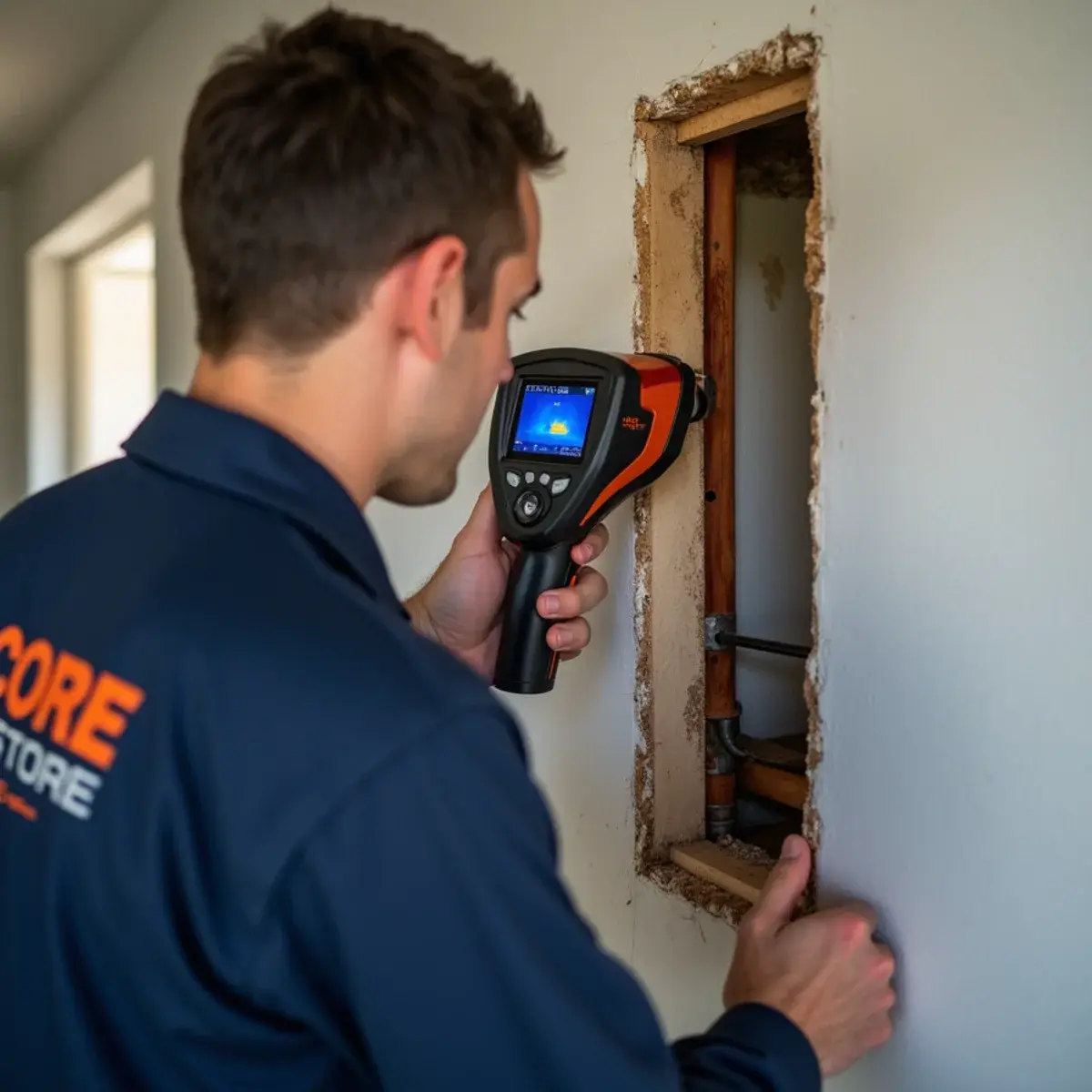
Water often exits a wall cavity at the bottom plate, several feet from where the actual break is. We locate the break with thermal imaging before opening anything.
Scope of work
What burst pipe & leak cleanup includes
Water stopped and the failure point located
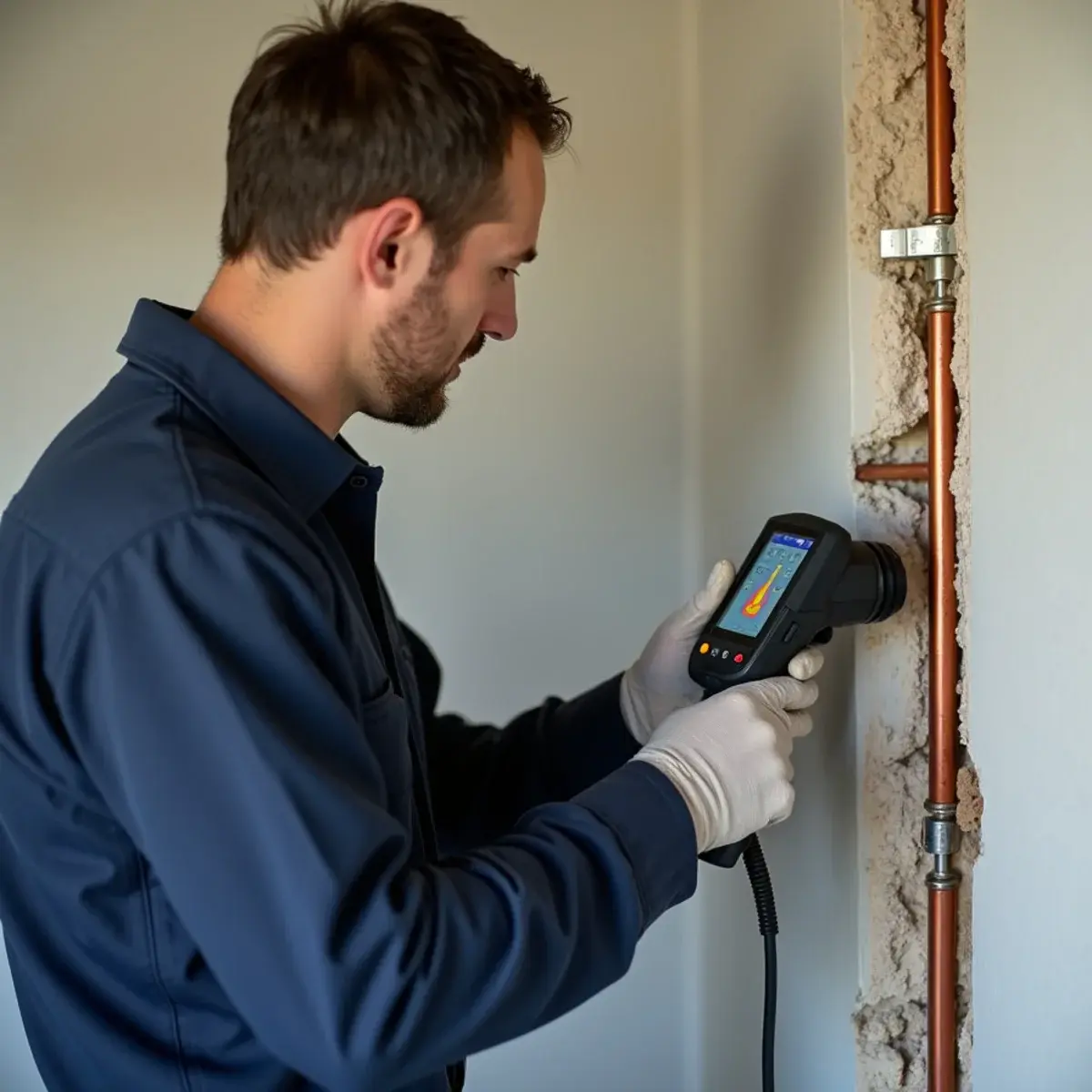
We shut the main or isolate the affected branch, then find the break with thermal imaging and acoustic listening equipment before anything is opened — so the wall gets cut once, in the right place.
Minimum-opening access
Typically baseboard off and a clean horizontal cut in the lower 24 inches of drywall, rather than exploratory demolition. On a Rossmoyne or Highland Park house with original plaster and period trim, every square foot we do not open is a square foot nobody has to recreate.
Full downstream tracking
Pressurised water travels. We follow it under flooring, into adjacent rooms and — in two-storey homes — into the ceiling assembly below, then set drying for the real footprint rather than the room where you saw water.
Cavity drying and antimicrobial treatment
Saturated insulation removed, framing and cavity surfaces treated, and directed airflow fed into the stud bays through discreet ports so the assembly dries rather than being closed up damp.
Coordination with a licensed plumber
Plumbing is a separately licensed trade. We stop the water and coordinate the repair so the line is confirmed fixed before we close anything, rather than leaving you to referee between two contractors.
Closing up with a matched finish
New insulation, drywall, taping, texture matched by hand, paint to a natural break, baseboard and any flooring that came out. Texture matching is what separates a repair you can see from one you cannot.
How it works
Our burst pipe & leak cleanup process
- 1
Stop the water
First step on every call. We shut the main or isolate the affected branch, and we'll show you where your shut-off is so you can act faster next time.
- 2
Find the failure point
Thermal imaging and acoustic listening equipment let us pinpoint the break so we open the smallest possible section of wall or ceiling instead of exploratory demolition.
- 3
Extract and open the assembly
Standing water comes out first. Then we make controlled openings — typically removing baseboard and cutting a clean line of drywall — to expose the cavity, remove saturated insulation and get airflow to the framing.
- 4
Dry the wall, floor and everything downstream
Water from a pressurized failure travels. We track it under flooring, into adjacent rooms and, in two-story homes, into the ceiling below, then set drying for the full affected footprint rather than just the room where you saw water.
- 5
Treat and verify
Exposed framing and cavity surfaces get an antimicrobial application. Air scrubbers run through drying. Equipment stays until readings confirm dry.
- 6
Close it back up
New insulation, drywall, taping, texture matching, paint, baseboard and any flooring that had to come out. Matching an existing texture is a skill, and it's the difference between a repair you can see and one you can't.
Why Glendale's older housing stock fails at the pipes
Homes built before roughly 1960 in this area were plumbed in galvanized steel. Zinc coating on the inside of that pipe wears away, iron corrodes, and mineral scale builds until the interior diameter shrinks to the width of a pencil. The pipe looks structurally fine from the outside right up until a threaded joint fails. If your home is in Adams Hill, Vine Street, Citrus Grove or any of the older pockets near downtown and hasn't been repiped, this is a question of when.
Post-war homes moved to copper, which lasts far longer but is vulnerable in two ways: pinhole leaks from aggressive water chemistry, and slab leaks where copper embedded in concrete abrades against the slab as it expands and contracts. Homes from the last two decades use PEX, which is excellent, though the crimped fittings still occasionally fail and, in the 2000s, some polybutylene systems were installed that have a well-documented failure history.
The practical takeaway: know the plumbing era of your house. It tells you what will fail and roughly when, and it's the single most useful thing a Glendale homeowner can know about their property before the emergency happens.
The three failures we see most, and how to prevent them
Washing machine hoses. Standard rubber hoses are rated for a handful of years and routinely left in place for fifteen. Replace them with stainless braided hoses, and shut the valves off when you leave town for more than a few days. A failed hose delivers roughly six gallons a minute with nothing to stop it.
Water heaters. Twelve years is a realistic service life for a tank in this water. Check the pan and the area around the base twice a year, keep the temperature-and-pressure relief valve piped to a drain, and if the unit sits in a finished area or above living space, install a pan with a drain line or a leak sensor that shuts off supply automatically.
Angle stops and supply lines at toilets and sinks. These little chrome valves are the most-ignored plumbing in the house and the source of an enormous share of overnight losses. If yours are original to a home built more than twenty years ago, replacing them is a low-cost afternoon that prevents a five-figure claim.
Honest cost drivers
What determines the price of this work
How long the pipe ran
A leak caught in ten minutes affects one wall. The same leak running for ten hours affects a floor assembly, a ceiling below and the rooms on either side. Duration is the single biggest cost driver.
Where the break happened
A line in an accessible wall is straightforward. A line inside a slab, in a second-floor ceiling, or behind a tiled shower wall means opening finishes that cost significantly more to put back.
Whether it was hot or cold water
Hot-water losses spread faster because the heat drives evaporation and pushes humidity through the structure. They frequently affect a larger area than an equivalent cold-water break.
Finish quality being replaced
Replacing a section of painted drywall is inexpensive. Replacing a matched hardwood run, custom cabinetry or a tiled wall assembly is not.
Plumbing repair itself
We restore; a licensed plumber repairs or repipes. When the failure exposes a wider problem — a house still on galvanized supply, for example — we'll flag it so you can decide whether to repipe while the walls are already open.
Get a free, measured estimate — not a phone guess
Free assessment · 60-minute emergency response · We bill your insurance carrier directly
Why us for this
Why Glendale calls Drycore Restore for burst pipe & leak cleanup
We know which era of Glendale pipe failed before we arrive
Pre-1960 in Adams Hill or Citrus Grove means galvanized failing at a threaded joint. Postwar slab means abraded copper. Newer construction means a fitting or an appliance connection. That tells us what to bring and where to look first.
Thermal imaging on the first visit
Not scheduled as a second appointment or subcontracted. Locating the break precisely is what keeps the opening small, and on a historic house that decision is worth more than the drying.
We flag the wider problem honestly
If the failure exposes a house still on original galvanized, we say so — and point out that the walls are already open, which is the cheapest moment you will ever have to repipe.
Insurance handled where it actually splits
Most California policies cover the resulting damage but exclude the pipe repair itself. We document the split clearly so you are not surprised by which invoice your carrier pays.
Questions
Burst Pipe & Leak Cleanup FAQs
We stop the water, and we coordinate a licensed plumber to make the actual repair — plumbing is a separately licensed trade and we won't cut corners on it. Everything after that point, from extraction through drying, treatment and rebuilding the wall, is us.
A sudden pipe failure is a textbook covered peril under most standard policies, and coverage generally extends to the resulting damage to floors, walls and contents. Note that the pipe repair itself is sometimes excluded even when the water damage is covered. We help you separate those in the claim.
As little as possible. We locate the break with thermal imaging first, then make a clean horizontal cut — often just the lower 24 inches behind the baseboard — so the cavity can be dried and the repair is easy to close and blend.
Yes, and quickly. Water that entered a wall cavity doesn't evaporate on its own in a sealed assembly; it sits against framing and insulation and starts growing mold in 24 to 48 hours. A short inspection with a moisture meter now is far cheaper than remediation later.
Three tells together are close to conclusive: rust-coloured water on the first draw in the morning, water pressure that has quietly declined over the years, and visible corrosion or scaling at any exposed connection under a sink or at the water heater. A house built before 1960 showing all three has never been repiped.
Related restoration services
Water Damage Restoration
Full-service recovery from the first gallon extracted to the last coat of paint — one crew, one invoice, one point of contact.
Read moreSlab Leak Detection & Repair Support
Thermal and acoustic location of under-slab leaks — pinpointed before anyone breaks concrete.
Read moreWater Damage Repair & Reconstruction
The rebuild phase most restoration companies hand off — done in-house, so the job actually finishes.
Read more
Further reading from our crews
Preventing Burst Pipes in Older Glendale Homes
If your Glendale home was built before 1960 and hasn't been repiped, a supply line failure isn't a possibility. It's a schedule you don't have access to.
Read moreWhere Is My Water Shut-Off Valve? Find It Before You Need It
The single highest-value ten minutes of home maintenance there is. Most people first look for their shut-off while standing in water.
Read more
Burst Pipe & Leak Cleanup across our full service area
We provide this service throughout Glendale and the surrounding foothill communities. Choose your city or neighborhood for local detail.
- Glendale
- Montrose
- La Crescenta
- Verdugo Woodlands
- Rossmoyne
- Adams Hill
- Chevy Chase Canyon
- Sparr Heights
- Burbank
- Pasadena
- La Cañada Flintridge
- Eagle Rock
- Atwater Village
- Tujunga
- Sunland
- Altadena
- South Pasadena
- Silver Lake
- North Hollywood
- Toluca Lake
- Shadow Hills
- Lake View Terrace
- Sylmar
- San Fernando
- Sierra Madre
- Monrovia
- Duarte
- Azusa
- Glendora
- San Dimas
- La Verne
- Claremont
- Sun Valley
- Studio City
- Valley Village
- Sherman Oaks
- Van Nuys
- Panorama City
- Arleta
- Pacoima
- Mission Hills
- North Hills
- Encino
- Reseda
- Northridge
- Granada Hills
- Tarzana
- Winnetka
- Canoga Park
- Woodland Hills
- Chatsworth
- Glassell Park
- Cypress Park
- Highland Park
- Mount Washington
- Los Feliz
- Echo Park
- Lincoln Heights
- El Sereno
- Boyle Heights
- East Los Angeles
- Hollywood
- Hollywood Hills
- Downtown Los Angeles
- Koreatown
- Westlake
- Pico-Union
- Mid-Wilshire
Need burst pipe & leak cleanup in Glendale?
Call +1 (201) 277-9344 for 24/7 dispatch, or request a free on-site assessment. Licensed, bonded & insured · We bill your insurance carrier directly.
Licensed, bonded & insured · We bill your insurance carrier directly · 24/7 Emergency Service