
Glendale, CA · 24/7 response
Ceiling & Roof Leak Water Damage Repair in Glendale, CA
Emergency tarping, attic drying and texture-matched ceiling repair that doesn't leave a visible patch.
- 5.0 from 3 Google reviews
- Licensed, bonded & insured
- 60-minute emergency response
24/7 emergency response
A real person answers any hour — and you get a real ETA for your address, not a number off a website. 60-minute response in Glendale.
Dry-Verified Guarantee
Equipment stays until moisture meters match your home's dry standard.
Direct insurance billing
Daily moisture logs and carrier-format estimates. Most clients pay only their deductible.
Mitigation & rebuild in-house
One company from the first gallon extracted to the last coat of paint.
A ceiling stain is a symptom with a long history. By the time water shows on the finished side of drywall it has already crossed the roof deck, the insulation and the framing above it — and it has probably been doing so for longer than one storm.
Drycore Restore handles the full sequence: emergency tarping to stop the intrusion, controlled relief of trapped water, attic and cavity drying, insulation replacement, and a ceiling repair that blends into the existing texture instead of announcing itself.
Roof leaks in Glendale cluster in predictable places. Flashing at chimneys and skylights, valleys where two roof planes meet, tile roofs where the underlayment has aged past its life while the tile still looks perfect, and flat or low-slope sections on mid-century and contemporary homes where ponding water finds any seam.
Need ceiling & roof leak damage in Glendale right now?
Free assessment · 60-minute emergency response · We bill your insurance carrier directly
Free on-site assessment
Tell us what's happening and we'll dispatch a ceiling & roof leak damage crew or call you straight back.
What we're looking for
Signs and problems this service solves
A brown ring that grows with each rain
Concentric staining is the classic signature of repeated wetting and drying. The stain marks the low point of the water's path, not necessarily the location of the leak.
A ceiling that is bulging or sagging
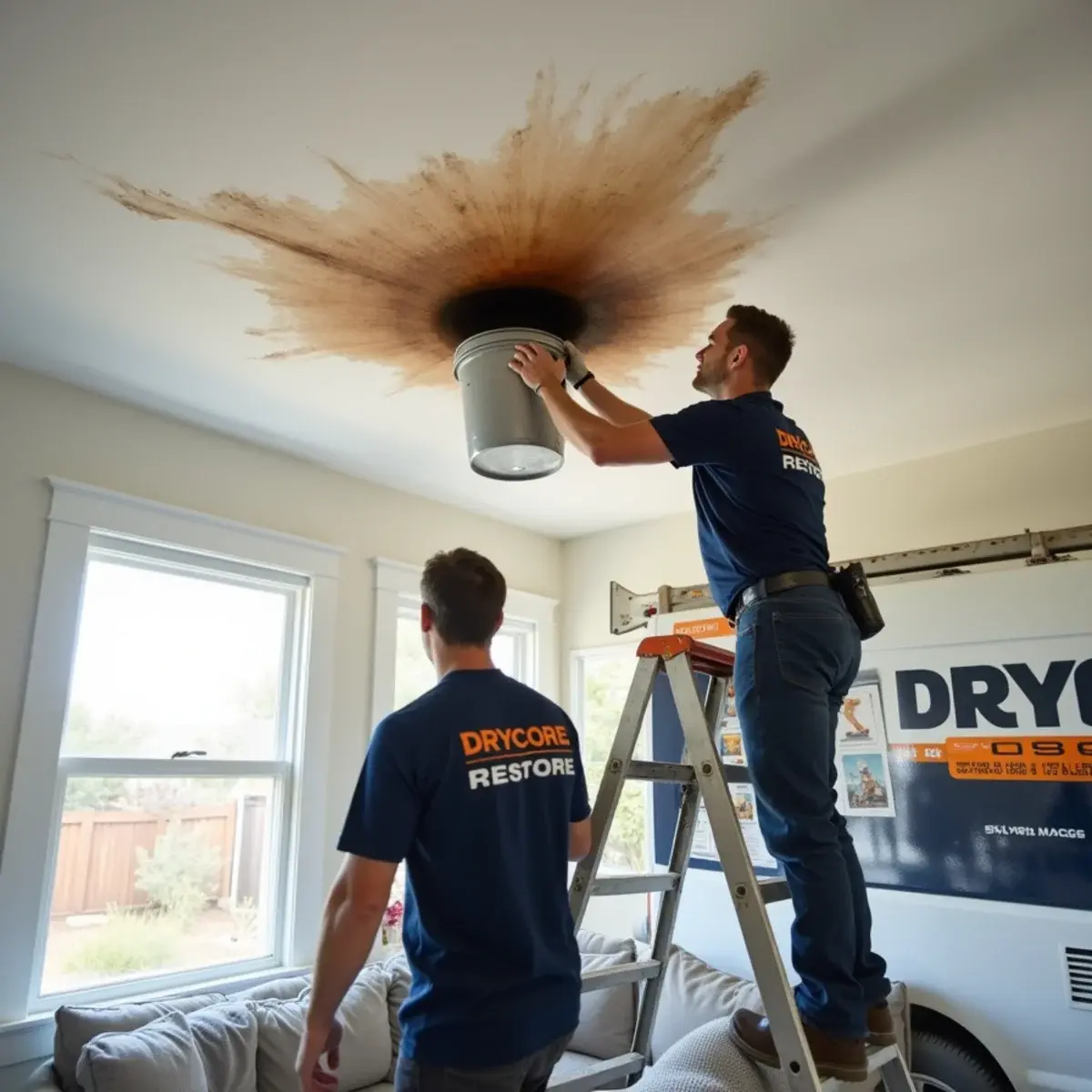
Trapped water above drywall. Do not poke at it standing underneath — a saturated panel can release dozens of pounds of water and material at once. Keep everyone out of the room and call.
Paint peeling or bubbling on a ceiling
Moisture behind the paint film pushes it off the drywall. It's an early warning that appears before staining does.
Water at a wall/ceiling corner or around a light fixture
Water follows framing and takes the easiest exit — often the gap around a can light or the seam at a wall. That's an electrical hazard as well as a water problem.
Damp or matted attic insulation
If you can access your attic safely, dark, compressed or musty insulation directly identifies where water is entering above.
Staining that only appears in wind-driven rain
Intermittent leaks that track with storm direction usually indicate a flashing or siding penetration issue rather than a failed roof field.
Scope of work
What ceiling & roof leak damage includes
Emergency tarping to stop the intrusion
Reinforced tarp installed with proper fastening and overlap so it sheds water and survives wind, rather than a sheet that tears loose in the next storm. This is temporary protection and we are explicit about how long it holds.
Controlled relief of trapped water
Where drywall is holding water we open it at a chosen low point with catchment below and nobody standing underneath — instead of letting a saturated panel fail wherever and whenever it wants to.
Attic-side assessment and moisture mapping
We inspect from above, map the wet area on the deck and framing, and track how far water travelled laterally along the rafters. The entry point is routinely ten to fifteen feet uphill of the stain.
Wet insulation removed, cavity dried
Insulation that took on water never regains its R-value and holds moisture against framing, so it comes out. Then the deck, framing and remaining ceiling assembly are dried with directed airflow and dehumidification.
Treatment of framing that stayed wet
Antimicrobial application, and where surface growth has started, HEPA vacuuming and abrasion before anything is closed up.
Texture-matched ceiling rebuild
New drywall, taping and a matched finish — knockdown, orange peel, skip trowel, smooth, or hand-troweled plaster on older Glendale homes. Texture matching is the part everyone notices, so it gets sampled before we commit.
How it works
Our ceiling & roof leak damage process
- 1
Emergency tarping and source control
If the roof is actively leaking, we tarp it so restoration can proceed instead of waiting on roofing weather. Tarping is temporary protection, not a repair, and we're direct about that.
- 2
Controlled relief of trapped water
Where drywall is holding water, we relieve it at a chosen point with containment below rather than letting the panel fail wherever it wants to. This limits damage to a repairable area.
- 3
Attic and cavity assessment
We inspect the attic side, map the wet area on the deck and framing, and identify how far the water traveled laterally along the rafters before it came through.
- 4
Removal and drying
Saturated insulation is removed — wet insulation never regains its R-value and holds water against framing. Then we dry the deck, framing and remaining ceiling assembly with directed airflow and dehumidification.
- 5
Treatment
Framing and sheathing that stayed wet for an extended period get antimicrobial treatment and, where surface growth has begun, HEPA vacuuming and abrasion before rebuild.
- 6
Ceiling rebuild and texture match
New drywall, taping, and a matched texture — knockdown, orange peel, skip trowel or smooth — then primer and paint. On older Glendale homes with acoustic or hand-troweled plaster ceilings we match the finish by hand.
Why the leak is almost never directly above the stain
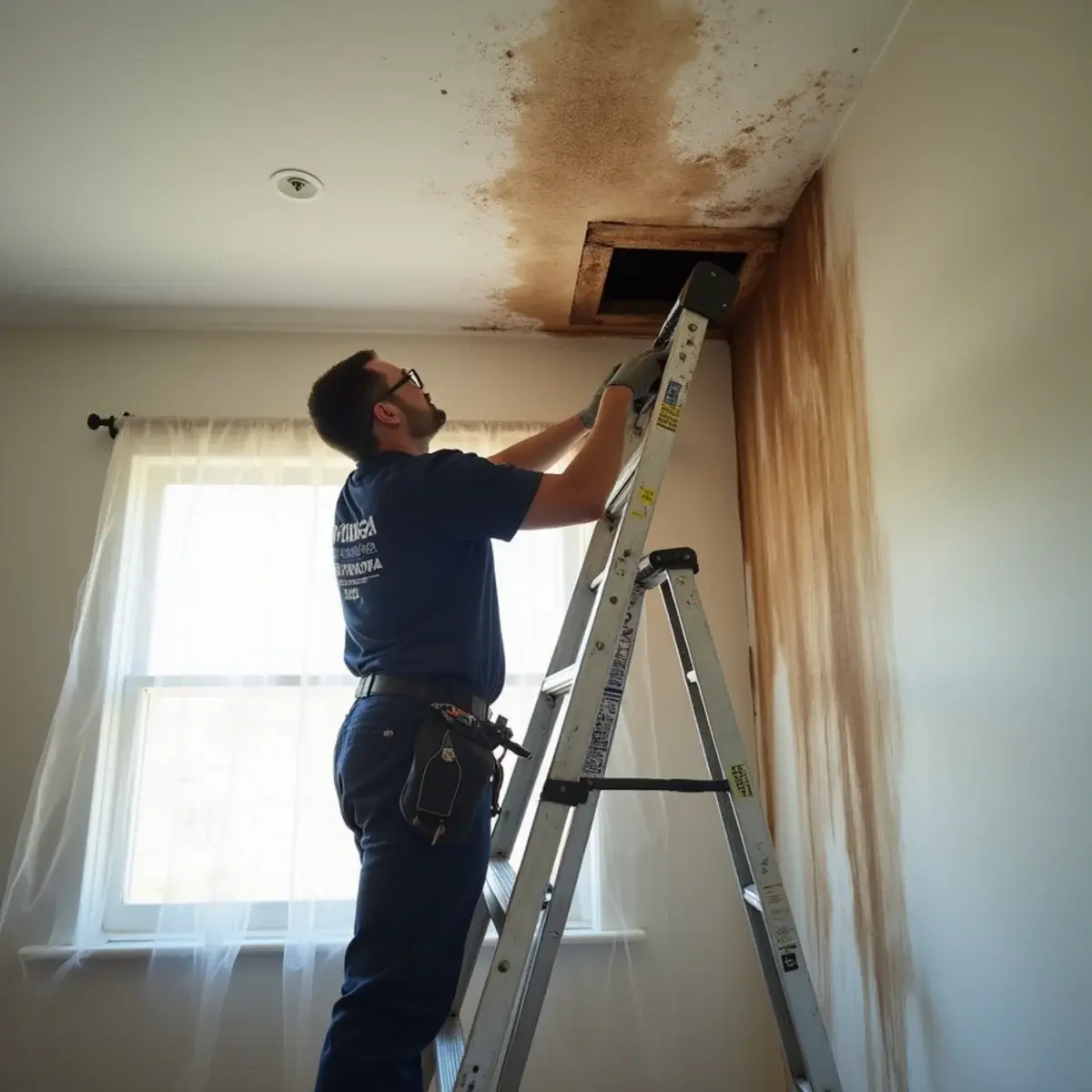
Water entering a roof lands on the deck and then travels. It runs down the slope of the sheathing, along the top of a rafter, across a truss chord, until it finds a penetration — a gap around a vent, a seam in the drywall, a can light housing — and drops. It's routine for the actual entry point to be ten or fifteen feet uphill of where you see the stain.
This is why chasing a leak from the inside fails so often, and why we look at the attic side and the roof itself rather than cutting into the ceiling where the stain is. Thermal imaging from inside plus a physical inspection above almost always resolves it faster than exploratory demolition.
It's also why one stain can indicate several entry points. If the underlayment on a tile roof has aged out, every valley and penetration on that slope is a candidate, and repairing one flashing detail may just move the stain to a different spot next winter.
Tile roofs, flat roofs and the Glendale hillside problem
Clay and concrete tile roofs are common across Glendale, and they create a specific false confidence: the tile is essentially permanent, so the roof looks fine indefinitely. But the tile isn't what keeps water out — the underlayment beneath it is, and that felt or synthetic membrane has a service life measured in decades, not centuries. A 40-year-old tile roof with original underlayment will leak, and it will keep leaking until the tile is lifted and the underlayment replaced.
Mid-century and contemporary homes in the foothills often have low-slope or flat sections that were never designed for the water volume an atmospheric river delivers. Ponding water finds seams that shed light rain without a problem. If your leak only appears during major storms, a low-slope section is the first place to look.
Hillside properties add wind. Roofs on exposed ridgelines above Chevy Chase Canyon or the Verdugo foothills take driving rain at angles that a valley-floor roof never sees, which is why flashing details fail there first.
Honest cost drivers
What determines the price of this work
Size of the affected ceiling area
A two-foot patch is a small job. Once the affected area spans much of a room, replacing the full ceiling plane often produces a better result than patching and can cost less than repeated blending attempts.
Texture and finish complexity
Matching a flat painted ceiling is easy. Matching a 1930s hand-troweled plaster finish, or dealing with an acoustic ceiling that may contain asbestos and require testing, is significantly more involved.
Insulation replacement
Removing and replacing wet insulation across an attic area is priced by square footage and by insulation type.
Whether the roof is repaired first
We won't close up a ceiling under an active leak. Roofing repair is separate work; we coordinate the sequence and can tarp indefinitely in the meantime.
Access and height
Standard eight-foot ceilings are straightforward. Vaulted ceilings, two-story entries and stairwell soffits require staging and add labor.
Get a free, measured estimate — not a phone guess
Free assessment · 60-minute emergency response · We bill your insurance carrier directly
Why us for this
Why Glendale calls Drycore Restore for ceiling & roof leak damage
We know the leak is not above the stain
Water runs down the sheathing and along framing before it finds a penetration. We locate from the attic and the roof rather than cutting into the ceiling under the mark, which is how exploratory demolition gets avoided.
Straight talk about tile roofs
The tile is effectively permanent; the underlayment beneath it is not. A forty-year-old tile roof on original underlayment will keep producing leaks in new places, and we say that rather than repairing one flashing detail and letting you think it is solved.
We relieve sagging ceilings safely
A saturated panel can drop dozens of pounds of water and debris without warning. We open it deliberately from the side with catchment below — never from underneath with a screwdriver and a bucket.
Plaster ceilings assessed for key failure
On older homes we tap the field before calling a ceiling salvageable, because wet plaster can lose its keys and be structurally detached while looking perfectly intact. That is a safety check most crews do not perform.
Questions
Ceiling & Roof Leak Damage FAQs
Get everyone out of the room and move furniture if you can do it quickly and safely from the edges. Put a container down and place a bucket, but do not stand under it and do not puncture it yourself — a saturated panel can release a large volume of water and heavy debris without warning. Call us and we'll relieve it under control.
We provide emergency tarping to stop the intrusion, and we handle everything below the roof deck. The roof repair or replacement is separately licensed roofing work; we coordinate with your roofer or recommend one, and we'll sequence our rebuild after the roof is watertight.
Yes — knockdown, orange peel, skip trowel, smooth and hand-troweled plaster. Texture matching is the part of ceiling repair most people notice, so we take time to sample and match before committing to the whole area.
Damage from a sudden event — wind removing tile or shingles, a tree limb puncturing the deck — is usually covered, including the interior damage that results. Leaks from a roof that simply wore out over time are generally treated as deferred maintenance and excluded. The documentation of what caused it is what decides the claim.
A properly installed reinforced tarp holds for several weeks to a few months depending on sun and wind exposure. It buys time to get a roofer scheduled and a claim processed, and to do the repair in dry weather rather than during a storm sequence — but it is not a season-long solution. We will tell you roughly how long yours should last and re-tarp if the repair timeline runs long.
Related restoration services
Water Damage Restoration
Full-service recovery from the first gallon extracted to the last coat of paint — one crew, one invoice, one point of contact.
Read moreStructural Drying & Dehumidification
Metered, logged drying that ends when the meters say dry — not when the calendar says it's been three days.
Read moreWater Damage Repair & Reconstruction
The rebuild phase most restoration companies hand off — done in-house, so the job actually finishes.
Read more
Further reading from our crews
Sagging Ceiling From Water: What To Do in the Next Ten Minutes
A saturated ceiling panel is a suspended container of water. Handled deliberately it's a repairable hole. Handled badly it's an injury.
Read moreYour Ceiling Stain Is Probably the Air Conditioner
Every July we get the same call: a brown stain spreading across a bedroom ceiling, no plumbing above it, and an air handler in the attic.
Read more
Ceiling & Roof Leak Damage across our full service area
We provide this service throughout Glendale and the surrounding foothill communities. Choose your city or neighborhood for local detail.
- Glendale
- Montrose
- La Crescenta
- Verdugo Woodlands
- Rossmoyne
- Adams Hill
- Chevy Chase Canyon
- Sparr Heights
- Burbank
- Pasadena
- La Cañada Flintridge
- Eagle Rock
- Atwater Village
- Tujunga
- Sunland
- Altadena
- South Pasadena
- Silver Lake
- North Hollywood
- Toluca Lake
- Shadow Hills
- Lake View Terrace
- Sylmar
- San Fernando
- Sierra Madre
- Monrovia
- Duarte
- Azusa
- Glendora
- San Dimas
- La Verne
- Claremont
- Sun Valley
- Studio City
- Valley Village
- Sherman Oaks
- Van Nuys
- Panorama City
- Arleta
- Pacoima
- Mission Hills
- North Hills
- Encino
- Reseda
- Northridge
- Granada Hills
- Tarzana
- Winnetka
- Canoga Park
- Woodland Hills
- Chatsworth
- Glassell Park
- Cypress Park
- Highland Park
- Mount Washington
- Los Feliz
- Echo Park
- Lincoln Heights
- El Sereno
- Boyle Heights
- East Los Angeles
- Hollywood
- Hollywood Hills
- Downtown Los Angeles
- Koreatown
- Westlake
- Pico-Union
- Mid-Wilshire
Need ceiling & roof leak damage in Glendale?
Call +1 (201) 277-9344 for 24/7 dispatch, or request a free on-site assessment. Licensed, bonded & insured · We bill your insurance carrier directly.
Licensed, bonded & insured · We bill your insurance carrier directly · 24/7 Emergency Service