Your Ceiling Stain Is Probably the Air Conditioner
Every July we get the same call: a brown stain spreading across a bedroom ceiling, no plumbing above it, and an air handler in the attic.
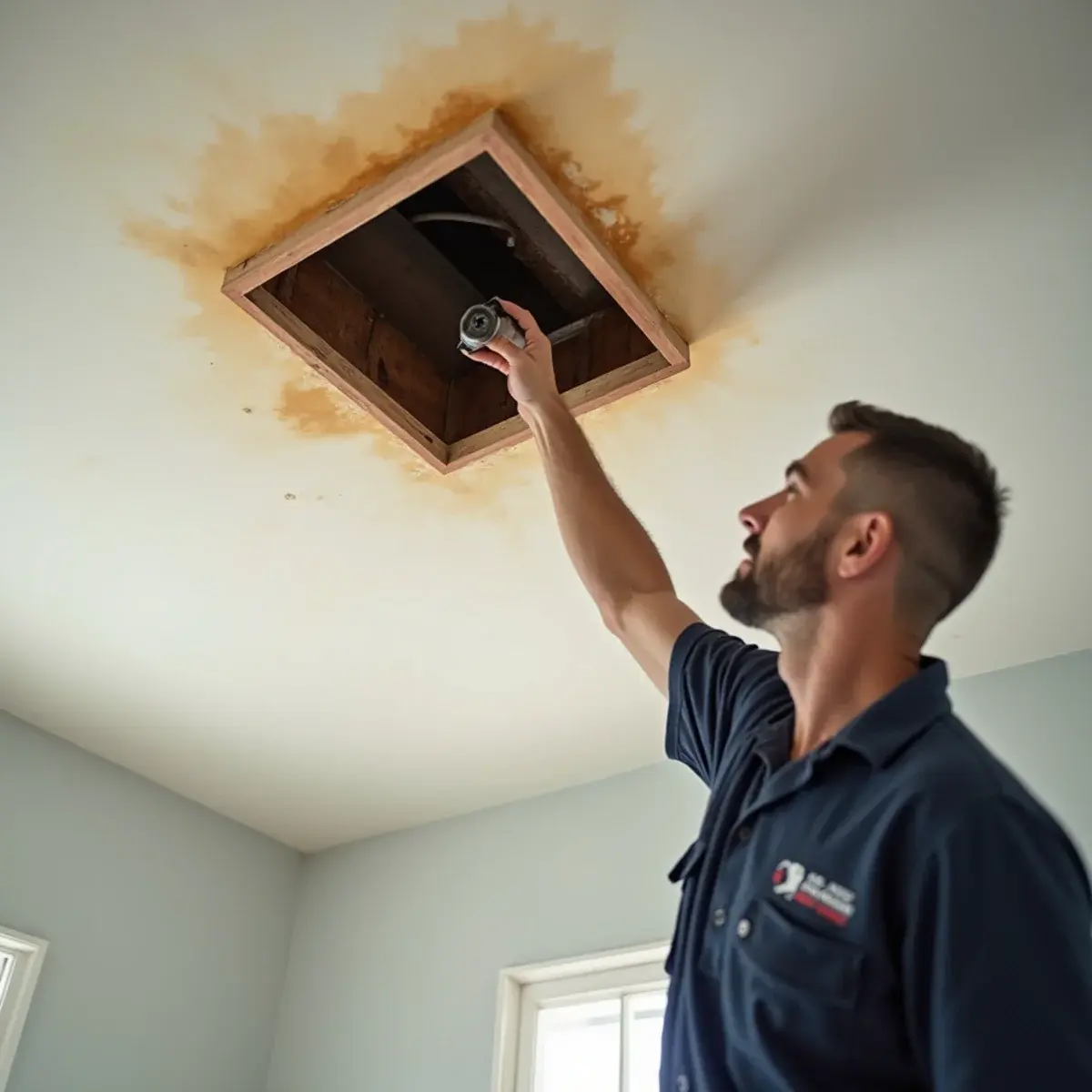
Here's a category of water damage most homeowners have never considered until it happens to them: your air conditioner floods your ceiling.
It's one of the most common summer calls we take across the San Fernando Valley — Reseda, Winnetka, Woodland Hills, Tarzana, Van Nuys — and it's almost entirely preventable for the cost of an annual service visit.
Dealing with this right now? We answer 24/7.
Free assessment · 60-minute emergency response · We bill your insurance carrier directly
An air conditioner is a dehumidifier
Cooling works by passing warm indoor air across an evaporator coil that's colder than the air's dew point. The air cools, and the water vapor it was carrying condenses onto the coil — exactly the way a cold glass sweats on a warm day.
That water has to go somewhere. It drips off the coil into a drain pan, and from there it leaves through a condensate drain line — typically three-quarter-inch PVC — that discharges outside, into a plumbing drain, or into a condensate pump.
The volume is larger than people expect. A residential system running hard through a Valley summer can move several gallons a day, and on a humid day considerably more. Over a season that's hundreds of gallons flowing through a small pipe that nobody ever looks at.
Why the line clogs
The drain line carries water that has just washed across a cold, damp coil in a dark enclosed space. That's ideal conditions for biological growth, and over time algae and bacterial biofilm build up inside the pipe.
Dust drawn through the return adds to it. Air handlers pull household dust past the coil, some of it sticks to the wet surface, and it washes into the drain line where it combines with the biofilm into a soft plug.
The plug builds gradually and then blocks completely. Once it does, condensate has nowhere to go, so it backs up and fills the drain pan. When the pan overflows, the water goes wherever gravity takes it — and in a very large share of Southern California homes, the air handler is in the attic, directly above finished ceilings.
Call +1 (201) 277-9344 — 24/7 in Glendale
Free assessment · 60-minute emergency response · We bill your insurance carrier directly
Why it does so much damage before you see it
This is the part that makes it expensive. The overflow is slow and continuous rather than sudden, and it starts in an attic nobody visits.
Water lands on the attic floor, soaks into insulation, and spreads across the ceiling drywall from above. Insulation holds it against the material and slows evaporation. The drywall absorbs it, the paper facing on the attic side stays wet, and microbial growth begins within a couple of days.
By the time a stain appears on the finished side, the assembly has typically been wet for one to three weeks. The insulation above is compressed and contaminated, the drywall is compromised across a larger area than the stain shows, and there's growth on the back of the board and often on the framing.
That's why these jobs are rarely a simple ceiling patch. Wet insulation comes out — it loses its R-value permanently and holds water against framing — the affected ceiling section comes out, the cavity gets treated, and then it's rebuilt. Our ceiling and roof leak repair page covers the sequence.
Warning signs before the ceiling stains
The system usually tells you first, if you know what to listen for:
- Water pooling around an indoor air handler or in the secondary pan beneath it.
- A musty smell coming through the supply registers when the system starts.
- The system short-cycling or shutting off unexpectedly — a float switch doing its job.
- A drain line outside that used to drip during operation and has stopped.
- Higher indoor humidity than usual with the system running normally.
- Any discolouration on a ceiling below an attic air handler, however faint.
The three-part fix
Clear the line annually. Any HVAC service should include flushing the condensate line, and if yours doesn't, ask. Between visits you can maintain it yourself: locate the cleanout tee near the air handler, and periodically pour a cup of distilled vinegar into it to inhibit growth. Avoid bleach on systems with metal drain pans — vinegar is gentler and works.
Confirm the secondary pan and its overflow. Code requires an attic air handler to sit in a secondary drain pan with its own overflow line, and that line should terminate somewhere conspicuous — classically over a window or a doorway, so water dripping there is impossible to ignore. Check that yours exists, isn't rusted through, and isn't itself blocked. A secondary pan full of standing water is a system that has already failed once.
Fit a float switch. This is the single highest-value item. A float switch sits in the pan or the drain line and cuts power to the system when water rises. The air conditioning stops, you notice immediately, and no water reaches the ceiling. They cost very little, install in under an hour, and turn a ceiling replacement into a service call.
Why the Valley gets this worse
Three factors compound in the San Fernando Valley specifically. The summers are long and severe — Woodland Hills regularly records the highest temperatures in Los Angeles — so systems run close to continuously for months rather than intermittently.
Attic installation is the regional norm. In much of the Valley's postwar housing the air handler sits in the attic because there was nowhere else to put it, which means any overflow lands on a ceiling rather than a garage floor.
And the housing is old enough that a lot of these systems have been replaced once or twice while the original drain line and pan stayed. We regularly find a modern high-efficiency unit sitting in a fifty-year-old rusted pan draining into an original line nobody has touched.
If you're in Reseda, Winnetka, Woodland Hills or anywhere with an attic air handler, this is worth ten minutes before the season starts.
Frequently asked questions
It depends on whether it reads as sudden or gradual. A blocked line that overflowed and was found quickly is often covered. One that has been dripping for two months and produced mold is frequently excluded as gradual damage or lack of maintenance. Finding it early affects both the repair cost and the coverage.
Usually yes. Find the cleanout tee near the air handler, remove the cap, and either pour vinegar through or use a wet/dry vacuum on the outdoor termination to pull the clog out. If you can't locate the line or the pan already holds standing water, get an HVAC tech in.
Very little as a part, and typically under an hour of labor to fit. Against a ceiling replacement plus insulation plus mold remediation, it's the best value item in home maintenance — and most homes with attic air handlers don't have one.
Yes. The system keeps cooling normally while the pan overflows — nothing about the cooling performance changes. A stain below an attic air handler with no plumbing above it is condensate until proven otherwise.
The bottom line
A blocked condensate line is a trivially cheap problem that becomes a ceiling replacement because it happens somewhere nobody looks. Clear the line, check the secondary pan, fit a float switch.
If you already have the stain, Drycore Restore handles the ceiling, the insulation and the cavity — not just the visible patch. Call +1 (201) 277-9344.
Related services
- Ceiling & Roof Leak Damage in Glendale
- Mold Remediation in Glendale
- Water Damage Repair & Reconstruction in Glendale