
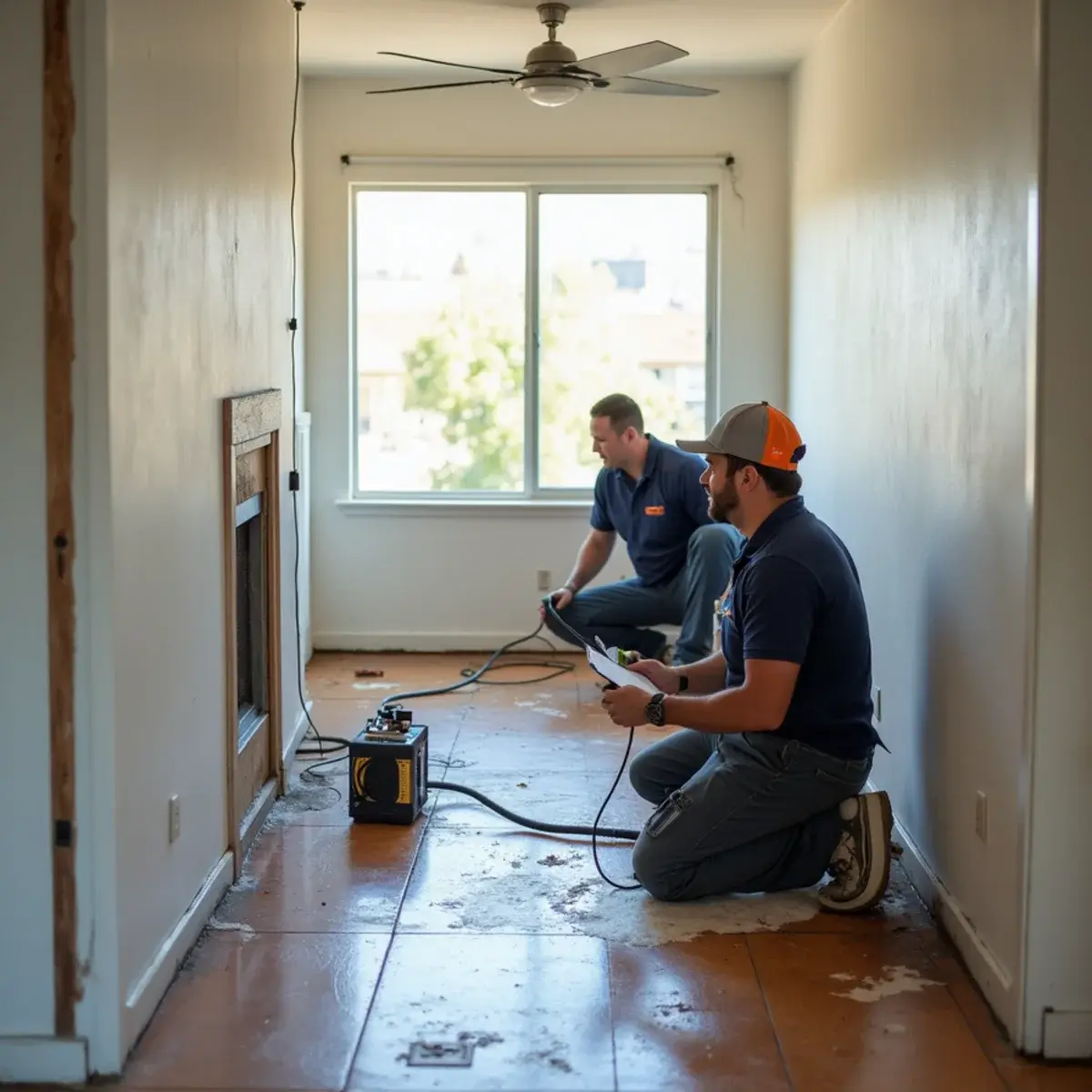
Glendale, CA · 24/7 response
Water Damage Restoration in Glendale, CA
Full-service recovery from the first gallon extracted to the last coat of paint — one crew, one invoice, one point of contact.
- 5.0 from 3 Google reviews
- Licensed, bonded & insured
- 60-minute emergency response
24/7 emergency response
A real person answers any hour — and you get a real ETA for your address, not a number off a website. 60-minute response in Glendale.
Dry-Verified Guarantee
Equipment stays until moisture meters match your home's dry standard.
Direct insurance billing
Daily moisture logs and carrier-format estimates. Most clients pay only their deductible.
Mitigation & rebuild in-house
One company from the first gallon extracted to the last coat of paint.
Water damage rarely announces itself politely. It shows up as a stain spreading across a ceiling at 2 a.m., a supply line letting go behind a washer while nobody is home, or a hillside storm drain backing up into a garage on Portola Ave. Whatever brought you here, the clock started the moment the water did — and the difference between a three-day dry-out and a six-week reconstruction is usually measured in hours.
Drycore Restore handles the entire recovery in-house for Glendale homeowners, landlords and business owners. We extract standing water, find the moisture you can't see, dry the structure back to its pre-loss moisture content, treat everything we touched to prevent mold, and then rebuild what had to come out. You are not handed off to three separate contractors and left to referee between them.
We answer the phone around the clock, and we document every reading so your insurance adjuster gets a file they can approve instead of question. That combination — real restoration work plus clean paperwork — is what shortens a claim from months to weeks.
Need water damage restoration in Glendale right now?
Free assessment · 60-minute emergency response · We bill your insurance carrier directly
Free on-site assessment
Tell us what's happening and we'll dispatch a water damage restoration crew or call you straight back.
What we're looking for
Signs and problems this service solves
Standing water or saturated carpet
Visible water is the easy part. The concern is what soaked into the pad, the tack strip, the subfloor and the bottom plate of the wall while you were looking at the puddle. Carpet that squishes underfoot usually means the pad is at 100% saturation and the slab or subfloor beneath it is already wicking.
A ceiling stain that keeps growing
Brown-ringed stains that expand day over day mean water is still moving through the cavity. Drywall holds roughly a gallon of water per four square feet before it starts to sag — a bulging ceiling is a collapse warning, not a cosmetic issue.
Baseboards separating or paint bubbling
When the bottom plate and the back of the drywall take on moisture, trim swells and pulls away from the wall and latex paint blisters. This is classic wicking damage and it tells us moisture climbed the wall cavity rather than staying at floor level.
A musty smell you can't place
Microbial growth produces volatile organic compounds long before you can see a spot. If a room smells like a damp basement after a leak, something behind a surface is still wet.
Hardwood cupping or tile popping loose
Solid and engineered wood absorb moisture from the underside first and cup upward. Tile grout that cracks or hollow-sounding tile over a slab often means water traveled under the tile bed and is trapped there.
A water bill that jumped for no reason
In older Glendale neighborhoods with mid-century slab construction, a jump of a few thousand gallons with no change in usage is frequently the first evidence of a slab leak running quietly under the floor.
Scope of work
What water damage restoration includes
Same-visit moisture map of the whole affected area
Not just the room you called about. We meter adjacent rooms, the floor below on two-storey homes, and the wall cavities either side, then mark and photograph the perimeter. On most jobs the affected area is one to two rooms larger than what looks wet.
Water category and class classification in writing
Clean, gray or black, and IICRC Class 1 through 4. Both go on your paperwork because they determine what gets dried versus removed — and because an adjuster reviewing demolition line items wants to see the classification that justifies them.
Extraction, controlled demolition and antimicrobial treatment
Standing and sub-surface water out, wet insulation and unsalvageable porous material removed to a defined line, exposed framing and cavity surfaces treated with an EPA-registered antimicrobial.
A drying system sized to the affected volume
Air mover count from affected linear footage, dehumidification from cubic volume and loss class. Daily visits to record material moisture content, temperature, relative humidity and grains per pound, and to reposition equipment as the drying front moves.
Reconstruction to pre-loss condition
Insulation, drywall, taping, texture matched by hand to the existing surface, paint to a natural break, baseboard, flooring and cabinetry. Permits pulled with the City of Glendale where the scope requires them.
The complete documentation file
Pre-mitigation photographs, moisture map, daily readings, equipment run-hour log, final verification and a line-item estimate in the format carriers process. It is your file — keep it for resale and for any later mould question.
How it works
Our water damage restoration process
- 1
Emergency call and dispatch
A person answers — not a voicemail tree. We collect the essentials (what failed, whether the water is shut off, whether anyone is at the property) and dispatch a stocked truck. We aim to be on site within 60 minutes for Glendale addresses.
- 2
Inspection and moisture mapping
Before anything gets moved, we photograph the loss and map it. Penetrating and non-penetrating moisture meters establish readings in affected and unaffected areas, and a thermal camera shows us where water has traveled behind finishes. We also classify the water — clean, gray or black — because that decides what can be dried and what must be removed.
- 3
Extraction and containment
Truck-mounted and portable extraction units pull standing water and sub-surface water out of carpet, pad and hard flooring. We set containment barriers so we're not pushing humidity into dry parts of the house, and we move or block contents that are sitting in the affected area.
- 4
Controlled structural drying
We calculate how many air movers and dehumidifiers the affected volume actually needs rather than guessing, place them to create directed airflow across wet surfaces, and log temperature, relative humidity and grains per pound daily. Most Glendale jobs reach dry standard in three to five days.
- 5
Antimicrobial treatment and cleaning
Every surface that took on water gets treated with an EPA-registered antimicrobial, and HEPA air scrubbers run through the drying phase to keep airborne particulate down. Where the water was contaminated, affected porous materials are removed rather than treated.
- 6
Verification, then reconstruction
Equipment comes out only after meter readings match dry, unaffected areas — not on a calendar. Then we rebuild: drywall, texture, paint, baseboard, flooring, cabinetry. You get a final moisture report for your records and your insurer.
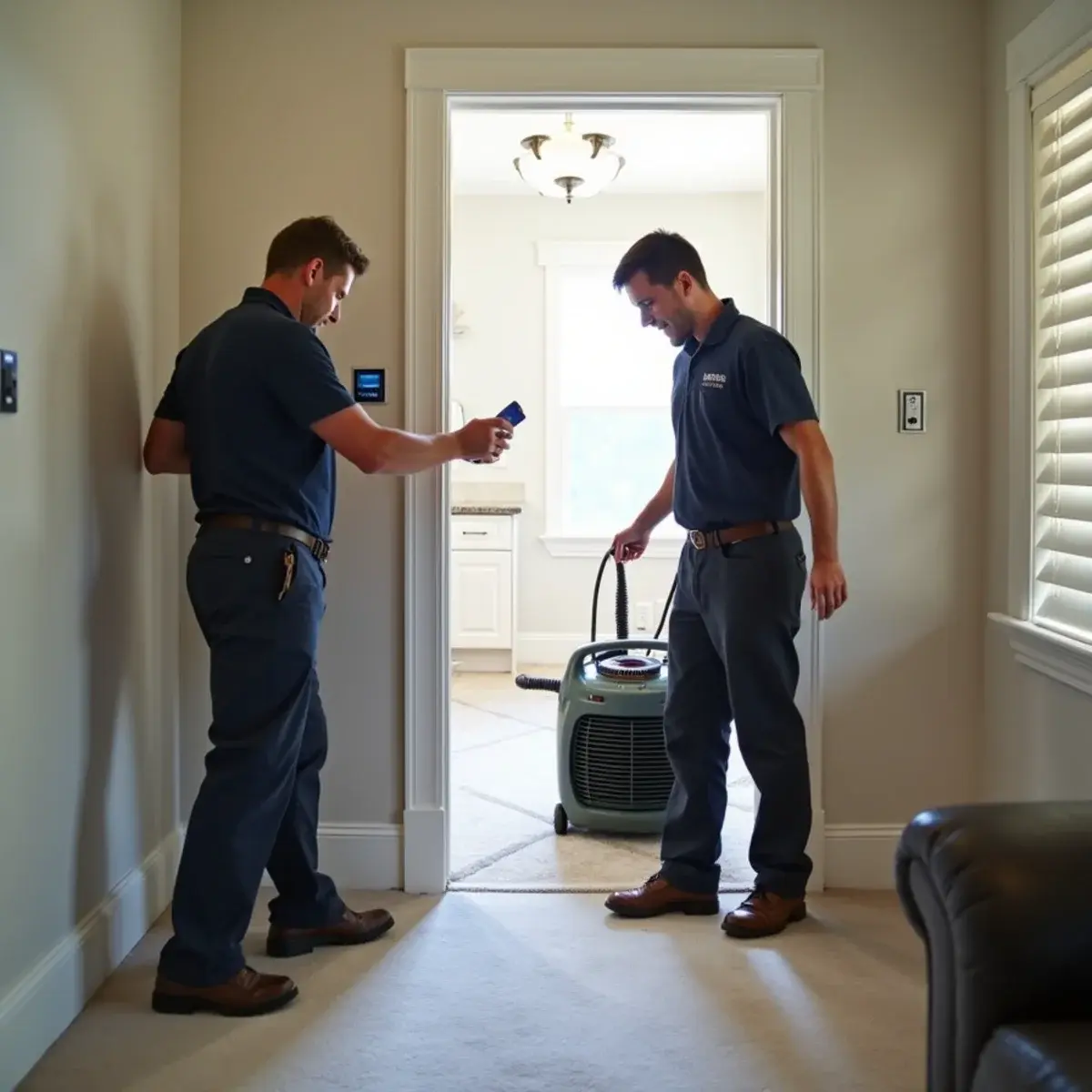
Why Glendale homes flood the way they do
Glendale's housing stock is unusually varied for a city this size, and the failure modes follow the construction era. The pre-1940 bungalows around Adams Hill and Vine Street were plumbed in galvanized steel, which corrodes from the inside out and fails at threaded joints with no warning. The mid-century tracts on the valley floor sit on post-tension and conventional slabs where a pinhole leak in a copper line under the concrete can run for weeks before anyone notices a warm spot on the floor.
Then there's the terrain. Water that falls on the Verdugo and San Rafael slopes has to go somewhere, and during a heavy winter storm the somewhere is often a downhill garage, a daylight basement or a crawl space. Homes downslope of the 2017 and 2020 burn areas see faster, dirtier runoff because scorched soil sheds water instead of absorbing it. We plan drying differently for those jobs — runoff is almost never clean water.
Knowing the pattern matters because it tells us where to look first. On a hillside property we check the uphill side of the foundation and the crawl space before we look at plumbing. In a 1950s ranch with an unexplained wet spot mid-slab, we bring leak detection equipment on the first visit instead of scheduling a second trip.
What we do about your insurance claim
Most water damage claims are denied or underpaid for one of two reasons: the documentation was thin, or the work was described in language the carrier's system doesn't recognize. We solve both. Every job gets dated photos from before we touch anything, a moisture map, daily atmospheric and material readings, and an equipment log showing exactly what ran and for how long.
We write estimates in the industry-standard line-item format carriers use, so an adjuster can approve the scope without a back-and-forth over what a "drying setup" means. When the adjuster wants to inspect, we meet them on site and walk the loss with them. And because emergency mitigation is a covered obligation under most policies, we start the work immediately rather than waiting days for approval while your floors keep wicking.
We'll also tell you honestly when a claim isn't worth filing. A small, contained loss under a typical deductible is often cheaper to handle out of pocket than it is to put on your loss history.
Honest cost drivers
What determines the price of this work
How much of the structure got wet
Cost tracks affected square footage and the number of rooms and levels involved far more than it tracks the volume of water. One saturated hallway that fed three bedrooms costs more than a large but contained garage.
Water category
Clean supply-line water can often be dried in place. Gray water from an appliance or black water from a sewer line requires removal and disposal of porous materials, which changes both labor and scope significantly.
What the water touched
Tile over concrete dries fast and cheap. Hardwood over a wood subfloor, plaster over lath in a pre-war home, or built-in cabinetry all need specialty drying — floor mat systems, injection drying, cabinet vents — and that adds equipment days.
Drying duration
Equipment is billed per unit per day. A home with good access and stable humidity dries faster than a hillside property with limited power, high ambient humidity or a dense floor plan.
Reconstruction scope
Putting a room back to pre-loss condition depends entirely on the finish level. Matching a builder-grade baseboard is not the same job as recreating 1920s crown molding in Rossmoyne.
Insurance participation
When a claim is approved, most homeowners pay their deductible and nothing more. We estimate in the same software carriers use, so the numbers we submit are the numbers they expect to see.
Get a free, measured estimate — not a phone guess
Free assessment · 60-minute emergency response · We bill your insurance carrier directly
Why us for this
Why Glendale calls Drycore Restore for water damage restoration
One company from extraction through final paint
The crew that removed your drywall installs the new one and matches the texture. That closes the gap where most restorations stall — the point a mitigation company leaves and you spend two months chasing a separate contractor whose scope does not match what was torn out.
We dry to a measured standard, not a calendar
Equipment leaves when affected materials read the same as unaffected materials of the same type elsewhere in your house. Competitors publish no drying guarantee at all; ours is that the meters decide, and you get the readings.
Estimates written the way carriers read them
Line-item format, classification stated, demolition justified by the moisture map. Adjusters approve scopes they can process without a back-and-forth, which is the difference between a claim that moves and one that sits.
Based in Glendale, not dispatched to it
Our shop is on Portola Ave, so crews and equipment start inside the city. That is what a 60-minute target rests on — and it is why we arrive knowing whether your street is 1920s galvanized or postwar slab.
Questions
Water Damage Restoration FAQs
We dispatch 24 hours a day and target arrival within 60 minutes anywhere in Glendale. Our base is on Portola Ave, so most addresses in Glendale proper, Montrose, La Crescenta and Verdugo Woodlands are a short drive. Call +1 (201) 277-9344 and we'll give you a real ETA, plus the steps to take before we get there.
Drying typically runs three to five days for a standard residential loss. Reconstruction depends on scope — a single room with drywall and paint may take a few days after drying, while flooring, cabinetry and custom finishes can run several weeks. We give you a schedule after the initial moisture mapping, not before.
Sudden and accidental water damage — a burst supply line, a failed water heater, an overflowing appliance — is covered under most standard California homeowners policies. Gradual seepage from a leak that went unaddressed for months, and rising floodwater from outside the home, generally are not. We review your declarations page with you before filing anything.
Box fans move air but do nothing about humidity, so you often end up spreading moisture into dry materials instead of removing it. Professional drying pairs high-velocity air movers with refrigerant or desiccant dehumidifiers that physically pull water out of the air, and it's verified with meters. DIY drying is the single most common reason we get called back for mold a month later.
Both. We're set up for mitigation and reconstruction, so the same company that removed your drywall puts it back, re-textures, paints and reinstalls trim and flooring. That eliminates the gap where most restoration jobs stall out waiting on a separate general contractor.
Related restoration services
Emergency Water Extraction
Truck-mounted units that pull hundreds of gallons an hour — the single highest-impact hour of any water loss.
Read moreStructural Drying & Dehumidification
Metered, logged drying that ends when the meters say dry — not when the calendar says it's been three days.
Read moreMold Remediation
Contained removal under negative pressure — we fix the moisture source too, so it doesn't come back.
Read more
Further reading from our crews
What To Do in the First Hour After Water Damage in Your Glendale Home
The decisions you make in the first sixty minutes decide whether this is a three-day dry-out or a six-week reconstruction. Here's the order to make them in.
Read moreWhat Water Damage Restoration Actually Costs in Glendale, CA
Nobody can quote a water loss over the phone honestly. But you can understand exactly what drives the number — and that's more useful than a fake range.
Read more
Water Damage Restoration across our full service area
We provide this service throughout Glendale and the surrounding foothill communities. Choose your city or neighborhood for local detail.
- Glendale
- Montrose
- La Crescenta
- Verdugo Woodlands
- Rossmoyne
- Adams Hill
- Chevy Chase Canyon
- Sparr Heights
- Burbank
- Pasadena
- La Cañada Flintridge
- Eagle Rock
- Atwater Village
- Tujunga
- Sunland
- Altadena
- South Pasadena
- Silver Lake
- North Hollywood
- Toluca Lake
- Shadow Hills
- Lake View Terrace
- Sylmar
- San Fernando
- Sierra Madre
- Monrovia
- Duarte
- Azusa
- Glendora
- San Dimas
- La Verne
- Claremont
- Sun Valley
- Studio City
- Valley Village
- Sherman Oaks
- Van Nuys
- Panorama City
- Arleta
- Pacoima
- Mission Hills
- North Hills
- Encino
- Reseda
- Northridge
- Granada Hills
- Tarzana
- Winnetka
- Canoga Park
- Woodland Hills
- Chatsworth
- Glassell Park
- Cypress Park
- Highland Park
- Mount Washington
- Los Feliz
- Echo Park
- Lincoln Heights
- El Sereno
- Boyle Heights
- East Los Angeles
- Hollywood
- Hollywood Hills
- Downtown Los Angeles
- Koreatown
- Westlake
- Pico-Union
- Mid-Wilshire
Need water damage restoration in Glendale?
Call +1 (201) 277-9344 for 24/7 dispatch, or request a free on-site assessment. Licensed, bonded & insured · We bill your insurance carrier directly.
Licensed, bonded & insured · We bill your insurance carrier directly · 24/7 Emergency Service