
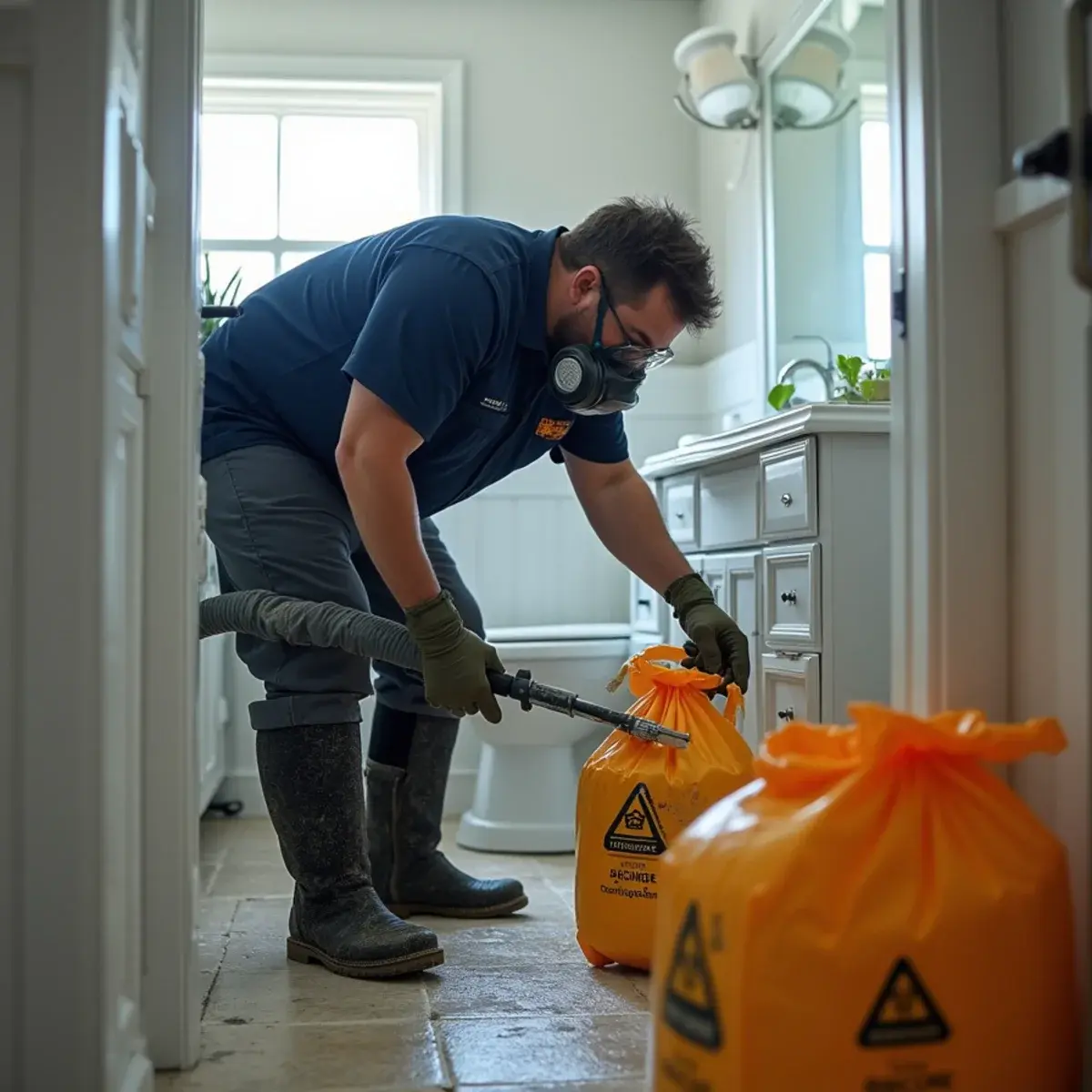
Glendale, CA · 24/7 response
Sewage Backup Cleanup in Glendale, CA
Biohazard-grade cleanup and disinfection — handled correctly the first time, with the odor gone for good.
- 5.0 from 3 Google reviews
- Licensed, bonded & insured
- 60-minute emergency response
24/7 emergency response
A real person answers any hour — and you get a real ETA for your address, not a number off a website. 60-minute response in Glendale.
Dry-Verified Guarantee
Equipment stays until moisture meters match your home's dry standard.
Direct insurance billing
Daily moisture logs and carrier-format estimates. Most clients pay only their deductible.
Mitigation & rebuild in-house
One company from the first gallon extracted to the last coat of paint.
A sewage backup is a health event, not a cleaning job. Category 3 water carries E. coli, hepatitis A, salmonella, parasites and the endotoxins that survive even after the bacteria are killed. Anything porous it touched is contaminated all the way through and cannot be disinfected back to a safe condition.
Drycore Restore responds to sewage losses in Glendale around the clock with the containment, PPE and disposal protocols the work requires. We remove what has to go, disinfect what stays, dry the structure properly, eliminate the odor at the source, and rebuild.
The two causes we see most are main line blockages — often tree roots in older lateral lines under mature parkway trees — and toilet overflows from a blockage downstream. Both start the same way: a fixture backing up when you run water somewhere else in the house.
Need sewage backup cleanup in Glendale right now?
Free assessment · 60-minute emergency response · We bill your insurance carrier directly
Free on-site assessment
Tell us what's happening and we'll dispatch a sewage backup cleanup crew or call you straight back.
What we're looking for
Signs and problems this service solves
Water backing up at a low fixture
When you flush a toilet and the shower drain gurgles or fills, the blockage is downstream of both. That's a main line problem and it will get worse with every gallon you add.
Sewage odor indoors
Persistent sewer gas smell indicates either a compromised trap or waste escaping the system somewhere it shouldn't. Both need investigation immediately.
Multiple slow drains at once
One slow drain is a local clog. Several slow drains across the house means the main lateral is restricted.
Wastewater surfacing in the yard
A wet, foul-smelling patch over the line's path usually means a broken or root-invaded lateral. Common in older Glendale streets with mature trees.
Visible waste on floors or in a shower pan
Do not walk through it and do not attempt to clean it with household products. Keep children and pets out of the area and call.
Backup after heavy rain
Storm infiltration into an aging lateral can overwhelm the line. If backups correlate with rainfall, the lateral likely has cracks or root intrusion letting groundwater in.
Scope of work
What sewage backup cleanup includes
Containment, negative pressure and full PPE
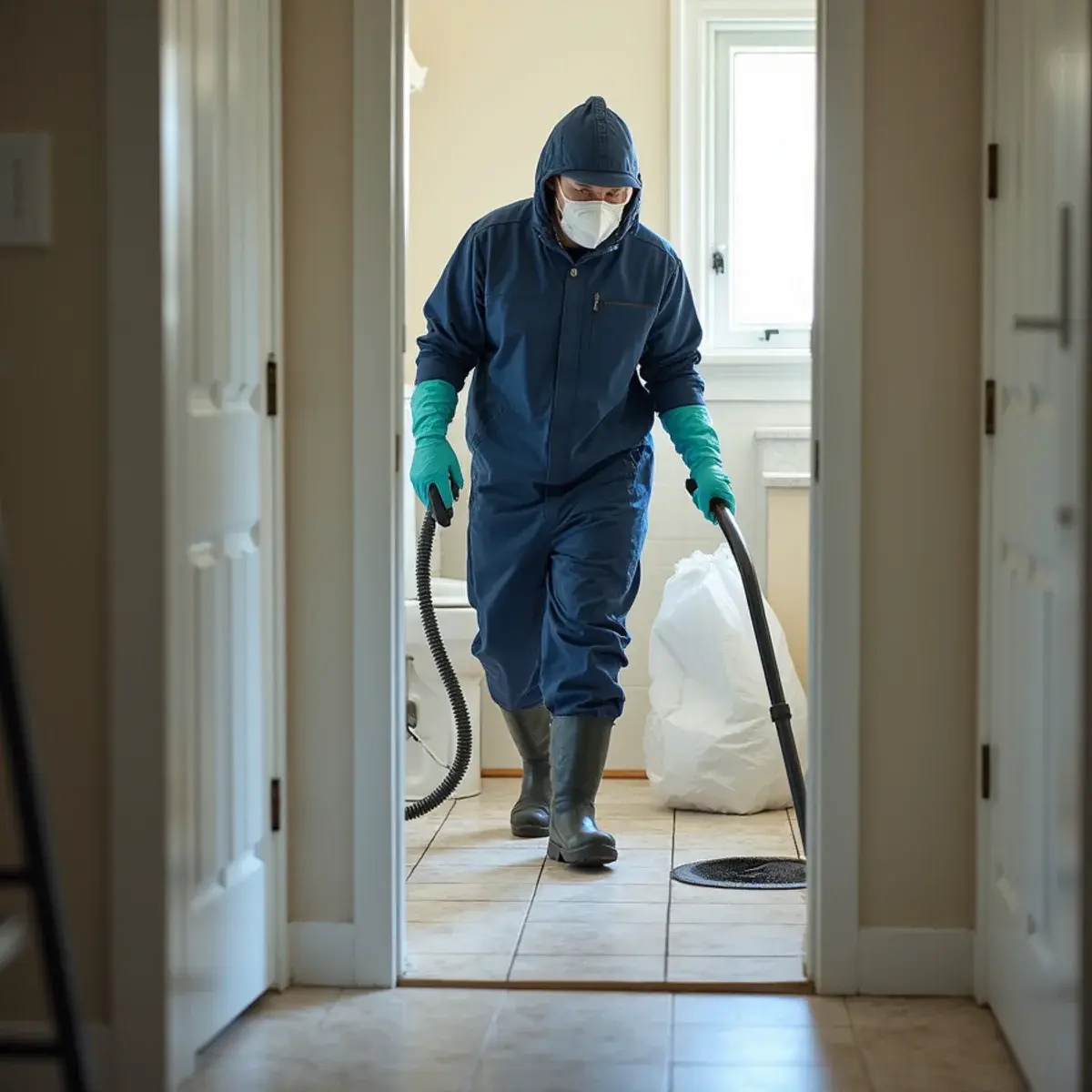
The work area is sealed and put under negative air with HVAC registers closed off, and crews work in respiratory protection. Occupants stay outside the containment for the duration.
Waste extraction with dedicated equipment
Solids and contaminated water removed with equipment that never touches a clean-water loss, and disposed of through approved channels rather than the nearest sanitary drain.
Removal of every porous material it reached
Carpet, pad, drywall to a defined height, insulation, particleboard cabinetry and affected contents, cut out and bagged inside containment. This is not a judgement call — porous material cannot be decontaminated internally.
Hospital-grade disinfection to correct dwell time
EPA-registered disinfectant applied to remaining structure and left the full contact time the label specifies. Framing and subfloor treated on every reachable face, not just what shows.
Odour eliminated at the molecular level
HEPA filtration throughout, then hydroxyl generation where needed. We do not fog a fragrance over treated surfaces and call it finished — returning odour means material was left in place.
Rebuild, with a recommendation you can act on
New insulation, drywall, flooring and cabinetry. Where a property has a backup history we recommend solid-surface materials and a camera inspection of the lateral before we close anything up.
How it works
Our sewage backup cleanup process
- 1
Isolate and contain
The affected area is sealed off with poly barriers under negative air pressure, HVAC registers are sealed, and crews work in full PPE with respiratory protection. Occupants stay out of the containment.
- 2
Waste extraction
Solids and contaminated water are removed with dedicated equipment that never gets used on clean-water losses, and disposed of through approved channels.
- 3
Removal of porous materials
Carpet, pad, drywall to a defined height above the contamination line, insulation, particleboard cabinetry and affected contents are cut out, bagged inside containment and disposed of as contaminated waste.
- 4
Cleaning and disinfection
Remaining structure gets cleaned and treated with EPA-registered hospital-grade disinfectant applied to the correct dwell time. Framing and subfloor are treated on all reachable faces.
- 5
Drying and odor elimination
The structure is dried and verified, and odor is addressed at the molecular level with HEPA filtration and, where needed, hydroxyl generation — not masked with a fragrance.
- 6
Rebuild
Once the area passes inspection, new insulation, drywall, flooring and cabinetry go back in. We recommend solid-surface materials in areas with a backup history.
Why nothing porous can be saved
People ask this on nearly every sewage job, usually about a rug or a section of drywall that looks barely affected. The answer is about structure, not appearance. Porous materials have interconnected void space, and contaminated water carries pathogens into that void space by capillary action. You can disinfect a surface. You cannot reliably disinfect the interior of a material you can't reach.
Beyond live pathogens, gram-negative bacteria leave behind endotoxins in their cell walls that remain biologically active after the organism is dead. Disinfecting a saturated porous material can kill everything in it and still leave a material that provokes respiratory response. This is why every professional standard specifies removal rather than treatment for porous materials in category 3 losses.
Semi-porous materials like framing lumber and concrete are a different case: they can be cleaned, treated and, if necessary, sealed, because contamination stays near the surface and can be physically removed by abrasion and HEPA vacuuming.
Root intrusion and Glendale's older sewer laterals
The lateral line connecting a house to the city main is the property owner's responsibility, and in Glendale's older neighborhoods a lot of them are original clay tile joined every few feet. Those joints are the perfect target for roots from the mature street trees the city is known for — roots find the moisture, enter through the joint, and grow into a mass that catches solids until the line stops flowing.
The tell is a pattern: backups that recur every year or two, usually worse in spring when roots grow fastest. Snaking clears it temporarily and cuts the roots back, but they return. A camera inspection shows what's actually happening in the line, and options range from hydro-jetting and root treatment through to trenchless lining or replacement.
If you're on your third backup at the same house, ask for a camera inspection before paying for a fourth cleanout. And if the line is being replaced, that's the moment to also address any drywall and flooring damage properly rather than patching around it again.
Honest cost drivers
What determines the price of this work
Area and materials affected
A contained overflow in a tiled bathroom is the least expensive version of this job. The same volume across carpeted living space costs several times more because everything porous is removed.
Depth of contamination
Waste that reached a subfloor seam, a wall cavity or a crawl space requires much more removal and treatment than surface contamination on tile.
Disposal requirements
Contaminated material has to be bagged, transported and disposed of according to regulation. Volume drives that cost directly.
Odor severity
Strong or long-standing odor may require sealing treated framing and extended hydroxyl or ozone treatment beyond standard cleaning.
Plumbing repair
Clearing the blockage and repairing or lining a root-damaged lateral is separate plumbing work. We coordinate it so the line is confirmed clear before we rebuild over it.
Get a free, measured estimate — not a phone guess
Free assessment · 60-minute emergency response · We bill your insurance carrier directly
Why us for this
Why Glendale calls Drycore Restore for sewage backup cleanup
We treat it as a health event, not a cleaning job
Category 3 water carries E. coli, hepatitis A and endotoxins that stay biologically active after the bacteria are dead. That is why removal, not treatment, is the standard for anything porous — and why we will not cut that corner to save you money today.
Separate equipment, genuinely
Extraction gear used on sewage never goes on a clean-water job. It is an obvious precaution that is easy to skip and impossible for a customer to verify, so we state it plainly.
We tell you when the lateral is the real problem
If you are on your third cleanout at the same address, we say so and recommend a camera inspection rather than quietly booking a fourth remediation. Glendale's mature street trees and original clay tile make this common.
The smell does not come back
Odour returns when contaminated material was cleaned instead of removed, or a subfloor never got treated. Removing the source and treating the substrate is what makes elimination permanent.
Questions
Sewage Backup Cleanup FAQs
It depends on the source. Overflow of clean supply water from a running toilet is category 1. Anything containing waste, or any backup coming up from the sewer line, is category 3 and gets treated as a biohazard regardless of volume. When in doubt we treat it as the more serious case.
Standard policies typically exclude sewer and drain backup unless you carry a specific water backup endorsement — which is inexpensive and worth adding. Damage from a sudden failure inside the home's own drain line is sometimes handled differently. We help document the origin so the claim is presented accurately.
Removal and disinfection generally take one to two days depending on area. Drying then runs its normal three to five days, and reconstruction follows. Most residential sewage jobs are complete within two to three weeks including rebuild.
Not if the job was done properly. Odor returns when contaminated material was left in place — a section of drywall that was cleaned instead of removed, or a subfloor that never got treated. Removing the source, treating the substrate and running HEPA and hydroxyl equipment eliminates it permanently.
We would strongly advise against it. Volume is not what makes sewage dangerous — pathogen load is, and a small backup on a bathroom floor carries the same organisms as a large one. Household cleaners do not achieve disinfection dwell times, a domestic vacuum will aerosolise contaminants, and porous materials you wipe down stay contaminated internally. Keep children and pets out of the area and call.
Related restoration services
Water Damage Restoration
Full-service recovery from the first gallon extracted to the last coat of paint — one crew, one invoice, one point of contact.
Read moreMold Remediation
Contained removal under negative pressure — we fix the moisture source too, so it doesn't come back.
Read moreFlood & Storm Damage Cleanup
Hillside runoff, debris flow and storm intrusion handled as the contaminated-water events they actually are.
Read more
Further reading from our crews
Why Your Sewer Backs Up Every Two Years (And How To Stop It)
If you've had the same drain snaked three times, you're not unlucky. You're paying maintenance on a line that needs a decision.
Read moreWater Damage Categories 1, 2 and 3 — What They Mean for You
Category is the single biggest factor in what a water loss costs and what can be saved — and it's decided on day one by what failed.
Read more
Sewage Backup Cleanup across our full service area
We provide this service throughout Glendale and the surrounding foothill communities. Choose your city or neighborhood for local detail.
- Glendale
- Montrose
- La Crescenta
- Verdugo Woodlands
- Rossmoyne
- Adams Hill
- Chevy Chase Canyon
- Sparr Heights
- Burbank
- Pasadena
- La Cañada Flintridge
- Eagle Rock
- Atwater Village
- Tujunga
- Sunland
- Altadena
- South Pasadena
- Silver Lake
- North Hollywood
- Toluca Lake
- Shadow Hills
- Lake View Terrace
- Sylmar
- San Fernando
- Sierra Madre
- Monrovia
- Duarte
- Azusa
- Glendora
- San Dimas
- La Verne
- Claremont
- Sun Valley
- Studio City
- Valley Village
- Sherman Oaks
- Van Nuys
- Panorama City
- Arleta
- Pacoima
- Mission Hills
- North Hills
- Encino
- Reseda
- Northridge
- Granada Hills
- Tarzana
- Winnetka
- Canoga Park
- Woodland Hills
- Chatsworth
- Glassell Park
- Cypress Park
- Highland Park
- Mount Washington
- Los Feliz
- Echo Park
- Lincoln Heights
- El Sereno
- Boyle Heights
- East Los Angeles
- Hollywood
- Hollywood Hills
- Downtown Los Angeles
- Koreatown
- Westlake
- Pico-Union
- Mid-Wilshire
Need sewage backup cleanup in Glendale?
Call +1 (201) 277-9344 for 24/7 dispatch, or request a free on-site assessment. Licensed, bonded & insured · We bill your insurance carrier directly.
Licensed, bonded & insured · We bill your insurance carrier directly · 24/7 Emergency Service