Why Your Sewer Backs Up Every Two Years (And How To Stop It)
If you've had the same drain snaked three times, you're not unlucky. You're paying maintenance on a line that needs a decision.
There's a pattern we see constantly across Glendale, Pasadena, South Pasadena and the older Los Angeles neighborhoods: a sewer backup every year or two, always a bit worse in spring, cleared by a plumber with a snake, and then back again.
Homeowners tend to treat each one as an isolated bit of bad luck. It isn't. It's a line with a structural problem, and snaking is treating the symptom.
Dealing with this right now? We answer 24/7.
Free assessment · 60-minute emergency response · We bill your insurance carrier directly
What's actually happening underground
The lateral is the pipe running from your house to the city main under the street. It belongs to you, not the city, which surprises a lot of people the first time it fails.
In housing built before roughly 1970, that lateral is very often vitrified clay tile — short sections, typically two to four feet, joined end to end. Every one of those joints is a seam, and older joints were sealed with mortar or bituminous compound that degrades over decades.
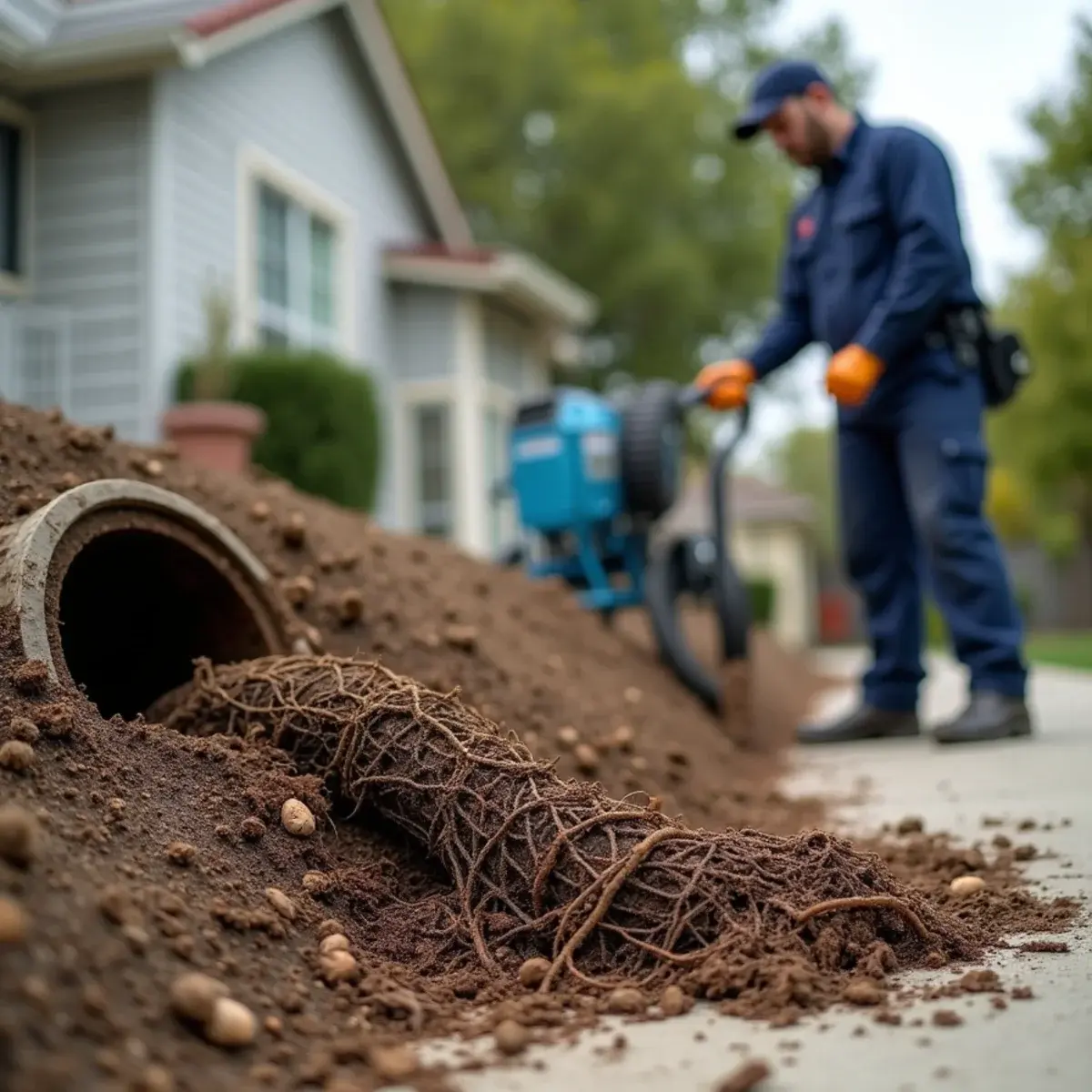
Roots are looking for exactly two things: moisture and nutrients. A sewer lateral carries both, and the tiny amount of vapor escaping a degraded joint is enough to attract them from a surprising distance. A hair root finds the joint, gets inside, and then thickens — and once it's in, it keeps growing into a mass that catches paper and solids until flow stops.
This is why the neighborhoods with the best tree canopies have the worst lateral problems. Claremont, South Pasadena, Valley Village and the older parts of Pasadena are lovely to walk through for the same reason their sewer lines fail.
Why it's always worse in spring
Root growth is seasonal. It accelerates sharply in spring as soil warms and the tree pushes new growth, which means the root mass inside your lateral gets denser during exactly the months when nobody is thinking about drains.
The second seasonal factor is rainfall. A cracked or root-damaged lateral lets groundwater in as well as letting sewage out, and after a wet winter the line is carrying infiltration on top of your household flow. That's why backups often cluster in the weeks after a significant storm.
If your backups correlate with either season, that's diagnostic. A blockage from grease or a flushed object is random. A blockage that follows the calendar is biological.
Call +1 (201) 277-9344 — 24/7 in Glendale
Free assessment · 60-minute emergency response · We bill your insurance carrier directly
The signs before it backs up
Backups rarely arrive without warning. The tells, roughly in order of how early they appear:
- Gurgling from a floor drain, shower or toilet when you run water somewhere else — air being displaced past a partial blockage.
- Several slow drains at once. One slow drain is a local clog; multiple slow drains means the problem is downstream of all of them.
- A toilet whose water level drops or rises on its own.
- Sewer odor outdoors along the line's path, or a patch of lawn that's greener and wetter than the rest.
- Backups that recur on a schedule rather than randomly.
- Drains that were fine for years suddenly becoming intermittent after a wet winter.
Snaking, hydro-jetting and what each one does
A cable machine — snaking — pushes a rotating cutting head through the line and shears the root mass out of the way. It restores flow, which is why it feels like a fix. What it doesn't do is remove the roots at the wall of the pipe or close the joint they came through, so regrowth starts immediately.
Hydro-jetting uses high-pressure water to scour the pipe wall and flush debris out. It's considerably more thorough than a cable and it buys longer between failures, but it still doesn't seal the entry point, and on a badly deteriorated clay line it can occasionally cause damage.
Root treatments — foaming herbicides formulated for sewer use — kill roots inside the line and slow regrowth. They're a genuine maintenance tool and worth using between cleanings, but they don't repair pipe.
The honest framing: cleaning is maintenance, not repair. If you're comfortable budgeting for it every eighteen months, that's a legitimate choice. What isn't legitimate is a plumber who has snaked the same line three times without ever suggesting you look inside it.
What a camera inspection tells you
This is the step that turns guessing into a decision. A camera on a flexible rod runs the length of the lateral and shows you exactly what's there: where the roots are entering, how many joints are compromised, whether the pipe has cracked, offset at a joint, developed a belly that holds standing water, or collapsed.
It also locates the problem. The camera head carries a transmitter, so the technician can mark the position and depth on the ground above — which is what makes a targeted repair possible instead of trenching the whole run.
Ask for the footage. A reputable operator will hand you a recording, and it's worth keeping. If you sell the property, a recent camera inspection showing a sound lateral is a genuine asset; if it shows a problem, you'd rather know before a buyer's inspector finds it.
The three real options
Spot repair. Excavate at the located failure, replace that section, backfill. Appropriate when the camera shows one bad joint or a single cracked section in an otherwise sound line. Cheapest, and it doesn't address the rest of the joints.
Trenchless lining (CIPP). A resin-saturated liner is pulled or inverted into the existing pipe and cured in place, forming a continuous jointless pipe inside the old one. Because there are no joints, there is nothing for roots to enter. It needs access points but not a trench down the length of your yard, which matters enormously if the line runs under a driveway, mature landscaping or a hardscaped patio.
Full replacement. Excavate and replace the lateral with modern ABS or PVC. The most disruptive and often the most expensive, and sometimes the only option when the existing pipe has collapsed or has a belly that lining would simply preserve.
Which one is right depends on what the camera shows, not on what's cheapest. A line with one bad joint and twenty good ones is a spot repair. A line with root intrusion at every joint is a lining or replacement decision, and spot-repairing it is buying the same problem again three feet further along.
The insurance angle nobody mentions
Standard California homeowners policies exclude sewer and drain backup. That exclusion is closed by a water backup endorsement, which is usually inexpensive and which a lot of homeowners have never been offered.
If you own a pre-1970 house with mature street trees, that endorsement is one of the highest-value additions available to you. Our guide to what homeowners insurance covers for water damage in California covers the other gaps worth closing.
Some policies also offer service line coverage, which covers the buried lateral itself — the pipe, not just the damage it causes. Given that the lateral is your responsibility and replacement is a five-figure project on a long run, that's worth asking your agent about.
When it does back up
A sewer backup is a category 3 event regardless of how much water is involved. That means containment, PPE, removal of every porous material it touched, hospital-grade disinfection and odor elimination at the source.
Nothing porous survives it — not because it looks bad, but because contaminated water carries pathogens into the interior void space of materials by capillary action, and you cannot disinfect the inside of something you can't reach. Our page on sewage backup cleanup explains the protocol, and the water damage categories explains why category decides everything.
Keep children and pets away, don't attempt to clean it with household products, and don't run any fixture that drains into the affected line while you wait.
Frequently asked questions
You can, and for some homeowners that's a rational choice — it's a known annual cost against a large one-time project. The risk is that root intrusion damages the pipe over time, so the line that could have been lined this year may need full replacement in five. A camera inspection tells you which trajectory you're on.
Sewer-specific foaming root treatments do kill roots in contact with them and slow regrowth meaningfully. They're a maintenance aid, not a repair — the joint is still open and roots will return. Household products like copper sulphate crystals are far less effective and can be hard on the system.
Generally the lateral is still your responsibility even where the invading roots come from a street tree, because the failure is treated as a defect in your pipe rather than damage caused by the tree. Rules vary by jurisdiction, and it's worth asking your city directly before assuming.
It's one of the cheapest diagnostics in the trade and dramatically cheaper than a wrong repair decision. Many plumbers include or discount it as part of a cleaning. Insist on getting the recording either way.
The bottom line
A backup every eighteen months is a message, not a coincidence. Snaking clears the flow; the camera tells you whether you're looking at one bad joint or a line that's finished.
If a backup has already reached your floors, Drycore Restore handles category 3 cleanup across Glendale and the surrounding communities, 24 hours a day. Call +1 (201) 277-9344.
Related services
- Sewage Backup Cleanup in Glendale
- Mold Remediation in Glendale
- Water Damage Repair & Reconstruction in Glendale