Wet Documents and Electronics: What Can Still Be Saved
Two rules, both counterintuitive, both time-critical: freeze the paper, and don't turn the electronics on.
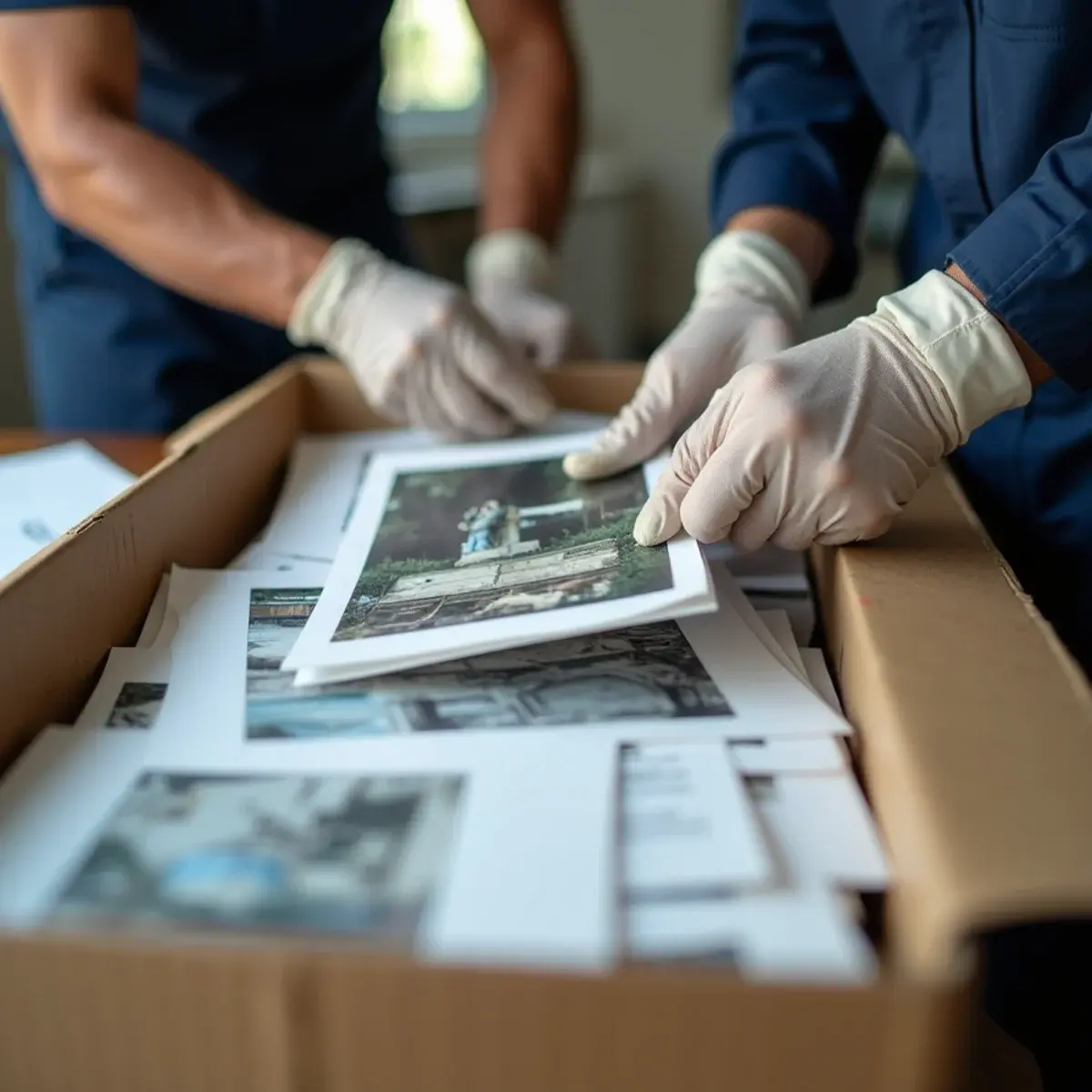
In most water losses the expensive items are structural and the irreplaceable ones are small — photographs, documents, a hard drive, a musical instrument, the box of letters nobody scanned.
Those items have the shortest decision window of anything in the building, and the correct actions are both counterintuitive enough that most people do the opposite.
Dealing with this right now? We answer 24/7.
Free assessment · 60-minute emergency response · We bill your insurance carrier directly
Rule one: freeze wet paper immediately
The instinct is to spread wet documents and photographs out to air-dry. That is the thing that destroys them.
As paper dries in air, the cellulose fibres bond to each other and to whatever is touching them. A stack of wet documents air-dried becomes a solid block that cannot be separated without tearing. Coated papers and photographs fuse emulsion-to-emulsion and are essentially unrecoverable once bonded. Inks bleed and migrate as moisture moves through the sheet.
Freezing stops all of it. It halts the fibre bonding, arrests ink migration, and prevents the mold growth that would otherwise start within a day or two. It doesn't dry anything — it buys you time, and time is the thing you don't have.
So: get wet paper into a freezer as fast as you reasonably can. Interleave with wax paper or freezer paper if you have any and time permits, pack loosely in plastic bags or boxes, and freeze. A domestic freezer is entirely adequate for the holding stage. Items can stay frozen for months while you arrange proper recovery.
How freeze-drying actually recovers them
Once frozen, documents go to a vacuum freeze-drying chamber. The frozen items are held below freezing under deep vacuum, and the ice sublimates — passes directly from solid to vapor without ever becoming liquid water again.
That's the whole trick. Because the water never returns to liquid form, the fibres never get the opportunity to bond, inks never re-migrate, and pages separate afterward. It's the same principle used to conserve archival and library material after floods, and it works on ordinary household paper just as well.
It is not fast — a batch can take days to weeks depending on volume and saturation — and it is not cheap per item. Which means the honest advice is to triage: freeze everything now while it's free, then decide later what's worth the recovery cost. Freezing costs nothing and preserves the option; air-drying forecloses it.
Photographs are the highest-value case and the most time-sensitive. If you can only act on one category in the first hour, make it photographs.
Call +1 (201) 277-9344 — 24/7 in Glendale
Free assessment · 60-minute emergency response · We bill your insurance carrier directly
Rule two: do not power on wet electronics
The instinct here is to check whether it still works. Doing that is frequently what kills it.
Water alone rarely destroys electronics outright. What destroys them is corrosion, which begins as soon as moisture and contaminants contact the board and continues long after the device appears dry. Applying power to a wet or damp board causes short circuits and electrolytic corrosion — it accelerates in minutes what would otherwise take days.
So: don't turn it on. Don't plug it in "just to check." If it's already on, shut it down and disconnect power. Remove batteries where you safely can.
Don't put it in rice, either — that's folklore, it doesn't remove moisture from inside a sealed enclosure, and it introduces starch and dust. What actually helps is getting it to a specialist who can open, decontaminate and dry the boards under controlled conditions, ideally within days.
Data is a separate question from the device
This is worth separating explicitly, because people conflate them and lose the wrong one.
For a phone, laptop or camera, the device may or may not be economically worth recovering. The data on it usually is, and data recovery is a distinct specialism operating on the storage medium rather than the machine.
For spinning hard drives especially, the platters are frequently intact even when the drive is unusable — a specialist opens it in a cleanroom and reads them. What ruins that possibility is someone powering the drive up to see whether it spins, because a head contacting a contaminated platter causes physical damage that no amount of expertise recovers.
So if the data matters: don't power it, don't open it yourself, and tell whoever is handling contents that this item is a data recovery candidate rather than a cleaning candidate. Our contents pack-out service triages exactly this on the first visit.
What else is time-critical
Beyond paper and electronics, a few categories reward fast action:
- Photographs and negatives — freeze, as above. Loose prints separated from albums if you can do it quickly without forcing.
- Artwork on paper and canvas — do not attempt to dry or handle a wet canvas. Get a conservator involved; the surface is fragile when saturated.
- Books — freeze. Standing them open to dry warps the boards and cockles the pages permanently.
- Leather and textiles — mold quickly, so these want airflow and dehumidification rather than freezing, and professional cleaning soon after.
- Musical instruments — wood instruments move dramatically with moisture and need controlled, slow drying rather than a fan.
- Anything with a metal component touching paper or fabric — paperclips, staples, frames. Remove them; rust staining transfers fast and permanently.
Documenting for the claim
Contents claims are underpaid more often than structure claims, and the reason is almost always documentation. Before you freeze or move anything, photograph it.
Individual photographs of significant items, including — especially — items that are obviously unsalvageable. A dumpster photo is not evidence of what was in the dumpster, and "a box of family documents" gets a generic allowance while an itemised inventory with images gets itemised.
For high-value or irreplaceable items, note what they are, approximate age and any provenance you know. If you have prior photographs of rooms that happen to show possessions in the background, those are useful too.
Our guide to documenting a water damage claim covers the wider approach — but the contents piece is the part most worth extra effort, because it's the part carriers scrutinise hardest.
Frequently asked questions
The sooner the better — within 24 to 48 hours ideally, before fibre bonding and mold growth begin. If items are already partly air-dried and stuck together, freezing still helps and a specialist can sometimes separate them, but the odds drop considerably.
Frequently, if they're frozen before drying. Freeze-drying separates prints that would otherwise fuse. Photographs that have already air-dried in a stack are the hardest case, and some are genuinely lost — which is why the freezer is the first move rather than a later one.
Ask about the data separately from the device. Devices are usually replaceable and often not economic to restore; data recovery from the storage medium is a different service with much better odds — provided nobody powered it up.
Specialty contents restoration is normally covered under contents coverage as part of a properly written claim, though limits apply. Document the items before anything moves, and raise irreplaceable items with your adjuster early rather than after the fact.
The bottom line
Freeze the paper before it dries. Don't power the electronics. Photograph everything first. Those three actions in the first hour decide what survives.
Drycore Restore triages contents on the first visit and coordinates freeze-drying and electronics specialists. Call +1 (201) 277-9344.
Related services
- Contents Pack-Out & Restoration in Glendale
- Water Damage Restoration in Glendale
- Commercial Water Damage Restoration in Glendale