
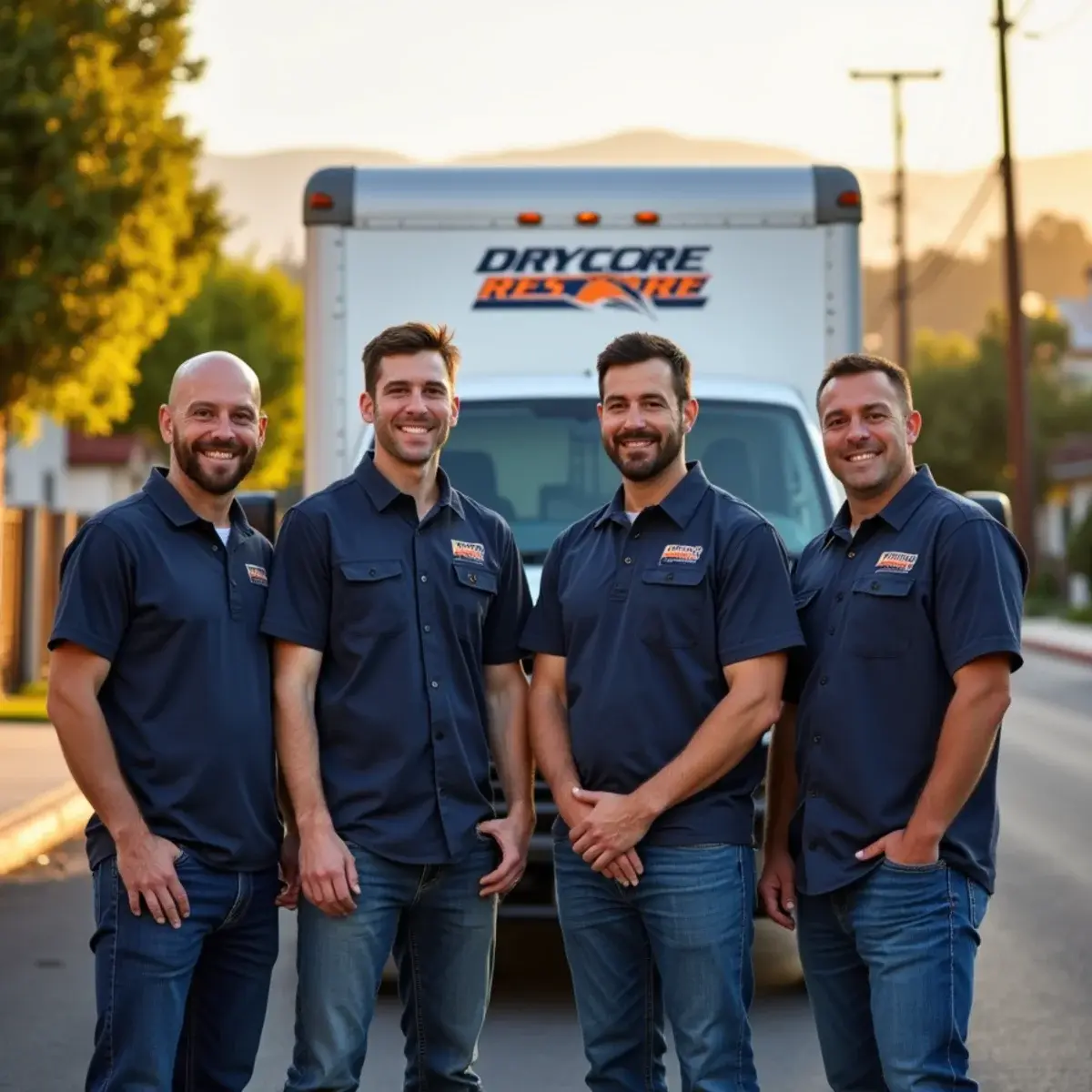
Locally owned & operated
About Drycore Restore — Water Damage Restoration in Glendale, CA
We work out of 749 Portola Ave, Glendale, CA 91206, between the valley floor and the Verdugo foothills. Everything we know about how water gets into Glendale homes, we learned within a few miles of that address.
- 5.0 from 3 Google reviews
- Licensed, bonded & insured
- 60-minute emergency response
24/7 emergency response
A real person answers any hour — and you get a real ETA for your address, not a number off a website. 60-minute response in Glendale.
Dry-Verified Guarantee
Equipment stays until moisture meters match your home's dry standard.
Direct insurance billing
Daily moisture logs and carrier-format estimates. Most clients pay only their deductible.
Mitigation & rebuild in-house
One company from the first gallon extracted to the last coat of paint.
Built around the two things that go wrong in this industry
At Drycore Restore, we specialize in providing fast, reliable, and professional water damage restoration services throughout Southern California. With years of experience, our team is dedicated to restoring homes and businesses to their original condition after water damage caused by leaks, floods, or storms. We offer comprehensive services including water extraction, structural drying, mold remediation, and full repair services to ensure your property is safe and restored to its pre-damage state. With 24/7 emergency response, we're here to help you recover quickly and efficiently, minimizing damage and disruption. Trust Drycore Restore for expert water damage restoration that you can count on.
That's the official version. The practical version is that we built this company around fixing the two failures we saw over and over in restoration work.
The first is drying by calendar instead of by measurement. A crew shows up, puts fans in a room, comes back Thursday and calls it dry because the surface feels dry. Six weeks later there's a musty smell nobody can locate and a remediation bill that dwarfs what proper drying would have cost. So we measure — a dry standard established from your own unaffected materials, daily readings, and a log you keep.
The second is the handoff. Mitigation companies dry and leave. Then the homeowner spends two months trying to get a separate contractor to put the walls back, with an insurance scope that doesn't quite match what was removed. We do both, so the job finishes.
Everything else — the 60-minute response target, the equipment list, the documentation — follows from those two decisions.
How we work
Standards, certifications and documentation
IICRC S500 drying protocols
We establish a dry standard from unaffected materials in your home and dry affected materials back to match, logging temperature, relative humidity, grains per pound and material moisture content daily.
IICRC S520 remediation protocols
Mold work is contained, run under negative air pressure with HEPA filtration, and verified. We recommend independent third-party clearance on jobs of consequence.
Carrier-format documentation
Dated photos before we touch anything, moisture maps, equipment logs and line-item estimates in the format adjusters expect — so claims move instead of stalling.
Licensed reconstruction
Reconstruction is regulated construction work. We pull permits with the City of Glendale where scope requires it rather than working around them.
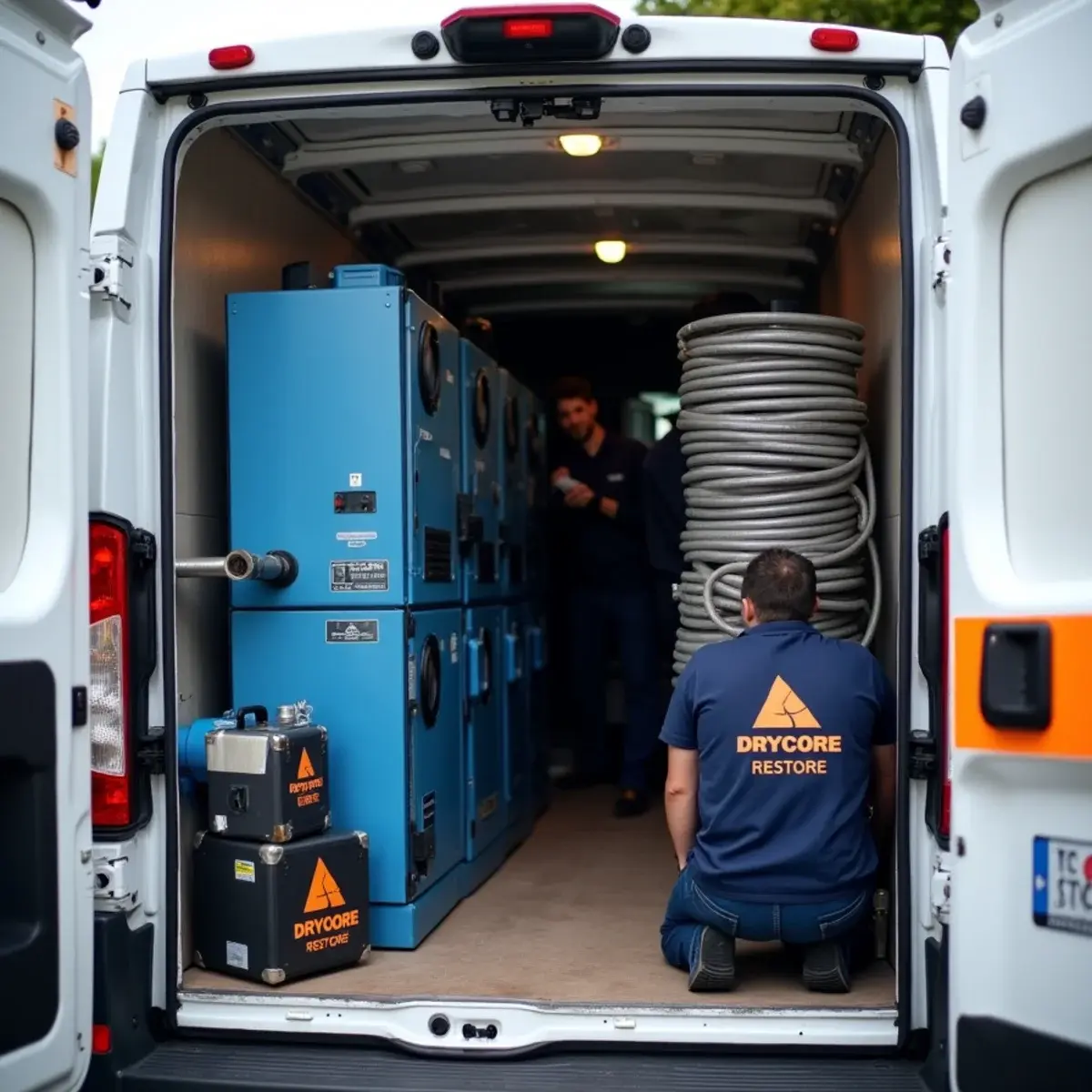
What's on the truck
Equipment that decides what gets saved
- Truck-mounted and portable extraction units
- Solids-handling trash pumps for storm and debris flow work
- Refrigerant and low-grain refrigerant dehumidifiers
- Desiccant dehumidification for large-volume and Class 4 losses
- High-velocity axial and centrifugal air movers
- Floor mat drying systems for hardwood salvage
- Injection drying systems for wall cavities and cabinetry
- Penetrating and non-penetrating moisture meters
- Thermal imaging cameras for moisture mapping and leak location
- Acoustic leak detection equipment for slab and in-wall leaks
- HEPA air scrubbers and negative air machines
- Hydroxyl generators for odor elimination
What you can expect
How we behave on a job site
We tell you when you don't need us
If a loss is small enough that filing a claim would hurt you more than help, we say so. If a job is better handled out of pocket, we say that too.
We try to save materials first
Demolition is faster and more profitable. It's also usually unnecessary when we're called early. We attempt in-place drying before we reach for a saw.
You get the documentation
Moisture logs, equipment records, photographs, final verification. It's your file — for your insurer, and for whoever buys the house in ten years.
Verified reviews
5.0 stars from 3 Google reviews
“My Family and I experienced a pipe burst in our wall a few weeks ago, we called Drycore and they came out to dry and disinfect everything for us. This was the first time that we had any issues like this, the staff came to our house and was very professional throughout the whole process.”
“I used Drycore to repair water damage in my bathroom and laundry room. They have been very responsive, accommodating and professional. I'm pleased with their work so far and am looking forward to having my vanity installed. I highly recommend them.”
“Called this company for a burst pipe in my kitchen. They responded very quickly and came out immediately. Highly recommend them for any water damage services.”
Our service area
68 communities around Glendale
Glendale
91201 · 91202 · 91203
Our home city. Based on Portola Ave with crews covering all nine Glendale ZIP codes around the clock.
Montrose
91020 · 91214
Foothill bungalows below the Verdugos, where winter runoff and 1920s plumbing are the two recurring problems.
La Crescenta
91214 · 91020
Directly below the San Gabriels — the highest debris-flow exposure of anywhere we serve, and we plan for it.
Verdugo Woodlands
91208
Wooded hillside streets in 91208 where mature landscaping, slope drainage and 1940s plumbing intersect.
Rossmoyne
91207 · 91206
Glendale's historic showpiece — where restoring the finish correctly matters as much as removing the water.
Adams Hill
91205 · 90065
Steep streets and 1920s bungalows in 91205 — challenging access and some of the oldest plumbing in the city.
Chevy Chase Canyon
91206
Canyon-road properties in 91206 where a whole watershed drains past your foundation every winter.
Sparr Heights
91020 · 91208
A close-knit foothill pocket between Montrose and the Verdugos, with a distinctly postwar failure profile.
Burbank
91501 · 91502 · 91504
Twelve minutes west — dense postwar housing, studio-adjacent commercial space and a lot of aging slab plumbing.
Pasadena
91101 · 91103 · 91104
Craftsman and Revival architecture where the finishes are the value — and demolition-first restoration destroys it.
La Cañada Flintridge
91011 · 91012
Large properties on canyon drainages below the San Gabriels — bigger homes, bigger losses, higher stakes.
Eagle Rock
90041
Craftsman and Spanish bungalows just over the Glendale line, with a lot of original plumbing still in service.
Atwater Village
90039
Flat river-adjacent blocks in 90039 where the water table sits high and the housing is nearly a century old.
Tujunga
91042 · 91043
Wash-adjacent foothill living at the mouth of Big Tujunga Canyon — real storm exposure, every winter.
Sunland
91040
Large-lot foothill living where equestrian properties, older ranch homes and seasonal runoff meet.
Altadena
91001
Directly under the San Gabriels, with the region's most acute fire-then-flood cycle and a lot of old, beautiful housing.
South Pasadena
91030
A small city of protected historic housing where careful, reversible restoration work is the only acceptable approach.
Silver Lake
90026 · 90039
Some of the steepest residential lots in Los Angeles, with cantilevered mid-century homes and difficult access.
North Hollywood
91601 · 91602 · 91605
Dense multi-family housing and mixed-use buildings where a single failure becomes four units' problem.
Toluca Lake
91602 · 91505
Established, high-finish homes near the river where discretion and material salvage matter as much as speed.
Shadow Hills
91040
Horse country on the edge of the city — big lots, barns, septic systems and drainage that has to cross a lot of ground.
Lake View Terrace
91342
Directly beneath burned canyon slopes, next to the largest flood control basin in the city.
Sylmar
91342
The valley's northern edge, on an alluvial fan below the San Gabriels — and full of housing built in one seismic era.
San Fernando
91340 · 91341
A dense independent city of older housing — where a single leak often affects a main house, a converted garage and a neighbor.
Sierra Madre
91024
The steepest of the foothill towns — narrow canyon streets, irreplaceable historic housing and serious debris flow exposure.
Monrovia
91016
One of the largest concentrations of pre-1940 housing in the San Gabriel Valley, sitting under a canyon that has burned.
Duarte
91010
A narrow strip between the mountains and the San Gabriel River — postwar slabs below, canyon drainage above.
Azusa
91702
Built at the mouth of San Gabriel Canyon — the largest drainage in the range discharges past this city.
Glendora
91740 · 91741
The city that literally wrote the textbook on post-fire debris flow — and the one place we plan hardest for it.
San Dimas
91773
Canyon drainage above, a reservoir below, and a housing stock just now hitting the age where slab plumbing fails.
La Verne
91750
Two cities in one — a compact historic core built for citrus, and hillside estates below Marshall Canyon.
Claremont
91711
A city of very old trees and very old housing — which is precisely why the sewer laterals keep failing.
Sun Valley
91352
Our closest Valley neighbor — a working mix of warehouses, older tract homes and the Tujunga Wash cutting through it.
Studio City
91604 · 91602
Two neighborhoods in one — flat 1940s tracts north of Ventura, and cantilevered hillside homes climbing south into the canyons.
Valley Village
91607
Small, dense and heavily treed — where one upstairs supply line routinely becomes three tenants' problem.
Sherman Oaks
91403 · 91423 · 91401
Hillside estates to the south, dense condos and postwar flats to the north, and the Sepulveda Basin at the western edge.
Van Nuys
91401 · 91405 · 91406
The centre of the Valley — the widest mix of housing, commercial and industrial property of anywhere we serve.
Panorama City
91402
A planned postwar community built almost all at once — which means its plumbing is now failing almost all at once.
Arleta
91331
Small lots, big households — where one leak routinely reaches a main house, a converted garage and a back unit.
Pacoima
91331
One of the Valley's oldest communities, built along a wash that has been carrying mountain runoff since long before the channel.
Mission Hills
91345
Quiet, established and built around the oldest structure in the Valley — with Bull Creek running along its edge.
North Hills
91343
Dense, mixed and heavily multi-family — where the building type matters more than the address.
Encino
91316 · 91436
Estate lots south of Ventura where the drying system has to be calculated, not estimated — and the finishes are the whole cost.
Reseda
91335
Flat, hot and built almost entirely in one decade — with air conditioning that runs half the year and drains that clog.
Northridge
91324 · 91325 · 91326
A neighborhood substantially rebuilt after 1994 — which means two very different construction eras behind the same walls.
Granada Hills
91344
Climbing into the Santa Susanas — larger lots, real slope, and a stretch of Balboa with its own seismic history.
Tarzana
91356 · 91335
Hillside lots south of Ventura, a working medical district in the middle, and postwar flats to the north.
Winnetka
91306
About as uniform as tract housing gets — which makes what fails here highly predictable, and worth getting ahead of.
Canoga Park
91303 · 91304
One of the west Valley's oldest townsites, layered with dense apartment development and backing onto Warner Center.
Woodland Hills
91364 · 91367
The hottest corner of the Valley, with estate homes climbing into a very high fire severity zone.
Chatsworth
91311
The Valley's northwest corner — sandstone outcrops, horse property, canyon runoff and a large industrial base.
Glassell Park
90065
Ten minutes from our shop — steep northeast LA streets above, flat river-adjacent ground below.
Cypress Park
90065
Where the Arroyo Seco meets the LA River — permeable ground, old housing and a working industrial edge.
Highland Park
90042
One of LA's densest concentrations of Victorian and Craftsman housing — and a neighborhood mid-renovation, opening walls constantly.
Mount Washington
90065 · 90042
Some of the steepest residential ground in Los Angeles — where getting equipment to the water is half the job.
Los Feliz
90027 · 90039
Architecturally significant estates in the hills, 1920s courtyard apartments in the flats, Griffith Park above both.
Echo Park
90026
Steep, dense and full of houses reached only by public stairway — plus one of LA's finest Victorian districts.
Lincoln Heights
90031
The oldest neighborhood in Los Angeles — which means the oldest plumbing, and a lot of it still in service.
El Sereno
90032
Rolling northeast LA hills with older housing, big families and a lot of lots carrying more than one home.
Boyle Heights
90033
Dense, historic and heavily multi-generational — one of the oldest continuously lived-in parts of the city.
East Los Angeles
90022 · 90063
Unincorporated county territory — which changes the permit process on every reconstruction we do here.
Hollywood
90028 · 90038 · 90068
A dense stock of 1920s apartment buildings with ninety-year-old cast iron in the walls — plus commercial space that can't afford to close.
Hollywood Hills
90046 · 90068
Canyon roads, cantilevered houses and a very high fire severity zone — the most access-constrained work we do.
Downtown Los Angeles
90012 · 90013 · 90014
High-rise commercial, century-old adaptive reuse lofts and Arts District warehouses — the largest-scale work we do.
Koreatown
90005 · 90006 · 90010
The densest residential neighborhood in the county — where one failure can reach more households than anywhere else we work.
Westlake
90057 · 90026
One of the oldest and densest concentrations of pre-1940 apartment housing anywhere in Los Angeles.
Pico-Union
90006 · 90015
Surviving Victorian blocks inside one of the densest neighborhoods in the city — old materials, high occupancy.
Mid-Wilshire
90019 · 90036 · 90010
Miracle Mile offices, Art Deco apartment buildings and period single-family — plus ground that seeps tar.
Drycore Restore
749 Portola AveGlendale, CA 91206Get Directions →+1 (201) 277-9344
Monday – Sunday · Open 24 hours a day, 7 days a week
Questions
About working with us
We dispatch 24 hours a day, every day, and target arrival within 60 minutes anywhere in Glendale. Our base is at 749 Portola Ave, so crews and equipment are already in the city rather than coming from across the county. Call +1 (201) 277-9344 and we'll give you a real ETA plus the steps to take before we arrive.
Shut off the water at the source or at the main if you can reach it safely. Kill power to affected rooms at the breaker if water is near outlets. Photograph everything before you move anything — those pre-cleanup photos matter most to your adjuster. Then lift what you can off the floor and call us. Don't use a household vacuum on water and don't run your central HVAC if any part of the duct system got wet.
Structural drying typically runs three to five days for a standard residential loss, longer for dense materials like plaster, hardwood or concrete slab. Reconstruction depends on scope — a single room of drywall, texture and paint takes a few days after drying, while flooring and cabinetry can run two to six weeks, mostly driven by material lead times. We give you a schedule after the initial moisture mapping, not before.
Yes. We document every job with dated photos, moisture maps, daily atmospheric and material readings and equipment logs, and we write estimates in the line-item format carriers use. We meet your adjuster on site, and we begin emergency mitigation immediately rather than waiting days for approval while your floors keep wicking. Most homeowners on an approved claim pay their deductible and nothing more.
Sudden and accidental water damage — a burst supply line, a failed water heater, an overflowing appliance — is covered under most standard California policies, including the resulting damage to floors, walls and contents. Gradual seepage from a leak that went unaddressed for months is generally excluded, and rising floodwater from outside the home requires separate flood insurance. We review your declarations page with you before anything is filed.
We measure it. Before drying starts we establish a dry standard by taking moisture readings from the same materials in an unaffected part of your home. Then we dry the affected materials back to match that number, taking daily readings until they do. Equipment comes out when the meters say dry, not when the calendar says it's been three days — and you receive the complete moisture log at the end.
Water damage doesn't wait. Neither do we.
Call now for 24/7 emergency response across Glendale and the surrounding foothill communities. Free on-site assessment, direct insurance billing, and crews that finish the job.
Licensed, bonded & insured · We bill your insurance carrier directly · 24/7 Emergency Service