
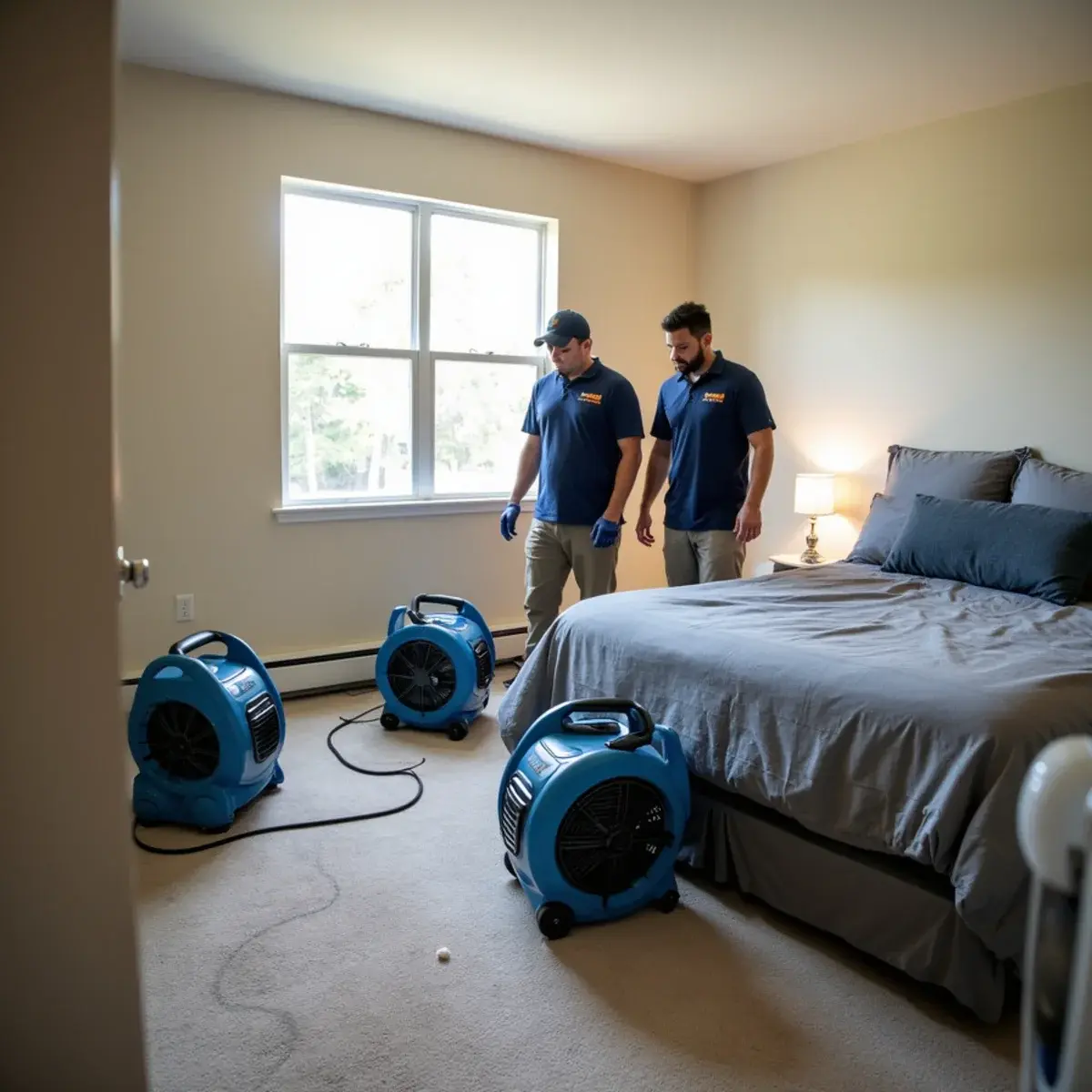
Glendale, CA · 24/7 response
Structural Drying & Dehumidification in Glendale, CA
Metered, logged drying that ends when the meters say dry — not when the calendar says it's been three days.
- 5.0 from 3 Google reviews
- Licensed, bonded & insured
- 60-minute emergency response
24/7 emergency response
A real person answers any hour — and you get a real ETA for your address, not a number off a website. 60-minute response in Glendale.
Dry-Verified Guarantee
Equipment stays until moisture meters match your home's dry standard.
Direct insurance billing
Daily moisture logs and carrier-format estimates. Most clients pay only their deductible.
Mitigation & rebuild in-house
One company from the first gallon extracted to the last coat of paint.
Getting the water out is the loud part of the job. Drying the structure is the part that determines whether you have mold in six weeks. It's also the part that's easiest to get wrong, because a room can feel dry to the touch while the framing behind the drywall is still holding 30% moisture content.
Drycore Restore treats drying as a measured process. We establish a dry standard from unaffected areas of your home, calculate the equipment the affected volume actually requires, and take daily readings until affected materials match that standard. Every number goes in a log you receive at the end.
That discipline matters more in Glendale than people expect. Our dry climate makes open-window drying tempting, but on a humid winter storm day or in a hillside home with poor air exchange, uncontrolled drying just relocates moisture into unaffected rooms.
Need structural drying & dehumidification in Glendale right now?
Free assessment · 60-minute emergency response · We bill your insurance carrier directly
Free on-site assessment
Tell us what's happening and we'll dispatch a structural drying & dehumidification crew or call you straight back.
What we're looking for
Signs and problems this service solves
The surface feels dry but the smell lingers
Odor is a moisture indicator. If a room still smells damp after the visible water is gone, something behind a finish is holding water.
Condensation on windows after a leak
Elevated indoor humidity from evaporating structural moisture shows up on the coldest surface in the room. It's a sign there's more water in the air than the space can handle.
Hardwood that cupped and hasn't flattened
Cupping means the underside of the board is wetter than the top. Left alone it can progress to crowning or permanent deformation. Specialty floor drying can often save it.
Cold spots on a wall
Evaporating water cools a surface. A thermal camera reading several degrees below the surrounding wall almost always corresponds to trapped moisture.
Drying that has stalled
If moisture readings stop dropping day over day, it means either the dehumidification is undersized, the air movers are aimed wrong, or there's a hidden reservoir — trapped water in a cavity, under cabinetry or beneath flooring.
A previous contractor pulled equipment early
We're frequently called in after another company removed fans on day three because the job "looked done." We re-map and finish it properly.
Scope of work
What structural drying & dehumidification includes
A dry standard taken from your own house
Before equipment goes in, we record moisture content in the same materials in an unaffected area. That number is the target — not a generic figure, because normal moisture content varies by construction era, by material and by season in Glendale.
A calculated equipment system, not an estimate
Air movers from affected wall and floor linear footage; dehumidification from cubic volume and loss class. Undersized dehumidification is the single most common reason a job stalls at day five with readings that will not drop.
LGR or desiccant, chosen for the material
Low-grain refrigerant units for most residential work. Desiccant for Class 4 losses and dense materials — plaster, solid hardwood, concrete slab — where refrigerant units cannot pull the air dry enough to keep evaporation going.
Specialty systems that save finishes
Floor mat systems that pull moisture up through hardwood under negative pressure; injection drying into wall cavities through ports behind baseboard; directed airflow into cabinet bases through the toe-kick. All three exist to avoid demolition.
Daily logged monitoring
Temperature, relative humidity, grains per pound and material moisture content recorded every visit, with equipment repositioned as the drying front moves. Comparing indoor to outdoor GPP tells us whether the dehumidifiers are winning or something changed.
Verification and the completed log
Equipment comes out when affected materials match the dry standard. You receive the full record — the document that answers a mould question later, and that a buyer's inspector will respect.
How it works
Our structural drying & dehumidification process
- 1
Establish the dry standard
We take moisture content readings from the same materials in an unaffected part of the property. That number — not a generic target — is what we dry your affected materials back to.
- 2
Map the full extent of moisture
Non-penetrating meters scan large areas quickly; penetrating pin meters confirm actual moisture content in framing and subfloor; thermal imaging shows migration paths. We mark and photograph the affected perimeter.
- 3
Calculate the drying system
Air mover count comes from affected wall and floor linear footage; dehumidifier capacity comes from the cubic volume and class of water loss. Undersized equipment is the number one cause of stalled drying.
- 4
Create controlled airflow
Air movers go at a shallow angle along wet surfaces to strip the saturated boundary layer of air off the material. Dehumidifiers pull that moisture out of the room air and dump dry air back in. The room becomes a closed drying chamber.
- 5
Specialty drying where it's needed
Hardwood gets floor mat systems that pull moisture up through the boards. Wall cavities get injection drying through discreet holes behind baseboard. Cabinets and toe-kicks get directed airflow rather than demolition wherever we can manage it.
- 6
Daily monitoring and a final verification
We return every day to record temperature, relative humidity, GPP and material moisture content, and reposition equipment as the drying front moves. When affected materials match the dry standard, equipment comes out and you get the complete log.
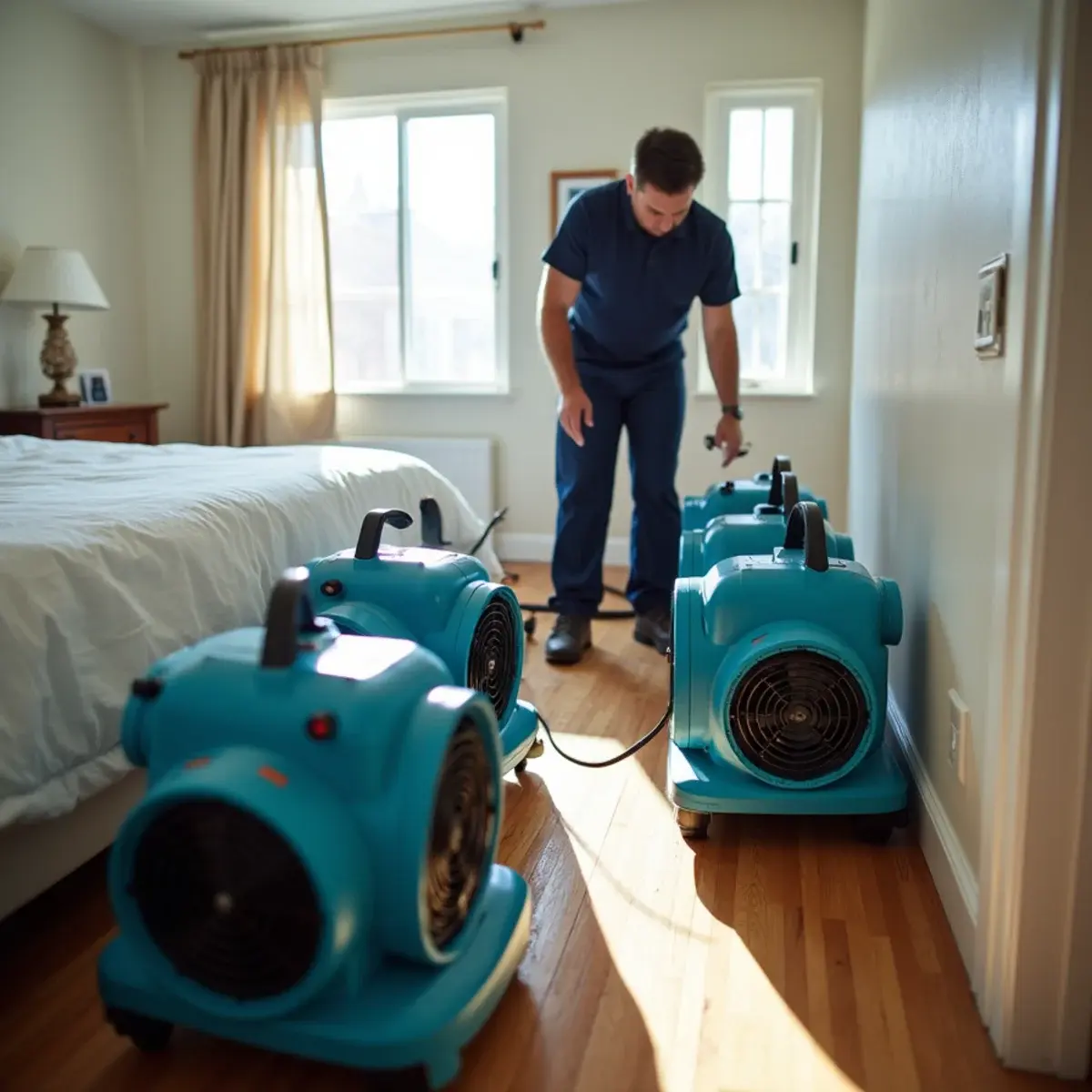
How we know when something is actually dry
"Dry" is not a feeling, it's a measurement. Wood framing at equilibrium in Southern California typically sits somewhere in the low teens for moisture content; drywall and concrete have their own baselines. Because those baselines vary by house, by season and by which side of the Verdugos you're on, we never use a fixed target. We measure your own unaffected materials and dry the wet ones back to match.
We also watch the air, not just the material. Grains per pound tells us how much water the room air is actually holding, and comparing indoor GPP to outdoor GPP tells us whether the dehumidifiers are winning. When the differential collapses, something has changed — a window got opened, a dehumidifier filled, or we found a moisture source we hadn't accounted for.
The log we hand you at the end is not a formality. If you sell the property, or if a mold question comes up later, that document is the proof the structure was returned to a normal moisture content under a recognized standard.
Drying without gutting the house
There's a lazy version of this trade where everything wet gets torn out because demolition is faster than drying. We'd rather save materials. In-place drying of hardwood, cavity drying behind baseboard, and directed airflow into cabinet bases routinely preserve finishes that would otherwise have been landfilled — which is both cheaper for you and less disruptive to live through.
That said, we don't dry what shouldn't be dried. Wet insulation loses its R-value and holds water against framing, so it comes out. Saturated particleboard and MDF swell irreversibly. Anything touched by contaminated water gets removed regardless of how salvageable it looks. We'll always tell you which category a given material falls into and why.
Honest cost drivers
What determines the price of this work
Equipment days
Drying is billed by unit per day. A loss that needs eight air movers and two dehumidifiers for four days costs roughly twice one that needs the same equipment for two.
Material type
Drywall and carpet release moisture readily. Plaster over lath, solid hardwood, concrete slab and dense hardwood cabinetry hold it much longer and often require specialty systems.
Class and category of loss
The IICRC classes a loss by how much material absorbed water. A Class 4 loss with deeply saturated low-evaporation materials needs desiccant dehumidification and considerably more time than a Class 1.
Ambient conditions
A cool, humid week during a Glendale winter storm slows evaporation. A warm dry stretch helps. We adjust the system rather than the schedule.
Power availability
Older Glendale homes with limited panel capacity sometimes need us to distribute equipment across circuits or bring a generator, which adds setup time.
Get a free, measured estimate — not a phone guess
Free assessment · 60-minute emergency response · We bill your insurance carrier directly
Why us for this
Why Glendale calls Drycore Restore for structural drying & dehumidification
The only drying guarantee in this market
Our Dry-Verified Guarantee: equipment stays until moisture meters read dry. Every competitor page we reviewed states no drying guarantee at all — the industry norm is to pull equipment on a scheduled day and hope.
We finish jobs other companies called dry
A frequent call: another crew removed fans on day three because the surface felt dry, and six weeks later there is a smell. We re-map with meters and thermal imaging and complete it properly rather than starting a remediation.
We try to dry before we demolish
Removing material is faster and more profitable than drying it. In-place drying of hardwood, wall cavities and cabinet runs routinely saves finishes a demolition-first approach would have skipped, and it is cheaper for you.
Equipment run hours logged for reimbursement
Drying raises your power bill for the days it runs, and it is a legitimate claim line item. We log actual run hours so it gets reimbursed rather than quietly absorbed.
Questions
Structural Drying & Dehumidification FAQs
Three to five days covers most residential losses in Glendale. Dense materials — plaster, hardwood over a subfloor, concrete slab — can push it to seven or more. We can't promise a date up front because the honest answer depends on daily readings, but we'll tell you after day one whether you're looking at a short job or a long one.
Air movers are roughly as loud as a bathroom fan and dehumidifiers hum continuously, so it's noticeable but livable. Most clients stay in the home unless the affected area includes a bedroom or the water was contaminated. Please don't switch the equipment off overnight — an eight-hour gap can add a full day to the job.
There is a measurable increase for the days equipment runs, and it's a legitimate line item on most insurance claims. We log actual run hours so it can be reimbursed rather than absorbed. It's still far cheaper than the mold remediation that follows an incomplete dry-out.
Frequently, yes — if we reach them before the boards delaminate or the finish blisters through. Floor mat drying systems create negative pressure across the surface and pull moisture up through the wood. It takes longer than drying a room and costs less than a new floor.
Because equipment count comes from affected linear footage and cubic volume, not from how bad the water looked. A room where water wicked two feet up every wall needs considerably more than one with a wet patch of carpet, and a plaster house needs more than a drywall house of the same size.
Related restoration services
Water Damage Restoration
Full-service recovery from the first gallon extracted to the last coat of paint — one crew, one invoice, one point of contact.
Read moreEmergency Water Extraction
Truck-mounted units that pull hundreds of gallons an hour — the single highest-impact hour of any water loss.
Read moreMold Remediation
Contained removal under negative pressure — we fix the moisture source too, so it doesn't come back.
Read more
Further reading from our crews
How Long Does Water Damage Drying Actually Take?
Three to five days covers most residential losses — but the number is a result, not a schedule. Here's what determines it and how dryness gets verified.
Read moreCan Hardwood Floors Be Saved After Water Damage?
Usually yes, if someone reaches them fast and dries them the right way. The default in this industry is to tear them out, and that's frequently unnecessary.
Read more
Structural Drying & Dehumidification across our full service area
We provide this service throughout Glendale and the surrounding foothill communities. Choose your city or neighborhood for local detail.
- Glendale
- Montrose
- La Crescenta
- Verdugo Woodlands
- Rossmoyne
- Adams Hill
- Chevy Chase Canyon
- Sparr Heights
- Burbank
- Pasadena
- La Cañada Flintridge
- Eagle Rock
- Atwater Village
- Tujunga
- Sunland
- Altadena
- South Pasadena
- Silver Lake
- North Hollywood
- Toluca Lake
- Shadow Hills
- Lake View Terrace
- Sylmar
- San Fernando
- Sierra Madre
- Monrovia
- Duarte
- Azusa
- Glendora
- San Dimas
- La Verne
- Claremont
- Sun Valley
- Studio City
- Valley Village
- Sherman Oaks
- Van Nuys
- Panorama City
- Arleta
- Pacoima
- Mission Hills
- North Hills
- Encino
- Reseda
- Northridge
- Granada Hills
- Tarzana
- Winnetka
- Canoga Park
- Woodland Hills
- Chatsworth
- Glassell Park
- Cypress Park
- Highland Park
- Mount Washington
- Los Feliz
- Echo Park
- Lincoln Heights
- El Sereno
- Boyle Heights
- East Los Angeles
- Hollywood
- Hollywood Hills
- Downtown Los Angeles
- Koreatown
- Westlake
- Pico-Union
- Mid-Wilshire
Need structural drying & dehumidification in Glendale?
Call +1 (201) 277-9344 for 24/7 dispatch, or request a free on-site assessment. Licensed, bonded & insured · We bill your insurance carrier directly.
Licensed, bonded & insured · We bill your insurance carrier directly · 24/7 Emergency Service