

91750 · 24/7 Emergency Service
Water Damage Restoration in La Verne, CA
Two cities in one — a compact historic core built for citrus, and hillside estates below Marshall Canyon.
- 5.0 from 3 Google reviews
- Licensed, bonded & insured
- 2-hour response target
24/7 emergency response
A real person answers any hour — and you get a real ETA for your address, not a number off a website. 60-minute response in Glendale.
Dry-Verified Guarantee
Equipment stays until moisture meters match your home's dry standard.
Direct insurance billing
Daily moisture logs and carrier-format estimates. Most clients pay only their deductible.
Mitigation & rebuild in-house
One company from the first gallon extracted to the last coat of paint.
La Verne is unusually split for a city its size. The southern half around Old Town and the University of La Verne is the original Lordsburg townsite — compact, walkable, and full of early-century housing built during the citrus era.
The northern half climbs toward Live Oak and Marshall Canyons into large-lot estate development, much of it from the last few decades, on sloped ground below the front range.
Those two halves fail in completely different ways, and a company that treats them the same gets it wrong. The south is a plumbing-age and historic-materials problem. The north is a drainage and large-volume drying problem.
Water damage in La Verne? Call and we'll roll.
Free assessment · 2-hour response target · We bill your insurance carrier directly
Free La Verne assessment
About 50 minutes from our Glendale base. Tell us what's happening and we'll call you straight back — any hour.
The historic core: old plumbing under finishes worth keeping
Housing around Old Town and the university dates largely from the early twentieth century, plumbed in galvanized steel and finished in plaster over wood lath with original millwork and oak flooring.
Galvanized fails from the inside out, at threaded joints, inside walls. When it does, the priority is opening as little as possible — thermal imaging locates the break so we cut a specific twelve-inch section rather than exploring a wall carrying finishes that can't be reproduced.
Plaster also needs different treatment from drywall. It's denser, holds far more water and releases it slowly, so a wall reading dry at the surface after three days can still be well above normal in the brown coat. And it fails by losing its keys — the material squeezed through the lath that holds the assembly up — which means a wall can be structurally detached while looking perfectly fine. We tap the field to assess that before calling anything salvageable.
The northern hillside: drainage and drying volume
Estate development below Live Oak and Marshall Canyons sits on sloped ground that receives both surface runoff during peak rainfall and subsurface flow arriving on a delay, sometimes on a clear day after the storm has passed.
Homes built into grade carry a retaining relationship with the hillside behind them. During a wet winter that wall holds saturated soil under pressure, and seepage appears low on the uphill side, often with no visible crack from inside. It's addressed by intercepting water outside — a French drain on the uphill side, corrected grading, a sump where water is going to arrive regardless — not by sealing from within.
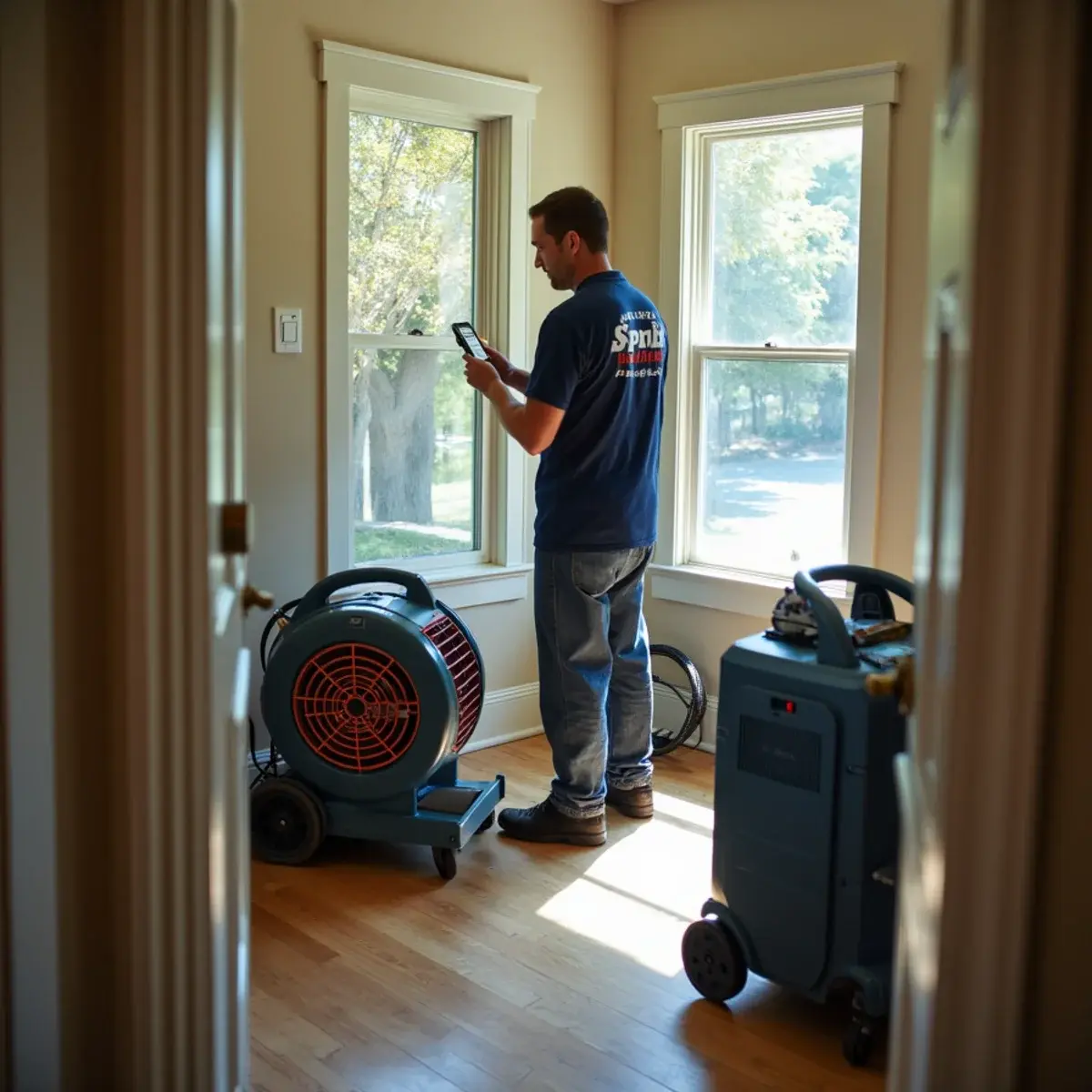
Larger homes also need the drying system calculated rather than estimated. Open volumes and high ceilings push the dehumidification requirement well beyond what floor area suggests, and undersizing is the most common reason a big dry-out stalls with readings that stop dropping.
Citrus-era irrigation and what's still buried
La Verne grew up around citrus, and a fair amount of the infrastructure that served those groves is still in the ground — old irrigation lines, standpipes, capped laterals and drainage that was cut through when tracts were built over the groves.
It surfaces occasionally during a water loss when the source turns out not to be the house at all. An abandoned line that was never properly capped, or a buried drainage path that now runs toward a foundation instead of away from one, produces the kind of persistent moisture problem that looks inexplicable until someone digs.
We flag it when we find it. Chasing a moisture reading that never resolves is a good way to spend money without fixing anything.
Local risk profile
What causes water damage in La Verne
Original galvanized plumbing in the Lordsburg core
Early-century supply lines fail inside walls carrying plaster and millwork that can't be reproduced.
Hillside seepage below Live Oak and Marshall Canyons
Sloped estate lots take subsurface flow against uphill foundation walls during wet winters.
Undersized drying in large-volume homes
Open plans and high ceilings need capacity well beyond what floor area alone suggests.
Legacy citrus-era irrigation infrastructure
Abandoned lines and altered drainage paths beneath older tracts produce persistent, hard-to-source moisture.
Most requested here
Restoration services for La Verne properties
Burst Pipe & Leak Cleanup
The most common call we get in Glendale — and the one where a fast response saves the most drywall.
Learn moreStructural Drying & Dehumidification
Metered, logged drying that ends when the meters say dry — not when the calendar says it's been three days.
Learn moreCrawl Space & Basement Water Removal
The part of the house nobody looks at — and the most common source of whole-home humidity and floor rot.
Learn moreWater Damage Repair & Reconstruction
The rebuild phase most restoration companies hand off — done in-house, so the job actually finishes.
Learn moreMold Remediation
Contained removal under negative pressure — we fix the moisture source too, so it doesn't come back.
Learn more
Around La Verne
Landmarks and destinations we work near regularly.
- University of La Verne
- Old Town La Verne
- Marshall Canyon Regional Park
- Live Oak Canyon
- Heritage Park
- D Street
Streets and pockets we cover
Sub-areas within La Verne where we take calls.
- Old Town / Lordsburg
- D Street
- Marshall Canyon area
- Live Oak Canyon
- Northern hillside tracts
Why us, here
Why La Verne residents call Drycore Restore
Two different cities, two different jobs
Old Town Lordsburg is plaster and galvanized under finishes worth keeping. North of Foothill is drainage and large-volume drying. We ask which before loading.
Legacy citrus infrastructure surfaces
Abandoned irrigation lines and altered drainage under older tracts produce moisture that looks inexplicable until someone digs. We flag it rather than chasing readings.
Outer-edge coverage, stated up front
A two-hour window rather than our Glendale target. Honest is more useful to you than optimistic.
What La Verne calls sound like
La Verne is two jobs in one city. South of the tracks it's old plumbing under finishes worth saving; north of Foothill it's drainage and drying volume.
Verified reviews
5.0 stars from 3 Google reviews
“We had a pipe burst in our wall. Drycore came out to dry and disinfect everything for us.”
“Very responsive, accommodating and professional. I highly recommend them.”
“They responded very quickly and came out immediately.”
Local questions
La Verne water damage FAQs
About 50 minutes from our Glendale base. We dispatch 24 hours a day, and for La Verne we work to a 2-hour response target. Call +1 (201) 277-9344 and we'll give you a real ETA for your address rather than a number off a website — plus the steps to take before we arrive.
We serve 91750 and the surrounding streets. If you're not certain whether your address falls inside our range, call and ask — we'll tell you honestly rather than driving out and turning around.
Original galvanized plumbing in the Lordsburg core — Early-century supply lines fail inside walls carrying plaster and millwork that can't be reproduced. We also see hillside seepage below live oak and marshall canyons regularly here.
Both. The same crew that extracts and dries also installs the new drywall, matches texture, paints, and reinstalls trim, flooring and cabinetry — so the job actually finishes instead of stalling between two contractors.
Drycore Restore
749 Portola AveGlendale, CA 91206Get Directions →+1 (201) 277-9344
Monday – Sunday · Open 24 hours a day, 7 days a week
Nearby areas we also serve
Guides relevant to this area
The Water Damage an Earthquake Causes (And How To Reduce It)
After a significant quake, far more Los Angeles homes are damaged by their own plumbing than by structural failure.
Read moreWhy the Smell Comes Back (And How Odor Is Actually Removed)
If the smell returns on warm days, nothing was removed — something was covered. Odor is a material problem, not an air problem.
Read moreWet Documents and Electronics: What Can Still Be Saved
Two rules, both counterintuitive, both time-critical: freeze the paper, and don't turn the electronics on.
Read more
Water damage in La Verne? Call now.
About 50 minutes from our Glendale base. 24/7 dispatch, free on-site assessment, direct insurance billing.
Licensed, bonded & insured · We bill your insurance carrier directly · 24/7 Emergency Service