Can Hardwood Floors Be Saved After Water Damage?
Usually yes, if someone reaches them fast and dries them the right way. The default in this industry is to tear them out, and that's frequently unnecessary.
Wood floors are usually the most expensive thing water touches in a house, and they're the material most often written off unnecessarily.
The honest answer to whether yours can be saved is: probably, if someone gets to them within a day or two and uses the right method. Beyond that window the odds fall quickly — and the method matters as much as the timing.
Dealing with this right now? We answer 24/7.
Free assessment · 60-minute emergency response · We bill your insurance carrier directly
Why wood cups
Wood moves with moisture, and it moves more across the grain than along it. When water reaches a floor, the underside of each board absorbs more than the finished top — the finish slows absorption from above, and the water is usually coming from below or from the edges.
The wetter underside swells more than the drier top, so each board takes on a shallow dish shape with the edges higher than the centre. That's cupping, and it's the classic signature of a wood floor that has taken on water from underneath.
Cupping is not automatically permanent. It's a moisture gradient, and if you remove the moisture evenly the gradient equalises and the boards can flatten out. What makes it permanent is drying too fast from the top, which sets the deformation, or leaving it long enough for the adhesive or the wood fibre itself to fail.
Crowning — the opposite shape, centre higher than edges — usually means someone sanded a cupped floor before it finished drying. Once the floor flattens, the sanded high edges become low, and you've cut into boards that would have recovered.
The window, realistically
Within roughly 24 hours: excellent odds. The water is mostly in the surface layers and the subfloor, the adhesive bond is intact, and controlled drying usually returns the floor.
Two to five days: variable. Solid wood over a wood subfloor often still recovers. Engineered wood is at real risk because its layers are held by adhesive that softens with prolonged moisture. Glue-down installations start to release.
Beyond a week: poor. Delamination, adhesive failure, black staining from tannin reaction with metal fasteners, and microbial growth in the subfloor beneath. At that point the conversation shifts to replacement and to whether the subfloor is salvageable.
Category matters as much as time. Clean supply water gives you the timeline above. Water from a sewer backup or storm runoff is category 3, and a wood floor it saturated comes out regardless of how good it looks — you cannot decontaminate the interior of a porous material. Our guide to water damage categories covers why.
- Within 24 hours — excellent odds. Water is in the surface layers and subfloor, adhesive bond intact, controlled drying usually returns the floor.
- Two to five days — variable. Solid wood over a wood subfloor often recovers; engineered wood is at real risk as glue lines soften.
- Beyond a week — poor. Delamination, adhesive failure, black tannin staining at fasteners and growth in the subfloor beneath.
- Any timeframe, category 3 water — the floor comes out regardless of how good it looks. Porous material cannot be decontaminated internally.
Call +1 (201) 277-9344 — 24/7 in Glendale
Free assessment · 60-minute emergency response · We bill your insurance carrier directly
How mat drying actually works
The wrong approach is to point air movers at the surface. That dries the top of the boards while the underside stays wet, which increases the moisture gradient — the exact thing causing the cupping — and can lock the deformation in permanently.
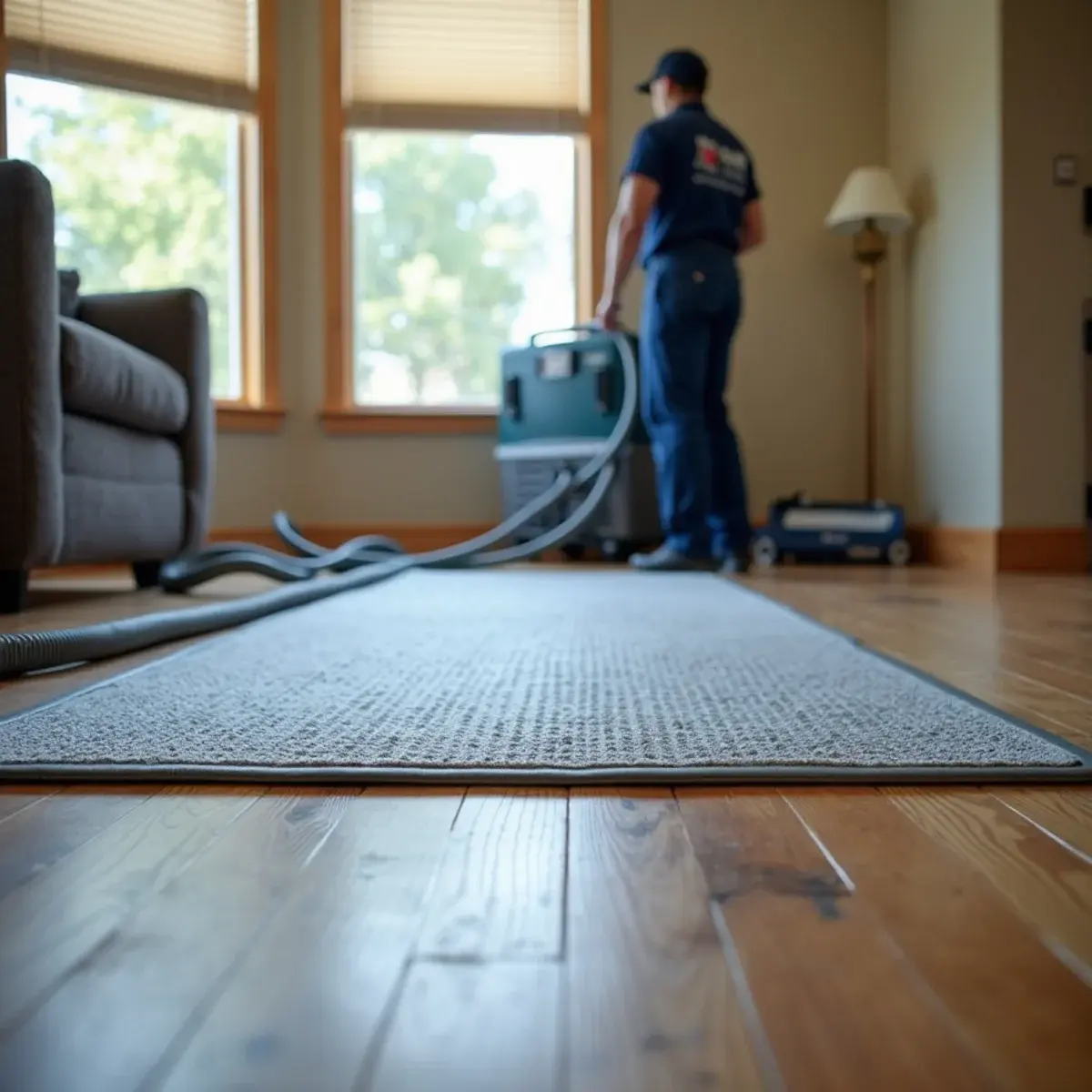
The right approach is a floor mat drying system. Sealed mats are laid on the floor surface and connected to a vacuum unit that pulls a negative pressure across them. Instead of blowing air at the wood, the system draws moisture up through the boards and out through the seams and the face.
That does two things at once: it removes water from the wettest part of the assembly, and it dries the floor from the bottom up, which flattens the gradient rather than steepening it. Combined with dehumidification to handle the released moisture, it's the difference between a floor that recovers and one that gets replaced.
It's slower than demolition. A mat-dried floor typically runs seven to ten days against three to five for a standard room, and it needs daily meter readings to confirm the moisture content is actually dropping. Our page on structural drying and dehumidification covers how that gets measured.
What has to happen underneath
A wood floor is the visible part of an assembly. Below it is underlayment, a subfloor, and — depending on the house — a crawl space or a slab.
If the subfloor is wet and you dry only the finish floor, you've solved the visible problem and left a reservoir underneath that will re-wet the wood and grow mold. On raised foundations we frequently dry from below as well as above, which is far more effective and is only possible if someone bothers to get into the crawl space.
Over a slab, the concrete itself holds a substantial reservoir and releases it slowly. That's why slab moisture testing before new flooring matters so much — a new floor laid over concrete that's still emitting moisture fails within a year, and most manufacturer warranties exclude it.
Solid, engineered and laminate
Solid hardwood has the best odds. It's thick enough to hold a gradient and be dried out of it, and if the surface suffers it can be sanded and refinished — usually several times over its life.
Engineered hardwood is a real veneer over a plywood or composite core, bonded with adhesive. It's more dimensionally stable than solid wood in normal conditions and less forgiving of saturation, because prolonged moisture attacks the glue lines. It can often be dried if reached quickly; once layers separate it's finished. The veneer is also usually too thin to sand more than once, if at all.
Laminate is a photographic layer over a fibreboard core. The core swells irreversibly when it gets wet and does not recover. Laminate that has taken meaningful water is a replacement, and there's no method that changes that.
Bamboo and cork vary widely by product and manufacturer. Worth attempting, worth low expectations.
Refinishing, and when to do it
Wait. This is the most common expensive mistake we see — a homeowner or a flooring contractor sands a cupped floor while it's still drying, and once it flattens the sanded edges become permanent low spots.
The sequence is: dry the floor to a verified moisture content matching unaffected areas of the same species in the same house, let it acclimatise, confirm it has flattened, and only then assess whether refinishing is needed.
Frequently it is — water marks the finish even when the wood recovers. But a light sand and refinish on a floor that dried properly is a fraction of the cost of replacement, and it leaves you with the original floor rather than a patch of modern stock that will never match in width, cut or color.
Frequently asked questions
Not necessarily, and don't let anyone tell you it is on day two. Cupping is a moisture gradient, and if the floor is dried evenly and slowly enough the boards frequently flatten. The decision to replace should come after proper drying, not before it.
Typically seven to ten days, against three to five for a standard room dry-out. It's slower because you're pulling moisture through dense material rather than off a surface — and it's still dramatically faster and cheaper than replacing the floor.
Generally yes, and carriers usually prefer it — drying costs less than replacement. The problem is more often a contractor who defaults to demolition because it's faster and more profitable. Ask specifically what will be attempted before anything comes up.
You'll dry the surface and steepen the gradient, which is the mechanism that locks cupping in. Mat systems work by pulling moisture up through the boards under negative pressure, and that isn't something rental equipment does.
The bottom line
The default answer in this trade is to tear a wet wood floor out, because demolition is fast and certain. The better answer, when someone reaches it in time, is to dry it properly from underneath and refinish what's already there.
Drycore Restore carries mat drying systems on the truck rather than as a special order. If you have a wet wood floor, call +1 (201) 277-9344 today rather than next week.
Related services
- Structural Drying & Dehumidification in Glendale
- Water Damage Restoration in Glendale
- Water Damage Repair & Reconstruction in Glendale