Why New Flooring Fails: Slab Moisture Testing Explained
The most expensive shortcut in restoration: laying a new floor over concrete that's still releasing moisture. It fails within a year and the warranty won't cover it.
Here's a failure we get called to more often than we should: a homeowner had water damage, the floor was replaced, and eight months later the new floor is cupping, lifting at the edges or smelling musty.
Almost every time, the cause is the same. The new floor went down over a slab that was still releasing moisture, and nobody tested it.
Dealing with this right now? We answer 24/7.
Free assessment · 60-minute emergency response · We bill your insurance carrier directly
Concrete is a reservoir, not a surface
A concrete slab is porous. It has an interconnected capillary structure that holds water throughout its thickness, and it exchanges moisture with whatever is above and below it.
When a slab gets wet — from a slab leak, a flood, or an appliance failure that ran for a week — water is absorbed into that structure across a much larger area than the visible wet patch. It then releases slowly, because moisture has to migrate through dense material to reach the surface where it can evaporate.
This is why a slab can feel bone dry to the touch and still be well above an acceptable level for flooring. The top few millimetres dry quickly and behave like a lid; the moisture below keeps migrating upward for weeks.
There's also a source you can't dry away: ground moisture beneath the slab. On a slab without a vapor barrier — which describes a lot of pre-1970 construction and almost every converted garage — the concrete is in permanent contact with damp soil and will always carry some moisture upward.
What happens when you cover it too early
Moisture that was evaporating into the room now has nowhere to go. It accumulates at the interface between the slab and whatever you laid on it, and the consequences depend on the flooring:
- Glue-down anything — the adhesive re-emulsifies and releases. Planks lift, tiles curl at the corners, and the whole floor loses bond progressively.
- Engineered wood — the core absorbs from below, boards cup, and the glue lines between layers begin to fail.
- Laminate — the fibreboard core swells irreversibly at the edges and the joints peak.
- Vinyl and LVP — trapped moisture causes bubbling, discolouration, and adhesive failure; the impermeable surface makes it worse by sealing the moisture in.
- Tile — usually survives structurally, but trapped moisture causes efflorescence, grout discolouration and, over time, bond failure.
- Carpet and pad — the pad stays damp permanently, and you get odor and microbial growth within months.
Call +1 (201) 277-9344 — 24/7 in Glendale
Free assessment · 60-minute emergency response · We bill your insurance carrier directly
The two tests that matter
There are two industry-standard methods, and they measure different things.
Calcium chloride test (ASTM F1869) measures the moisture vapor emission rate — how much moisture is coming out of the surface, expressed in pounds per 1,000 square feet per 24 hours. A sealed dish of anhydrous calcium chloride is placed on the bare slab under a covered dome for 60–72 hours, then weighed to see how much moisture it absorbed. It's a surface emission measurement, so it tells you what's coming out right now.
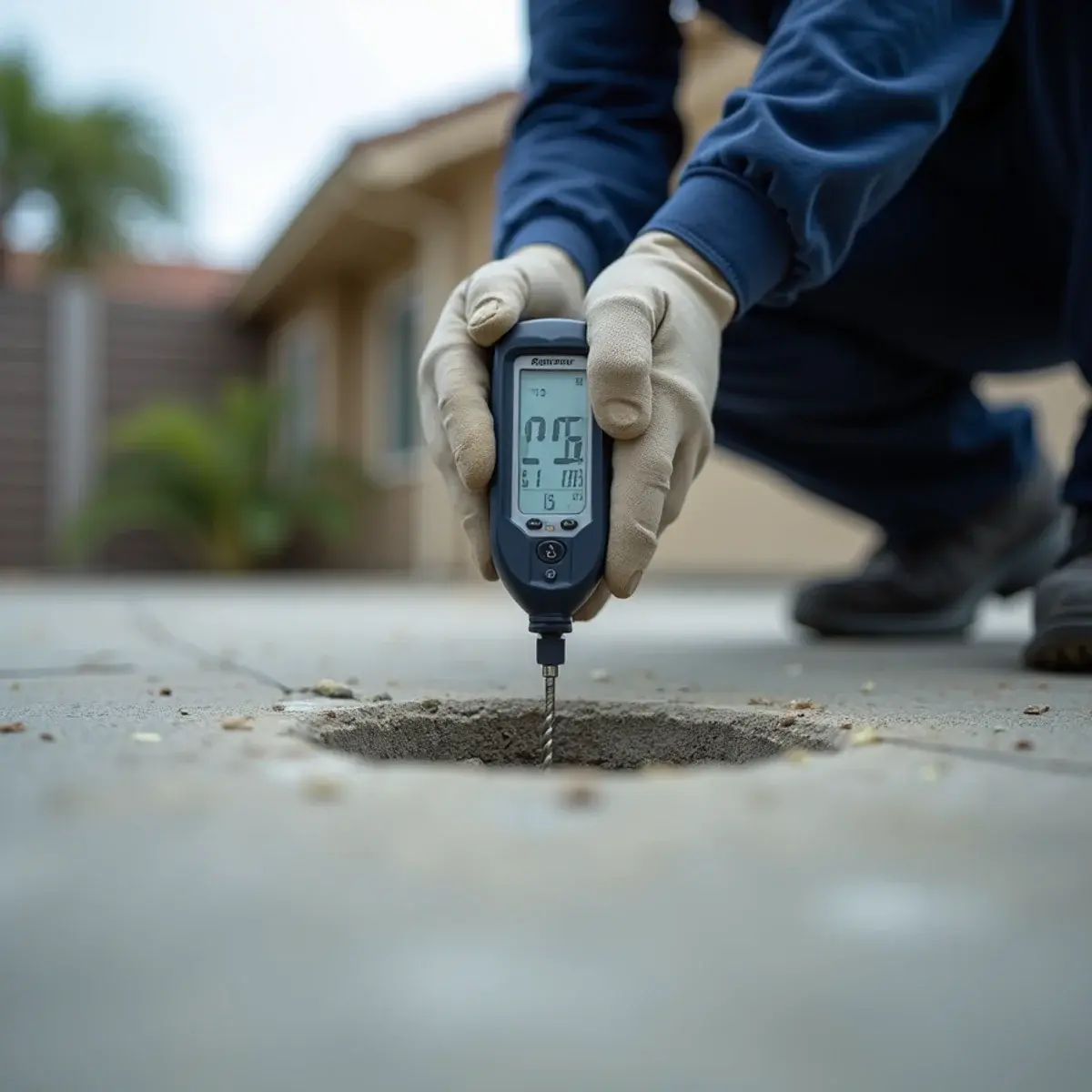
In-situ relative humidity test (ASTM F2170) measures the relative humidity inside the slab itself. Probes are drilled into the concrete to 40% of its depth (or 20% for a slab drying from both sides), sealed, allowed to equilibrate for 24 hours, and read. This is the more reliable method and the one most flooring manufacturers now specify, because it tells you what the slab will do once you cover it — not just what the surface is doing while it's open.
Acceptable thresholds are set by the flooring manufacturer, not by a universal standard, and they vary considerably by product. That's the number that matters, and it should be in the installation instructions.
What a moisture meter does and doesn't tell you
Restoration crews use pinless concrete moisture meters routinely, and they're genuinely useful — for tracking whether a slab is drying, for comparing affected and unaffected areas, and for mapping the extent of a loss.
What they can't do is qualify a slab for flooring installation. A meter reads a shallow depth and gives a relative indication, not the quantified emission rate or internal RH that manufacturers specify and that warranties reference.
So the sequence is: meters during drying to track progress, then a proper ASTM test before flooring goes down. Using the meter for both is the shortcut that causes the failures — and if a contractor tells you the slab is 'reading fine' without an ASTM test, ask which standard they're referencing.
How long a slab actually takes
Longer than the rest of the job. A slab that absorbed water during a loss commonly needs one to three weeks of active drying before it will pass, and sometimes considerably more — depending on thickness, how long it was wet, whether there's a vapor barrier beneath it, and ambient conditions.
That's frequently longer than the structural drying takes, which creates real pressure to move on. The walls are dry, the equipment is coming out, everyone wants the floor back. This is the moment where the shortcut happens.
Where a slab genuinely won't dry to spec — usually because there's no vapor barrier and ground moisture keeps feeding it — the answer isn't to wait indefinitely. It's a moisture mitigation system: an epoxy or similar membrane applied to the prepared slab that seals it and allows flooring over it. That adds cost, and it's dramatically cheaper than installing a floor twice.
Where this bites hardest
Some situations produce slabs that need more attention than average. Homes on the historic floodplain — Atwater Village, Cypress Park, Lincoln Heights, Pacoima and the river-adjacent flats — sit on permeable ground with a higher water table, so slabs stay damper year-round.
Converted garages are the other consistent case. They were typically poured as garage slabs with no vapor barrier, then finished as living space, and they carry ground moisture permanently. Any flooring failure in a converted garage should prompt a moisture test before the replacement goes down.
And slab leaks by definition put water into the slab from underneath, across a footprint much larger than the leak. Those slabs almost always need testing rather than assuming.
Frequently asked questions
Usually you, unfortunately. Nearly every flooring manufacturer's warranty excludes moisture-related failure and requires documented testing to the relevant ASTM standard. Without a test result, the claim generally fails — which is why the test is worth insisting on even when it delays you.
There are consumer kits, and a plastic sheet taped to the slab overnight will show obvious condensation. Neither produces the documented ASTM result a warranty requires. For a small area it's a reasonable screening step; before installing a floor you want the real test.
There's no calendar answer — it depends entirely on the slab. Weeks rather than days is normal for a slab that absorbed water. The only way to know is to test, and the only wrong answer is guessing because the schedule is tight.
The principle does, though the method differs. Wood subfloors are checked with a pin meter against the flooring manufacturer's specified moisture content and against the moisture content of the flooring itself — the differential between the two matters as much as either number.
The bottom line
Concrete releases moisture for weeks after everything else in the room is dry. Test it against the flooring manufacturer's threshold before you cover it, and keep the result.
Drycore Restore tests slabs before installing flooring rather than after the floor fails. Call +1 (201) 277-9344.
Related services
- Water Damage Repair & Reconstruction in Glendale
- Structural Drying & Dehumidification in Glendale
- Slab Leak Detection & Repair Support in Glendale