
Glendale, CA · 24/7 response
Slab Leak Detection & Water Damage Repair in Glendale, CA
Thermal and acoustic location of under-slab leaks — pinpointed before anyone breaks concrete.
- 5.0 from 3 Google reviews
- Licensed, bonded & insured
- 60-minute emergency response
24/7 emergency response
A real person answers any hour — and you get a real ETA for your address, not a number off a website. 60-minute response in Glendale.
Dry-Verified Guarantee
Equipment stays until moisture meters match your home's dry standard.
Direct insurance billing
Daily moisture logs and carrier-format estimates. Most clients pay only their deductible.
Mitigation & rebuild in-house
One company from the first gallon extracted to the last coat of paint.
A slab leak is water escaping from a pressurized line embedded in or beneath your concrete foundation. Because there is no visible drip and no obvious puddle, most slab leaks run for weeks or months before anyone notices — and by then the water has traveled under flooring, saturated the slab and started wicking up the base of the walls.
Glendale's mid-century tracts are the classic setting for this. Copper supply lines were routed through the slab as standard practice, and decades of thermal expansion rubbing against concrete abrades the pipe until it perforates. Hot-water lines fail first because they move the most.
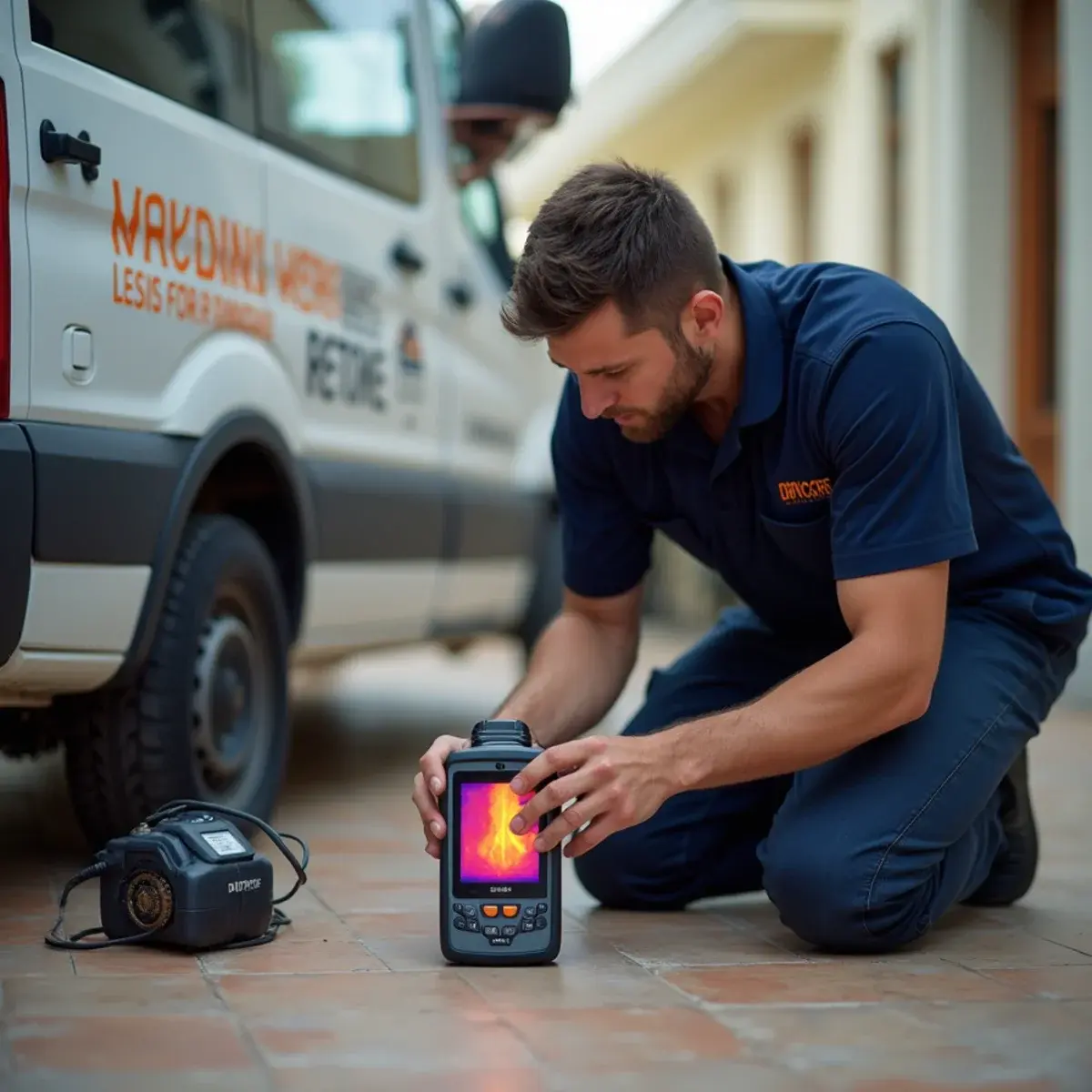
We locate the leak without breaking concrete on a hunch. Thermal imaging finds the temperature anomaly, acoustic equipment listens for the escaping water, and moisture mapping defines how far the water has spread — so when the concrete does get opened, it's opened once, in the right place.
Need slab leak detection & repair support in Glendale right now?
Free assessment · 60-minute emergency response · We bill your insurance carrier directly
Free on-site assessment
Tell us what's happening and we'll dispatch a slab leak detection & repair support crew or call you straight back.
What we're looking for
Signs and problems this service solves
A warm spot on the floor
The single most recognizable sign, and it means a hot-water line is leaking beneath. Usually noticed barefoot in the morning.
Water bill that climbed with no change in usage
A slab leak runs continuously. An unexplained increase of several thousand gallons a month with the same household routine is a strong indicator.
The sound of running water with everything off
Turn off every fixture and appliance and listen near the floor. A faint continuous rushing sound means water is moving in the system somewhere it shouldn't be.
Cracked or lifting flooring over the slab
Moisture beneath tile breaks the bond of the thinset; under wood, it causes cupping and adhesive failure; under vinyl, it lifts the edges. Damage often appears well away from the leak itself.
Damp carpet or baseboards with no fixture nearby
Water under a slab migrates to the perimeter and wicks up the drywall at the bottom plate. Damp baseboard in the middle of a wall with no plumbing behind it points down, not up.
Low water pressure across the house
Enough water escaping the system will show up as a general pressure drop, particularly noticeable on hot water.
Scope of work
What slab leak detection & repair support includes
Meter verification that a leak exists at all
We start at the water meter with every fixture off. A moving low-flow indicator confirms water is leaving the system; isolating the water heater's cold inlet then tells us whether it is the hot or cold side, which narrows the search before any equipment comes out.
Thermal imaging survey of the slab surface
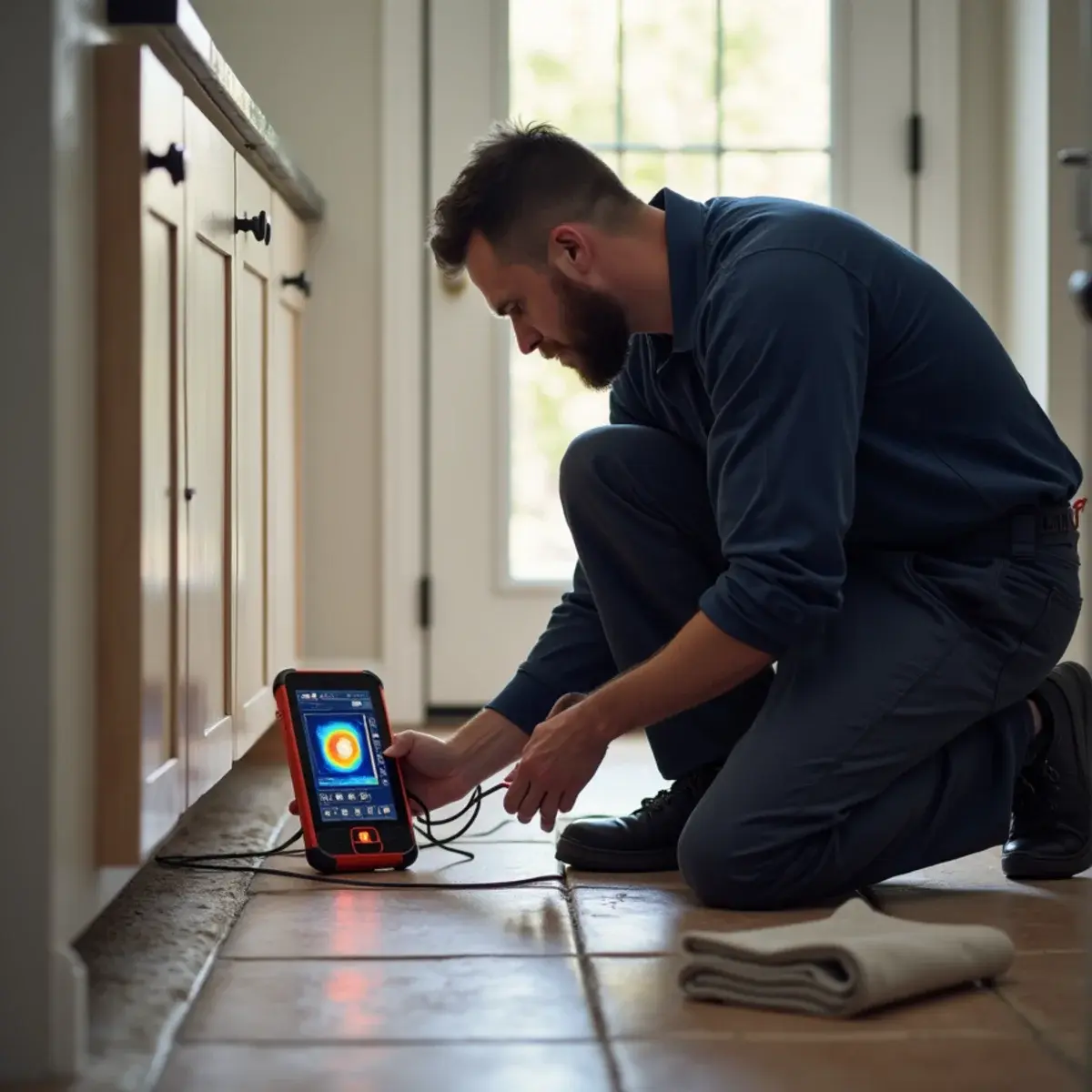
An infrared camera reads floor surface temperature. A hot-water leak shows as a distinct plume; a cold-water leak as an evaporatively-cooled band. This is the fastest way to reduce the search area from a room to a few square feet.
Acoustic location and line tracing
Ground microphones amplify the sound of pressurised water escaping through concrete, cross-referenced against traced pipe runs. Combining methods is what gets a target small enough to open once.
A marked location and depth for your plumber
We mark the spot on the floor and provide the documentation. Your plumber opens one hole in the right place instead of three in the wrong ones — which is the entire economic argument for detection.
Moisture mapping of the full spread
Water under a slab migrates to room perimeters and wicks up into wall plates. We routinely map a hallway leak that produced damp drywall in three adjacent rooms, and that footprint is what sets the drying scope.
Post-repair drying and slab verification
Directed airflow and dehumidification on the slab and wall cavities, then a calcium chloride or in-situ RH test before any new flooring goes down — because installing over concrete still emitting moisture destroys the new floor.
How it works
Our slab leak detection & repair support process
- 1
Verify a leak actually exists
We start at the meter. With all fixtures off, a moving meter dial confirms water is leaving the system. Then we isolate hot from cold to narrow which side is losing.
- 2
Thermal imaging survey
An infrared camera reads the surface temperature of the floor. A hot-water slab leak produces a distinctive plume; a cold-water leak shows as a cool, evaporatively-cooled band.
- 3
Acoustic and correlator location
Ground microphones amplify the sound of pressurized water escaping through concrete. Combined with line tracing, this narrows the location to within a small area rather than a room.
- 4
Moisture mapping of the affected area
We map how far moisture has moved through the slab and into wall assemblies. This is what determines the size of the drying job — often much larger than the leak itself.
- 5
Hand-off for repair
We provide a marked location and documentation to your plumber. Repair options are typically spot repair through the slab, rerouting the line through walls and attic, or a full repipe — and the right choice depends on the age and condition of the rest of the system.
- 6
Drying and restoration after repair
Once the line is fixed, we dry the slab, the wall cavities and any flooring that can be saved, then rebuild flooring, baseboard and drywall.
Spot repair, reroute or repipe — how to decide
This decision belongs to you, but it's easier with the right framing. A spot repair breaks the slab, fixes the failed section, and patches the concrete. It's the least expensive option and the right one when the plumbing is otherwise in good condition and this is a first failure — an isolated defect or a construction-era problem at one fitting.
A reroute abandons the under-slab section entirely and runs a new line overhead through walls and the attic. Nothing gets broken, the new line is accessible forever, and future leaks would be visible instead of hidden. It costs more than a spot repair and less than a repipe. When a home has had two slab leaks, this is usually the sensible answer for that line.
A full repipe replaces all supply plumbing. It's a significant project, but if a house is on original copper from the 1950s and has now had multiple pinhole failures, the third and fourth leaks are coming. Spending on repeated spot repairs to a system with a demonstrated failure pattern is throwing good money after bad.
What slab leaks do to the rest of the house
The leak itself is a plumbing problem. The damage is ours. Water under a slab doesn't stay put — it follows the path of least resistance through the sub-base and the slab's own capillary structure, and it emerges at the perimeter of rooms, under cabinet bases and along expansion joints.
From there it wicks upward into the bottom plate of framed walls and into drywall, which is where most of the visible damage happens. We routinely find a slab leak in a hallway that has produced wet drywall in three adjacent rooms. Drying that requires removing baseboard, drilling the cavity and running directed airflow into the wall assemblies, not just aiming fans at the floor.
Concrete is also a difficult material to dry — it releases moisture slowly and can hold a substantial reservoir. Where flooring is going back down, we verify the slab with a calcium chloride or in-situ relative humidity test before installation, because putting new flooring over a slab that's still releasing moisture destroys the new floor too.
Honest cost drivers
What determines the price of this work
Difficulty of locating the leak
A hot-water leak in an open room is straightforward to pinpoint. A cold-water leak under a tiled kitchen with cabinetry above it takes longer and may require more than one method.
Size of the moisture footprint
Water under a slab spreads laterally. The drying scope is set by how far it went, not by the size of the hole in the pipe.
Flooring type over the slab
Concrete under tile takes a long time to release moisture and may require specialty drying. Carpet over slab is fast. Glued-down wood is usually a loss.
Repair method chosen
Spot repair is cheapest short-term. Rerouting avoids breaking concrete and makes sense when the line has failed before. A full repipe is the most expensive and the last one you'll ever do.
Wall and cabinet involvement
When wicking reached the bottom plate, drywall and baseboard have to come off to dry the cavity, and kitchen and bath cabinetry sometimes has to be removed and reset.
Get a free, measured estimate — not a phone guess
Free assessment · 60-minute emergency response · We bill your insurance carrier directly
Why us for this
Why Glendale calls Drycore Restore for slab leak detection & repair support
Nobody breaks concrete on a hunch
We locate with thermal and acoustic equipment before a hammer comes out. A wrong guess costs a hole in your floor plus the repair of the hole, and it is the most avoidable expense in this whole category.
We know which Glendale tracts are failing now
Postwar Burbank, Sparr Heights, Panorama City, Sylmar and the valley-floor tracts were built on slabs with copper through the concrete in a narrow band of years. They reach end of life together, which is why three neighbours get slab leaks in two seasons.
Honest framing of spot repair versus reroute
First failure in a sound system: spot repair. Second failure on the same line: a reroute overhead usually wins on economics, because the third is coming. We give you that framing rather than quoting whichever is easiest.
We test the slab before flooring goes back
Concrete holds a real reservoir and releases it slowly. Skipping the ASTM test is the most common reason a replacement floor fails within a year — and manufacturer warranties exclude exactly that failure.
Questions
Slab Leak Detection & Repair Support FAQs
Thermal imaging, acoustic listening equipment and line tracing, cross-referenced against moisture meter readings. Combining methods gets us to a small target area. Concrete gets opened once, at the right spot, by the plumber doing the repair.
Most California policies cover the resulting water damage and often the cost of accessing the leak — the tear-out and repair of the concrete — while excluding the pipe repair itself. Coverage varies meaningfully between carriers, so we review your policy language before submitting anything.
Damage begins immediately but stays hidden. Most slab leaks we're called to have been running for weeks. The tell-tale signs — warm floor, high bill, damp baseboard — typically show up after the moisture footprint is already substantial, which is why acting on the first sign matters.
Yes, though it takes longer than framing or drywall. We use directed airflow and dehumidification, and on tiled or sealed slabs sometimes negative-pressure mat systems. We verify with a proper slab moisture test before any new flooring goes down.
Detection is a small fraction of what an unguided repair costs. Opening concrete in the wrong place means paying for the hole, the patch and then the correct hole — and on a tiled floor it can mean losing a run you cannot match. We locate first and give your plumber a marked spot with a depth, so the slab is opened once. The assessment itself is free.
Related restoration services
Burst Pipe & Leak Cleanup
The most common call we get in Glendale — and the one where a fast response saves the most drywall.
Read moreStructural Drying & Dehumidification
Metered, logged drying that ends when the meters say dry — not when the calendar says it's been three days.
Read moreWater Damage Repair & Reconstruction
The rebuild phase most restoration companies hand off — done in-house, so the job actually finishes.
Read more
Further reading from our crews
Slab Leak Signs in Mid-Century Glendale and Burbank Homes
Postwar tracts across Glendale and Burbank ran copper through the slab. Sixty years later, those lines are failing — and the signs are specific.
Read moreHidden Water Damage: The Signs Most Homeowners Miss
The expensive water losses aren't the dramatic ones. They're the slow ones nobody noticed for eight months — and they announce themselves in small ways first.
Read more
Slab Leak Detection & Repair Support across our full service area
We provide this service throughout Glendale and the surrounding foothill communities. Choose your city or neighborhood for local detail.
- Glendale
- Montrose
- La Crescenta
- Verdugo Woodlands
- Rossmoyne
- Adams Hill
- Chevy Chase Canyon
- Sparr Heights
- Burbank
- Pasadena
- La Cañada Flintridge
- Eagle Rock
- Atwater Village
- Tujunga
- Sunland
- Altadena
- South Pasadena
- Silver Lake
- North Hollywood
- Toluca Lake
- Shadow Hills
- Lake View Terrace
- Sylmar
- San Fernando
- Sierra Madre
- Monrovia
- Duarte
- Azusa
- Glendora
- San Dimas
- La Verne
- Claremont
- Sun Valley
- Studio City
- Valley Village
- Sherman Oaks
- Van Nuys
- Panorama City
- Arleta
- Pacoima
- Mission Hills
- North Hills
- Encino
- Reseda
- Northridge
- Granada Hills
- Tarzana
- Winnetka
- Canoga Park
- Woodland Hills
- Chatsworth
- Glassell Park
- Cypress Park
- Highland Park
- Mount Washington
- Los Feliz
- Echo Park
- Lincoln Heights
- El Sereno
- Boyle Heights
- East Los Angeles
- Hollywood
- Hollywood Hills
- Downtown Los Angeles
- Koreatown
- Westlake
- Pico-Union
- Mid-Wilshire
Need slab leak detection & repair support in Glendale?
Call +1 (201) 277-9344 for 24/7 dispatch, or request a free on-site assessment. Licensed, bonded & insured · We bill your insurance carrier directly.
Licensed, bonded & insured · We bill your insurance carrier directly · 24/7 Emergency Service