Sagging Ceiling From Water: What To Do in the Next Ten Minutes
A saturated ceiling panel is a suspended container of water. Handled deliberately it's a repairable hole. Handled badly it's an injury.
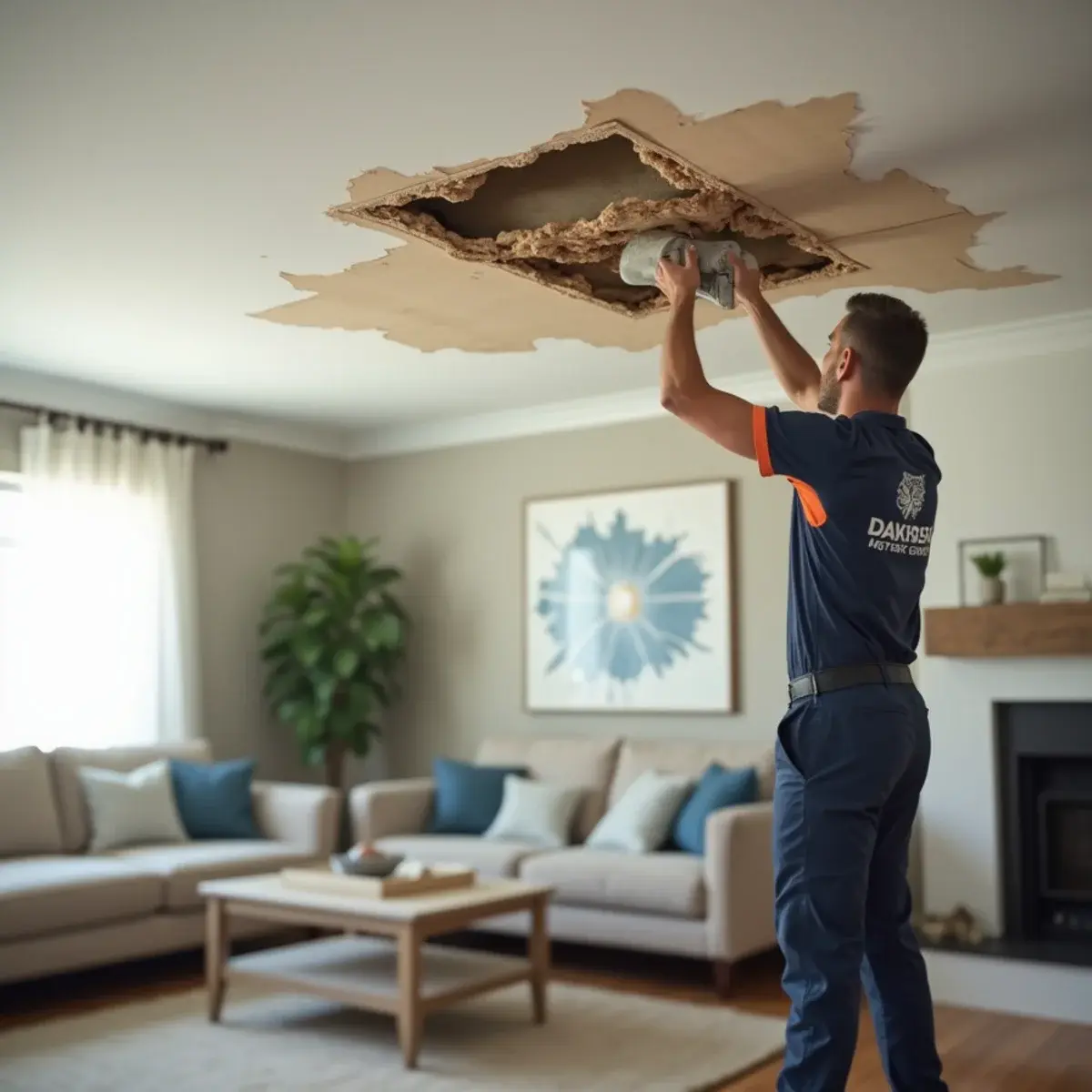
If you're reading this while looking at a bulge in your ceiling, do this first: get everyone out of the room, and don't stand under it.
Then read on. A sagging ceiling is one of the few water damage situations that's an immediate physical safety issue rather than just an expensive one.
Dealing with this right now? We answer 24/7.
Free assessment · 60-minute emergency response · We bill your insurance carrier directly
What you're actually looking at
Drywall is gypsum between paper facings. When water saturates it from above, the gypsum softens and the paper — which provides most of the tensile strength — loses its integrity.
Water pools on top of the panel between the joists, and the softened board deflects downward into a shallow bag holding it. That bulge is a container, and it's holding a genuinely surprising weight: water is a bit over eight pounds per gallon, so even a modest pocket is dozens of pounds hanging from fasteners in compromised material.
Failure isn't gradual. The board holds until the fasteners tear through the softened gypsum, and then the whole section goes at once — water, drywall, insulation, and sometimes whatever was resting on the ceiling in the attic above.
It also doesn't announce itself. A bulge that has been stable for two hours can let go in the next minute, because the material is continuing to weaken while the load stays constant.
The right sequence
Clear the room. People and pets out. If you can move furniture and electronics quickly from the edges without going under the bulge, do that — otherwise leave it and cover with plastic if you have any.
Kill the power to that room at the breaker. Water above a ceiling is water in contact with wiring, junction boxes and recessed light housings. If there's water around a light fixture, treat the room as live until the breaker is off.
Find and stop the source if you can. Upstairs bathroom, an appliance, a roof leak, an attic air handler. If it's plumbing and you can reach the shut-off safely, close it. If it's rain coming through the roof, that's a tarping job rather than something to solve from inside.
Photograph it from a safe distance before anything changes. This is your evidence and you can't recreate it once the ceiling is down.
Call. A saturated ceiling is not a wait-until-morning situation.
Call +1 (201) 277-9344 — 24/7 in Glendale
Free assessment · 60-minute emergency response · We bill your insurance carrier directly
What not to do
The single most dangerous thing — and the most common advice on the internet — is to puncture the bulge yourself with a screwdriver while standing under it holding a bucket.
Consider what happens when you succeed. The relief hole releases water under the weight of everything above it. The already-compromised board around the hole tears. You're directly beneath a collapsing panel holding dozens of pounds, in the dark, with wet electrical above you.
Also avoid:
- Standing on a ladder underneath or immediately beside the bulge.
- Pushing up on it to 'test' it — that concentrates load and tears fasteners.
- Running the HVAC, which spreads moisture and contamination through the ducts.
- Assuming the affected area is only what's visibly bulging.
- Cutting into a ceiling in a pre-1980 home without knowing whether the texture contains asbestos.
How it should be relieved
The controlled version looks quite different. A technician sets containment and catchment below — plastic sheeting and a collection point — and approaches from the side rather than from underneath.
The relief point is chosen deliberately, usually at the low point of the bulge, and made with a tool on a pole so nobody is beneath the panel when it opens. Water is released into the catchment in a controlled flow rather than all at once.
Once relieved, the assessment starts: how far the water travelled along the joists, whether the insulation above is saturated, whether the framing is wet, and how much of the ceiling has to come out. It's nearly always more than the stain suggests — water runs along the top of a joist and can enter the cavity a considerable distance from where it lands.
Then the wet insulation comes out, the cavity gets dried and treated, and the ceiling is rebuilt and texture-matched. Our ceiling and roof leak page covers the full sequence.
Where the water came from
Ceilings don't leak. Something above them does, and the entry point is frequently well away from where the stain appears — water runs downhill along framing until it finds a penetration.
The usual suspects, in rough order: a bathroom above (shower pan, toilet flange wax ring, supply line), a roof leak, an attic air handler with a blocked condensate line, a second-floor laundry, or a burst supply line in the floor assembly.
In two-storey homes the bathroom above is the single most common. In single-storey homes with attic HVAC, condensate overtakes roofing as the leading cause during summer.
Finding it matters as much as fixing the ceiling. Rebuilding a ceiling under an unresolved source just means doing it twice.
Frequently asked questions
There's no safe number — it depends on the span, the fastener spacing, how saturated the board already is and how long it's been loaded. A bulge the size of a dinner plate can hold enough weight to injure someone. Treat any visible deflection as unsafe.
No. A stable bulge means the water stopped arriving, not that the board recovered. Saturated gypsum keeps weakening while the load stays constant, so a bulge that has looked unchanged for hours can still fail. It needs relieving deliberately.
A stained but sound ceiling with no deflection can often be dried and repainted. A ceiling that has bulged has already lost structural integrity in that area and comes out. Plaster ceilings are a separate case — they can be detached from the lath while looking intact, which is covered in our [plaster drying guide](/blog/drying-plaster-walls-historic-homes).
Usually, if the cause was sudden — a burst supply line, an overflow, storm damage through a roof opening. A long-running leak that finally brought the ceiling down is more likely to be argued as gradual. Photograph before anything changes, because the cause and the timeline decide it.
The bottom line
Room clear, breaker off, source stopped if you can reach it safely, photographs from a distance, then call. Do not puncture it yourself from underneath.
Drycore Restore relieves saturated ceilings under control and handles everything above them. We answer 24 hours a day at +1 (201) 277-9344.
Related services
- Ceiling & Roof Leak Damage in Glendale
- Emergency Water Extraction in Glendale
- Water Damage Repair & Reconstruction in Glendale