How Fast Does Mold Grow After Water Damage?
The 24-to-48-hour figure gets repeated constantly. Here's what it actually means, where growth starts first, and why drying speed is the whole prevention strategy.

You've probably seen the number: mold begins growing within 24 to 48 hours of water exposure. It's accurate, but it's often misunderstood in a way that leads people to relax at hour 49 or panic at hour 12.
Here's what the timeline actually describes, what it depends on, and why it makes drying speed the entire prevention strategy.
Dealing with this right now? We answer 24/7.
Free assessment · 60-minute emergency response · We bill your insurance carrier directly
What the 24–48 hour window really means
Mold spores are present in essentially every indoor environment already — they arrive on shoes, through open doors, on the air. They're inert until they get moisture. What the 24-to-48-hour figure describes is the window in which dormant spores on a wet organic surface begin to germinate and colonize under typical indoor conditions.
Colonization is not the same as visible growth. Visible colonies usually appear somewhere between three days and a week, and detectable odor often precedes anything you can see. So a wall that looks fine on day four can already have active growth on its back side.
The window shifts with conditions. Warmer temperatures and higher humidity accelerate it; cooler, drier conditions extend it. But you should treat 24 hours as the point at which you're in a race, not the point at which you're safe.
Where growth starts first
Not everywhere at once. Mold needs a food source, and in a building that means cellulose. The materials most at risk, roughly in order:
- Paper facing on drywall — the back side, inside the wall cavity, where there's no airflow and nobody is looking.
- Carpet pad, which holds several times its weight in water and stays saturated long after the carpet surface feels dry.
- Wood framing and subfloor, particularly where insulation is holding water against it.
- Cabinet interiors and the enclosed cavity behind a toe-kick.
- Fiberglass insulation, which doesn't feed mold itself but holds water against materials that do.
- Cardboard, books, fabric and stored contents in a garage or crawl space.
Call +1 (201) 277-9344 — 24/7 in Glendale
Free assessment · 60-minute emergency response · We bill your insurance carrier directly
Why fans in the window don't count as drying
This is the single most common origin story we hear on mold jobs. Someone had a leak, put box fans on it for a day or two, the surface dried, and everyone moved on. Six weeks later there's a musty smell nobody can locate.
The problem is that surface drying and structural drying are different things. Air movement dries what it touches. It does nothing for water inside a wall cavity, under a cabinet, or in the subfloor beneath carpet pad — and without dehumidification, the moisture that does evaporate simply raises the humidity of the room and redeposits into materials elsewhere.
Proper structural drying with metered verification is what actually prevents mold, because it measures the materials themselves rather than judging by how the surface feels.
What actually prevents mold after a water loss
Speed first. Extraction within hours removes the bulk of the water mechanically, which is dramatically faster than evaporating it. Every gallon removed as liquid is a gallon that doesn't need equipment days.
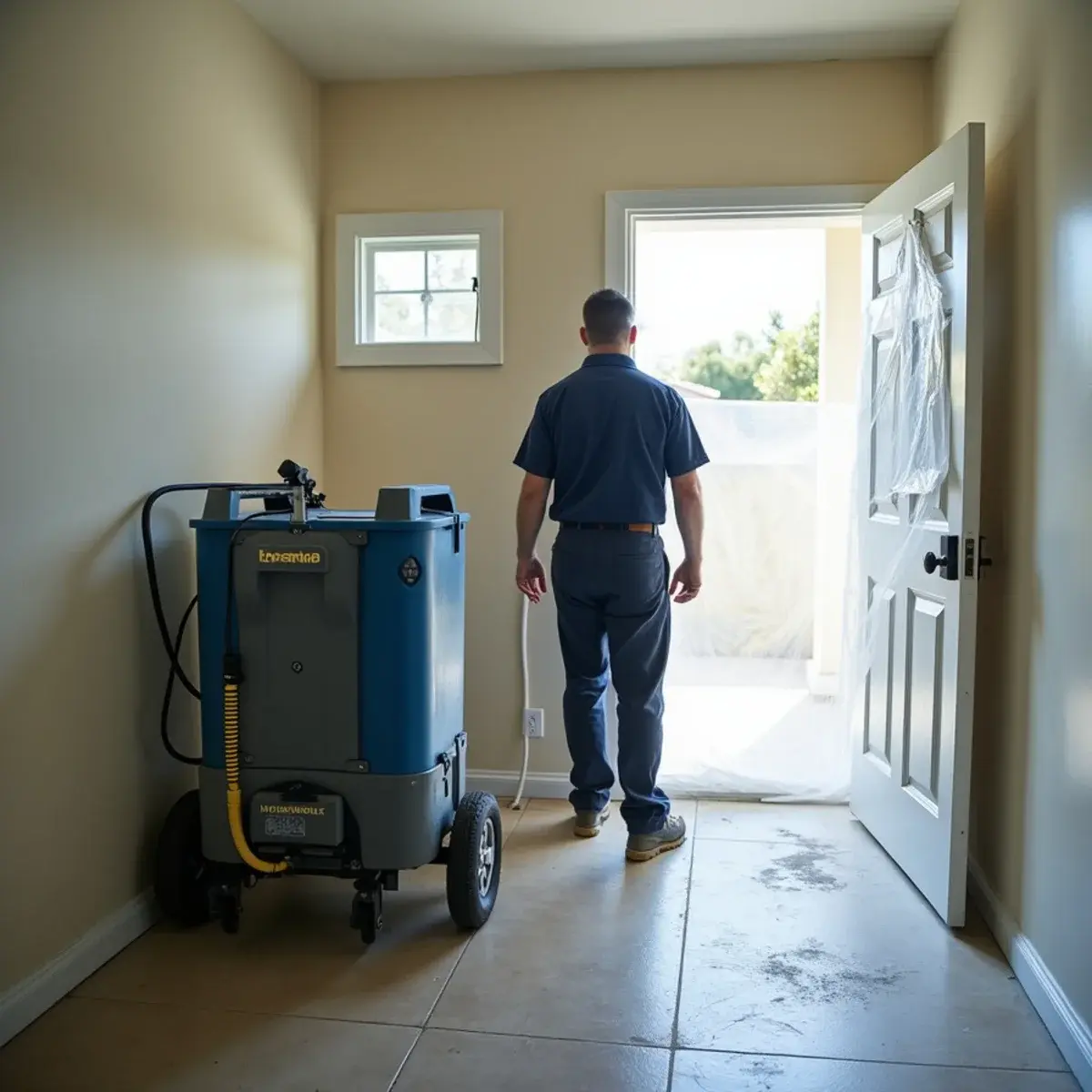
Then thorough drying with the right equipment, sized to the affected volume and verified against a dry standard rather than a calendar.
Then removal of what can't be dried. Wet fiberglass insulation loses its R-value and holds water against framing indefinitely — it comes out. Saturated carpet pad comes out. Materials touched by contaminated water come out regardless of appearance.
And antimicrobial treatment of surfaces that took on water, particularly inside cavities that will never be visible again once the wall closes.
Do those four things and there is nothing to remediate. That's genuinely the goal — mold remediation is what we do when prevention didn't happen, and it's several times the cost of doing the drying right the first time.
Signs mold is already established
If you're past the window and wondering whether you have a problem, the reliable indicators are:
- A persistent musty or earthy smell, especially one that's strongest in a specific room, closet or cabinet.
- Discoloration on drywall, wood or grout — black, green, gray or white, fuzzy or streaked.
- Respiratory symptoms, congestion or headaches that improve when you leave the house and return when you're home.
- Warping, bubbling paint or soft spots on a wall.
- Growth returning in the same spot after you cleaned it, which means the moisture source was never addressed.
A note on "black mold"
The species people mean gets more attention than the evidence supports, and the fixation causes real problems: homeowners demand species testing that doesn't change the remediation plan, and ignore other growth because it's the wrong color.
Under professional standards the response to indoor mold growth is the same regardless of species — contain it, remove it safely, fix the moisture. Testing is genuinely useful for confirming whether a suspected problem exists, defining the boundary of an area you can't see into, and verifying afterward that the work succeeded. Those are good reasons to test. Determining how frightened to be is not.
Frequently asked questions
Possibly, but a moisture meter settles it in ten minutes and a free inspection costs nothing. Odor develops after growth is established, so no smell today doesn't confirm the framing behind your drywall is dry.
On hard non-porous surfaces like tile, cleaning is reasonable. On drywall, wood or anything porous, bleach is mostly water — it lightens the surface stain while adding moisture to the material and leaving the growth inside intact. That's why it appears to work and then recurs.
There's no hard cutoff — it depends on temperature, humidity and materials. What's true is that every day of delay increases the probability and the eventual scope. If it's been a week, get an inspection rather than assuming either the best or the worst.
The bottom line
The 24-to-48-hour figure is best understood as a starting gun rather than a deadline. What determines whether you end up with a mold problem is how quickly water is removed and how thoroughly the structure is dried and verified.
Drycore Restore dries to a measured standard and documents every reading. If you've had a leak recently and want to know whether your walls are actually dry, call +1 (201) 277-9344 for a free moisture inspection.
Related services
- Mold Remediation in Glendale
- Structural Drying & Dehumidification in Glendale
- Water Damage Restoration in Glendale