Drying Plaster Walls: Why Historic Homes Need a Different Approach
A plaster wall can read dry at the surface and still be structurally detached from the lath behind it. Drywall rules don't apply.
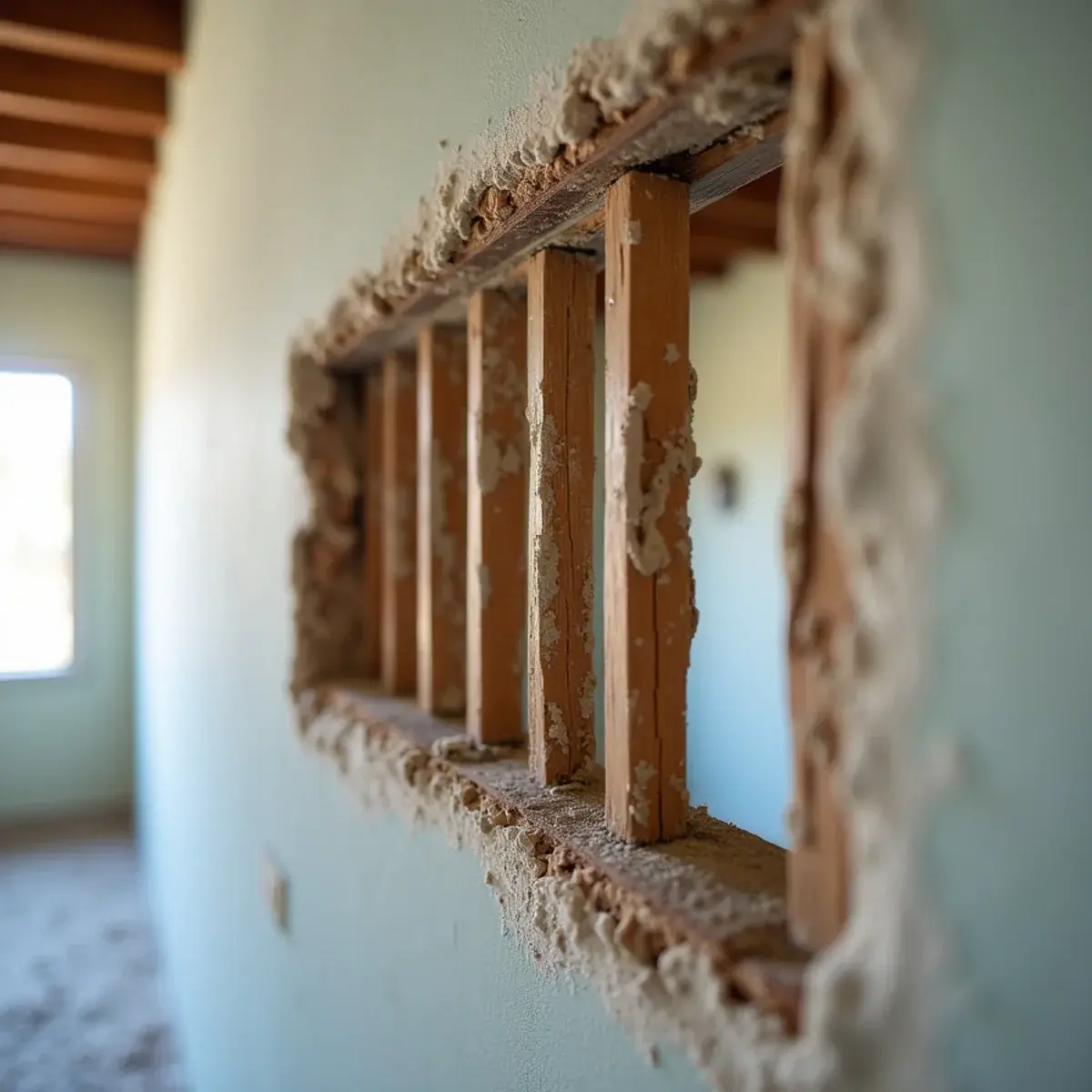
Across Rossmoyne, Pasadena, South Pasadena, Highland Park, Los Feliz, Sierra Madre and half of northeast Los Angeles, the walls aren't drywall. They're plaster over wood lath, and they behave nothing like the material most restoration crews are trained on.
Treat a plaster wall like drywall and one of two things happens: it gets torn out unnecessarily, or it gets called dry three days too early and fails months later. Both are avoidable.
Dealing with this right now? We answer 24/7.
Free assessment · 60-minute emergency response · We bill your insurance carrier directly
What a lath and plaster wall actually is
Thin wooden strips — the lath — are nailed horizontally across the studs with a small gap between each one. Wet plaster is then troweled on in coats, and it squeezes through those gaps and slumps over on the back side, forming what are called keys.
Those keys are the entire mechanical attachment. There are no screws and no adhesive holding the plaster to the wall — just thousands of small mushroomed lugs of hardened plaster hooked over the back of the lath.
The system is typically three coats: a scratch coat pushed into the lath, a brown coat that builds thickness, and a thin finish coat of lime or gypsum. Total thickness is usually three-quarters of an inch or more, against half an inch for standard drywall.
That extra mass is why plaster feels solid and sounds different when you knock on it. It's also why it behaves so differently when it gets wet.
Why it dries so much slower
Plaster is denser than gypsum board and there's more of it. It holds substantially more water per square foot, and it releases that water slowly because the moisture has to migrate through a thick, relatively low-permeability material to reach a surface where it can evaporate.
The practical consequence: a plaster wall can read acceptably dry with a surface meter on day three while the brown coat and the lath behind it are still well above normal. If equipment comes out at that point, the remaining moisture redistributes, the wood lath stays damp, and you have a mold problem in a cavity nobody can see.
So we measure deeper. Penetrating pin meters into the plaster body and, where accessible, readings on the lath and framing itself — not a non-penetrating scan of the finish coat. And we compare against the same material in an unaffected part of the same house, because plaster's normal moisture content varies with age, mix and season.
Expect seven to ten days on a plaster wall where drywall would take three to five. That's not padding; it's the material.
Call +1 (201) 277-9344 — 24/7 in Glendale
Free assessment · 60-minute emergency response · We bill your insurance carrier directly
Key failure: the thing that gets missed
Here's what makes plaster genuinely different from a restoration standpoint. Drywall degrades visibly — it sags, softens, crumbles, and you can see that it's finished.
Plaster fails invisibly. When water saturates the assembly, the keys behind the lath soften and break off. The plaster field can look completely intact from the room side while having no mechanical attachment to the wall at all. It's being held up by friction and by the surrounding sound plaster.
Months later — sometimes years — it lets go, usually in a sheet, usually without warning. On a ceiling that's a genuine safety issue.
The test is percussive. You tap systematically across the field with a knuckle or a soft mallet and listen. Sound plaster with intact keys rings solid. Detached plaster sounds hollow and drummy, and often moves fractionally under pressure. Any competent restoration crew working on a historic house should be doing this before declaring a wall salvageable, and most don't.
Drying it without destroying it
The goal is to remove moisture from the cavity and the plaster body without blasting the finish surface, which can craze the finish coat and lift historic paint or wallpaper.
Where possible we work through the cavity rather than the face. Removing baseboard and drilling discreet ports through the plaster low on the wall — behind where the baseboard returns — lets us push dry air into the stud bay and dry the lath and framing from behind. The ports are invisible once the baseboard goes back.
Dehumidification does the heavy lifting. Rather than aiming high-velocity air movers directly at a historic surface, we bring the room's grain-per-pound down and let the plaster release moisture into drier air at its own rate. It's slower and it doesn't damage anything.
Where wallpaper, decorative finishes or murals are involved, the calculus changes again — those may need a conservator's input, and it's worth asking before anyone points a fan at them.
Repairing in kind
When plaster does have to come out, the temptation is to patch with drywall. It's faster, cheaper and every crew knows how to do it. It also shows, permanently.
Drywall is thinner than three-coat plaster, so a patch sits proud or recessed relative to the surrounding wall. The transition telegraphs through paint. Worse, where a wall meets original casing, picture rail or a plaster cove, the reveal changes and the trim no longer sits correctly against it.
Replacing in kind means new lath — wood or metal — and a three-coat plaster system built to match the existing thickness, then a finish matched to the surrounding texture. On a smooth-troweled 1920s wall that means hand-troweling to match, not a spray texture.
It costs more and takes longer. On a house inside a Historic Preservation Overlay Zone it may also be required. And on any house of real architectural quality it's the difference between a repair you can't find and a permanent blemish. Our reconstruction service handles in-kind plaster work rather than defaulting to board.
Two things worth knowing before demolition
Asbestos and lead. Plaster systems in homes built before roughly 1980 can contain asbestos, particularly in textured finish coats and in the joint materials of early drywall. Paint from before 1978 may be lead-based. Disturbing either during demolition is a regulated activity in California, and testing before you start is both cheaper and safer than discovering it afterward.
Original plaster is a value asset. In a historic district, intact original plaster contributes to the character that gives the house its value. Buyers and appraisers in these neighborhoods notice. A house where the water damage was repaired in kind reads differently from one where a room was rebuilt in drywall, and the difference persists for the life of the building.
- Test for asbestos and lead first. Textured finish coats in pre-1980 homes can contain asbestos, and paint from before 1978 may be lead-based. Disturbing either is regulated in California.
- Tap the whole field, not one spot. Sound plaster rings; detached plaster sounds hollow and drummy. A wall can be structurally detached and look perfectly intact.
- Measure the brown coat, not the surface. A finish coat reading dry tells you almost nothing about the material behind it.
- Photograph the profiles before removal. Coves, picture rails and plaster returns at windows have to be reproduced, and nobody remembers the section afterward.
- Save a sample of the original texture. Matching a hand-troweled finish is far easier with a physical reference than from a photograph.
Frequently asked questions
Knock on them. Plaster sounds solid and dull; drywall sounds hollow between studs. Push a pin into an inconspicuous spot — it goes into drywall easily and won't penetrate plaster. And look at an electrical outlet: the wall thickness at the cut-out is usually visible.
Dried, wherever the keys are intact and the water was clean. Plaster is durable and expensive to reproduce properly. Where the percussive test shows detachment, or where category 3 water was involved, it comes out — but that should be a finding, not a default.
Because that's normal for the material. Plaster holds more water and releases it slower than drywall. What matters isn't the elapsed days but whether the readings are still dropping day over day. A plateau means something needs adjusting; a slow steady decline means it's working.
Sometimes, and the percussive test is decisive. A plaster ceiling that has lost its keys is a falling hazard regardless of how sound it looks, and it comes down deliberately rather than on its own schedule. See our guide on [what to do about a sagging ceiling](/blog/sagging-ceiling-water-damage-what-to-do).
The bottom line
Plaster needs longer drying, deeper measurement, a percussive check for key failure, and in-kind repair when it has to come out. None of that is exotic — it's just not what a crew trained on tract housing does by default.
Drycore Restore works on historic homes across Glendale, Pasadena and northeast Los Angeles. Call +1 (201) 277-9344.
Related services
- Structural Drying & Dehumidification in Glendale
- Water Damage Repair & Reconstruction in Glendale
- Mold Remediation in Glendale