Hillside Drainage and Foundation Protection in Glendale
Water on a slope moves through the ground, not just across it. That's why perfect grading and clean gutters still leave some hillside homes wet every winter.
A large share of Glendale sits on slopes — the Verdugo foothills, the San Rafael Hills, the canyon neighborhoods. Those properties have a water problem that flat-lot homes simply don't, and it's frequently misdiagnosed.
The tell is a homeowner who has cleaned every gutter, cleared every drain and regraded the yard, and still gets water in the crawl space every January.
Dealing with this right now? We answer 24/7.
Free assessment · 60-minute emergency response · We bill your insurance carrier directly
Two completely different kinds of water
Surface water is what you see: rain running down a driveway, sheeting off a slope, overflowing a blocked drain. It arrives during the storm, it's visible, and grading and drainage systems address it well.
Subsurface water is different. Rain that falls uphill percolates into the soil and travels laterally through it, moving downhill through permeable layers until it hits something less permeable. Frequently that something is your foundation. It arrives on a delay — often a day or more after the rain stopped, sometimes on a clear day — and no amount of surface grading affects it.
This is why a homeowner can do everything right on the surface and still have a wet crawl space. They're solving one problem while a different one continues.
How to tell which one you have
Timing is the clearest indicator. Water appearing during peak rainfall, entering at a visible point like a garage threshold or a low door, is surface water. Water appearing a day or two after the storm, seeping through a foundation wall or coming up at the base of a wall with no visible entry point, is subsurface.
Location helps too. Surface water enters at the lowest point where it can get in. Subsurface water enters on the uphill side of the structure, through cold joints, hairline cracks and the seam where the wall meets the footing.
Efflorescence — white crystalline deposits on concrete or masonry — maps subsurface movement. It's mineral left behind as water passed through the material and evaporated. Where you see it, water has been moving through that wall.
Call +1 (201) 277-9344 — 24/7 in Glendale
Free assessment · 60-minute emergency response · We bill your insurance carrier directly
What works for surface water
Grading is first. The ground should fall away from the foundation for at least the first several feet. Settling, added landscaping and hardscape projects routinely reverse this over decades.
Downspout discharge well away from the structure, not at the base of a wall. Extensions, splash blocks, or better, a piped connection that daylights downslope.
Area drains and swales sized for the volume, positioned to intercept flow before it reaches the house, and — critically — actually clear. A drainage system full of leaves is a decoration.
For driveways that slope toward a garage, a trench drain across the apron with a discharge that goes somewhere useful.
What works for subsurface water
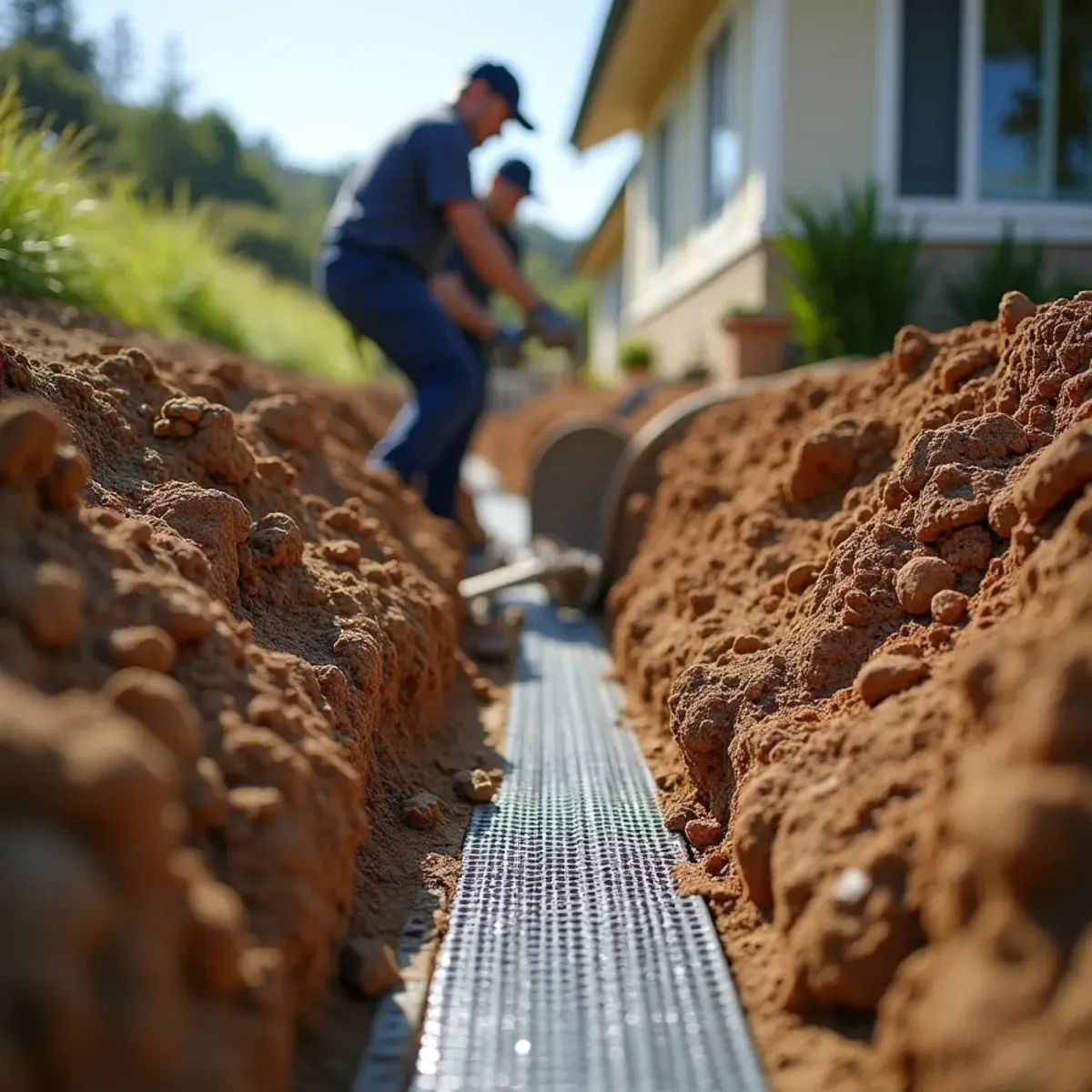
A French drain on the uphill side is the standard answer: a trench excavated below the level you want to protect, lined with filter fabric, containing a perforated pipe surrounded by drain rock, backfilled and daylighting downslope. It intercepts water moving through the soil before it reaches the foundation and gives it a preferred path.
Done right this is genuinely effective and largely permanent. Done wrong — no filter fabric, wrong rock, insufficient depth, or a discharge that doesn't actually drain — it clogs with fines within a few years and stops working.
For structures where water is going to get in regardless, a sump pump in the crawl space or low point, with a discharge line routed well away from the foundation, is the pragmatic answer. It doesn't stop the water, it manages it, and on some hillside lots that's the realistic goal.
Foundation waterproofing from the exterior — excavating and applying a membrane — is the most thorough option and the most expensive. It's usually reserved for below-grade living space rather than crawl spaces.
Landscaping choices that make it worse
A few patterns we see constantly on hillside properties:
- Planters built directly against the foundation, which hold irrigation water against the wall year-round.
- Irrigation lines running along the uphill side of the house, adding water to soil that's already the problem.
- Hardscape — patios, walkways, driveways — that channels water toward the structure rather than around it.
- Retaining walls without drainage behind them, which build hydrostatic pressure and eventually fail or leak.
- Regrading during a landscaping project that inadvertently directed flow toward the house.
- Vegetation removal on a slope, which reduces the soil's ability to hold together and absorb.
What we do during a loss that helps afterward
When we respond to hillside water intrusion — in Verdugo Woodlands, Chevy Chase Canyon, Adams Hill or anywhere on a slope — we document how water entered, not just that it did. Entry point, timing relative to the storm, water clarity, and where the moisture footprint extends.
That documentation is what makes the permanent fix possible. Handing a drainage contractor a specific entry point and a timing profile lets them design a solution. Handing them "the crawl space gets wet" gets you a guess.
The immediate work is crawl space and below-grade water removal — pumping, drying, treating and installing a vapor barrier. The drainage correction is a separate project, and we'll tell you honestly whether you need one or whether this was a one-off.
Frequently asked questions
Interior sealers can reduce surface dampness but they don't address water pressure from outside — the water is still there, still pushing, and it will find another path or eventually push the coating off. Effective solutions manage water before it reaches the wall.
It varies enormously with length, depth, access and where the discharge can go. On a Glendale hillside lot with difficult access it's a meaningful project. What we can say is that it's typically less than repeated annual water intrusion costs over a decade.
Most valley-floor properties don't. Hillside properties with a history of recurring intrusion often do, and it's a reasonable permanent answer when the water is going to arrive regardless. We'll tell you if we don't think you need one.
The bottom line
The reason some hillside homes get wet every winter despite obvious effort is that surface fixes don't touch subsurface water. Diagnosing which one you have is the whole first step.
Drycore Restore handles the emergency side and documents the intrusion path so the permanent fix has a target. Call +1 (201) 277-9344 any hour.
Related services
- Crawl Space & Basement Water Removal in Glendale
- Flood & Storm Damage Cleanup in Glendale
- Mold Remediation in Glendale