What All That Drying Equipment in Your House Actually Does
There's a lot of it, it's loud, and nobody explains it. Here's what each machine is doing and how to tell whether it's working.
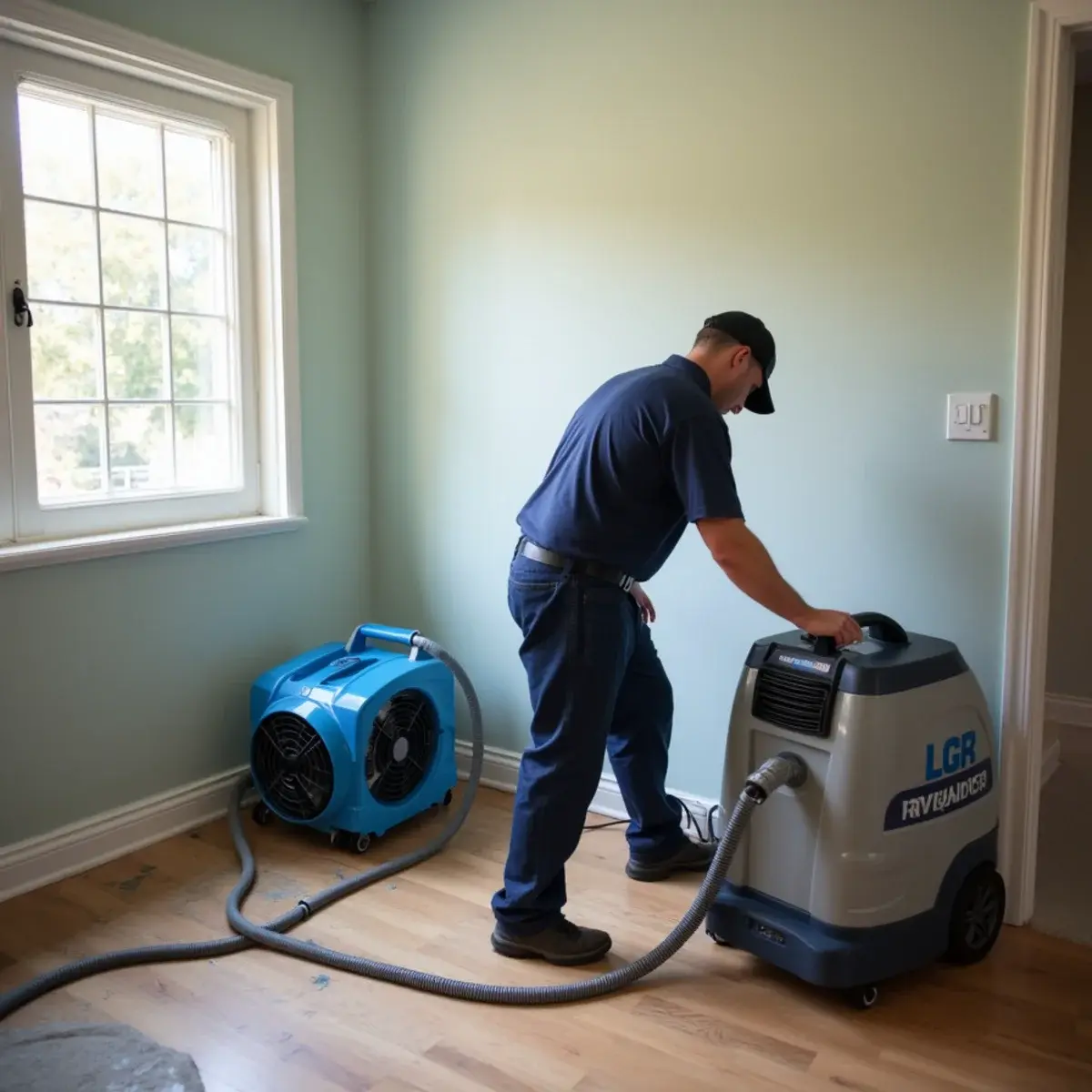
Your house is full of equipment, it's running twenty-four hours a day, and it's costing something per unit per day on your claim. It's entirely reasonable to want to know what it all is.
Here's each machine, what it does, and — more usefully — how to tell whether the setup you've been given is right.
Dealing with this right now? We answer 24/7.
Free assessment · 60-minute emergency response · We bill your insurance carrier directly
Air movers: they don't dry anything
The blue or yellow drum-shaped units on the floor. People assume they're drying the material. They aren't, directly.
When a wet surface sits in still air, a thin layer of saturated air forms against it — the boundary layer — and once that layer is saturated, evaporation effectively stops. The material stays wet not because it can't release moisture but because the air touching it can't accept any more.
An air mover strips that boundary layer away and replaces it with drier air, which lets evaporation continue. That's the whole job. It moves moisture from the material into the room air, where something else has to deal with it.
This is why fans alone make things worse. Without dehumidification you're just relocating moisture from wet materials into the room and then into dry materials elsewhere in the house.
Placement matters more than count. They should be angled shallowly along wet surfaces — roughly 15 to 45 degrees — to sweep the surface, not pointed straight at it. A rough rule is one per 10 to 16 linear feet of affected wall, plus extras for corners and specialty applications.
Dehumidifiers: the ones actually removing water
The large boxes with a hose running to a drain or a bathroom. These are what physically remove water from the environment, and they're the machines whose capacity determines whether your job succeeds.
LGR (low grain refrigerant) is the workhorse. It cools air below its dew point so moisture condenses out, then reheats and returns it. "Low grain" means it keeps pulling water out even when the air is already fairly dry, which is exactly when standard refrigerant units give up. Most residential jobs run these.
Desiccant dehumidifiers use a moisture-absorbing wheel instead of refrigeration. They work at low temperatures and can drive humidity far lower than refrigerant units, which is why they come out for large volumes, cold conditions, and Class 4 losses involving dense materials like concrete, plaster and hardwood.
Undersized dehumidification is the single most common reason a drying job stalls. If readings plateau for two days with the same setup, capacity is the first thing to question.
Call +1 (201) 277-9344 — 24/7 in Glendale
Free assessment · 60-minute emergency response · We bill your insurance carrier directly
Air scrubbers and negative air machines
Same machine, two jobs, distinguished by whether it's ducted.
As an air scrubber, it runs HEPA-filtered air within a space to reduce airborne particulate — dust from demolition, mold spores, general contamination. It's cleaning the air you're breathing while work happens.
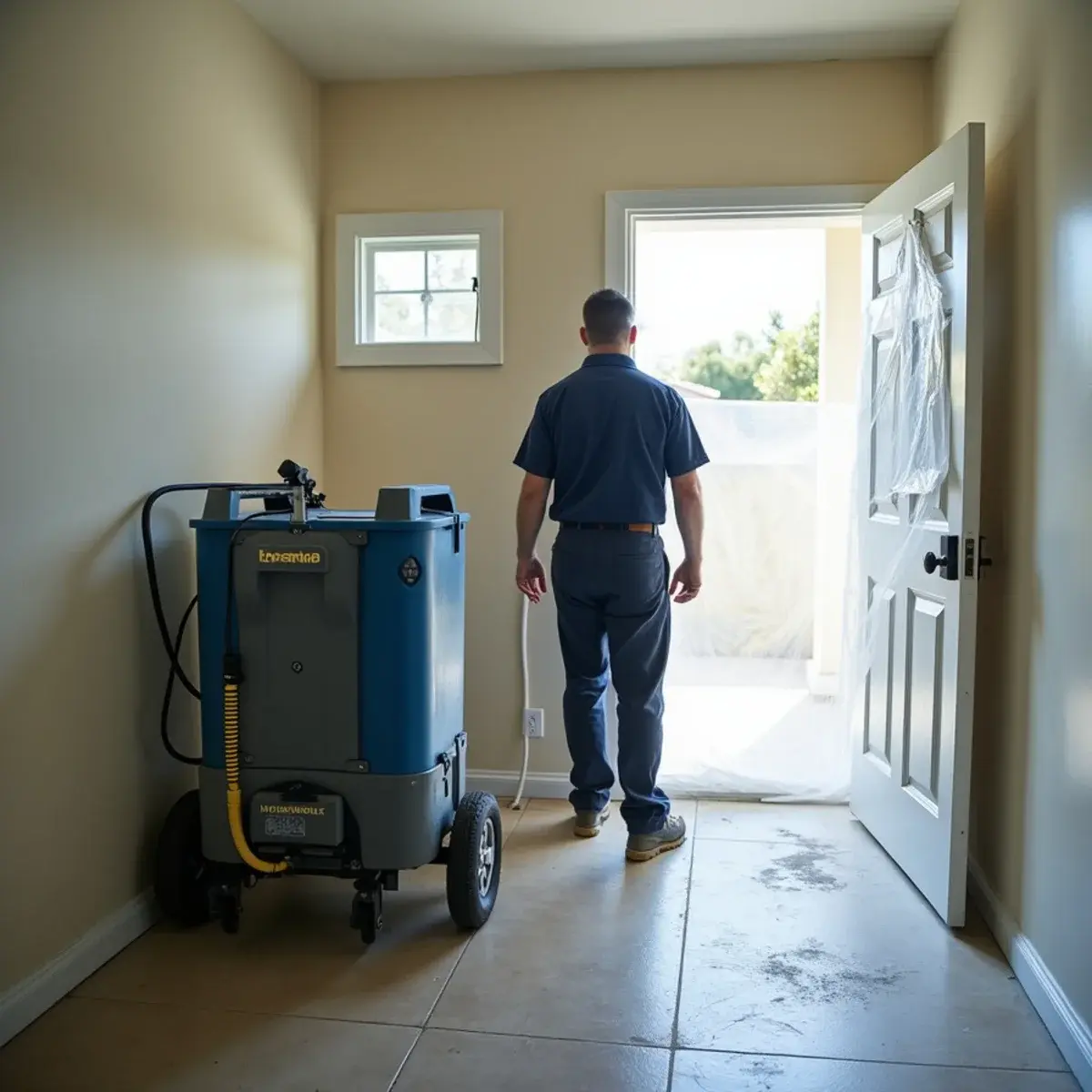
As a negative air machine, it's ducted to exhaust outside the containment. That makes the pressure inside the work area slightly lower than the surrounding space, so air flows *into* the containment and never out of it. This is what actually prevents cross-contamination during mold remediation — the plastic sheeting alone does very little without it.
If you have contained mold work happening and there's no ducted negative air machine, that's worth asking about.
The specialty equipment
Floor mat drying systems — flat sealed mats on a hardwood floor connected to a vacuum unit, pulling moisture up through the boards under negative pressure. This is what saves wood floors that would otherwise be replaced, covered in our guide to saving hardwood after water damage.
Injection / cavity drying systems — small hoses feeding dry air into wall cavities or cabinet bases through discreet drilled ports, so an assembly can be dried without cutting it open.
Hydroxyl generators — these produce hydroxyl radicals that break down odor molecules at a chemical level rather than masking them. Safe to run in occupied spaces, unlike ozone. Used on sewage and fire losses.
Heat drying / directed heat — raising material temperature to accelerate evaporation, used selectively on dense materials.
Moisture meters and thermal cameras — not drying equipment, but the reason anyone knows whether the rest of it is working.
How to tell your setup is right
You don't need to be an expert to sanity-check this:
- Is there at least one dehumidifier? Air movers without dehumidification is the classic wrong setup.
- Is the dehumidifier draining? It should have a hose to a drain, or someone emptying it daily. A full unit does nothing.
- Are air movers angled along surfaces, not pointed head-on at a wall?
- Is someone taking readings every day and writing them down?
- Are the numbers going down day over day? A plateau for two days needs an explanation.
- Is containment sealed where it's meant to be, with negative air ducted out?
- Was equipment removed after a verification reading, not on a scheduled day?
The two questions everyone asks
Can I turn it off at night? Please don't. An eight-hour gap lets moisture redistribute from wet materials back into ones that had already dried, and it commonly adds a full day. If the noise is genuinely unbearable in a bedroom, ask whether that room's equipment can be reduced rather than switching everything off.
What's it doing to my electricity bill? There's a real increase for the days it runs — and it's a legitimate line item on most insurance claims. We log actual run hours specifically so it can be reimbursed rather than absorbed. Ask your restoration company for the equipment log when the job is done; if they can't produce one, they weren't tracking it.
Both of those, incidentally, are good questions to ask on day one rather than day four.
Frequently asked questions
Because the count comes from a calculation, not a guess — air movers from affected linear footage, dehumidification from room volume and the class of loss. A room where water wicked two feet up every wall needs considerably more than a room with a wet patch of carpet.
You can rent consumer-grade fans and dehumidifiers, and for a very small contained spill that may be reasonable. What you can't rent is the metering, the dry standard, or the knowledge of where water actually went — and drying the visible surface while a cavity stays wet is the most common route to a mold problem.
Air movers, dehumidifiers and air scrubbers are safe to run in occupied spaces. Keep cords tidy and units out of reach. Ozone generators are the exception — those require an unoccupied space, which is one reason we prefer hydroxyl for occupied homes.
When affected materials read the same as the same materials in an unaffected part of your house, confirmed by meter and written into a log you receive. Not when it's been a certain number of days, and not when it feels dry.
The bottom line
Air movers move moisture into the air, dehumidifiers take it out, scrubbers clean what's airborne, and the meters tell you whether any of it is working. If someone can't explain which machine is doing what in your house, that's a reasonable thing to ask.
Drycore Restore sizes the system from the affected volume and hands you the daily log. Call +1 (201) 277-9344.
Related services
- Structural Drying & Dehumidification in Glendale
- Mold Remediation in Glendale
- Water Damage Restoration in Glendale