Crawl Space Moisture Problems in Glendale Homes
A large share of the air you breathe upstairs comes up through the floor. That makes a damp crawl space a whole-house problem, not a hidden one.
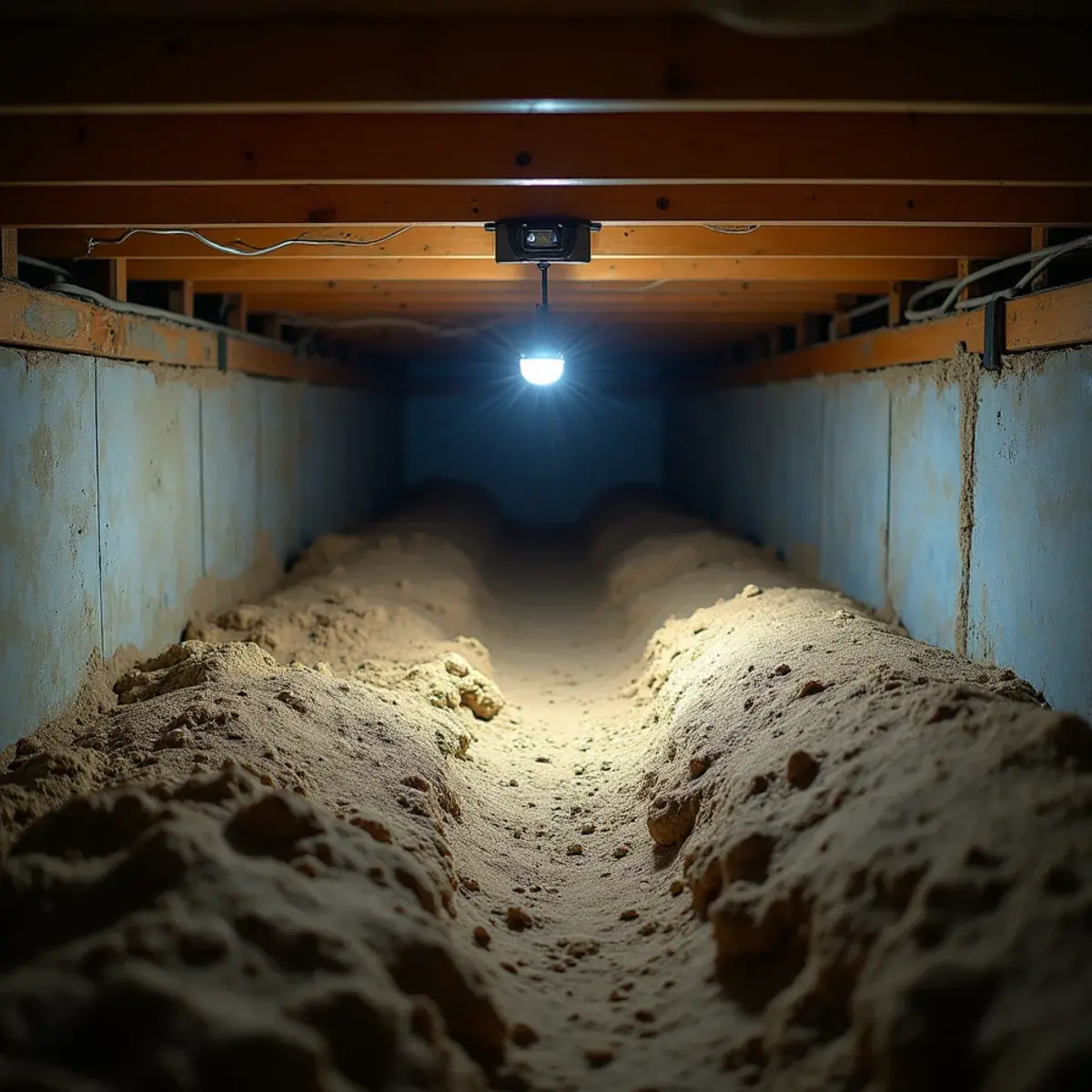
Crawl spaces are the least-visited part of any house, which makes them the easiest place for a slow problem to become a serious one. And unlike most hidden spaces, a crawl space is directly connected to the air you breathe.
Warm air rising through a building draws replacement air in from the lowest point. In a raised-foundation home, that's the crawl space. Whatever is down there — humidity, odor, spores — comes up.
Dealing with this right now? We answer 24/7.
Free assessment · 60-minute emergency response · We bill your insurance carrier directly
The stack effect, and why it matters
Buildings breathe. Warm air rises and escapes at the top through the attic, gaps at recessed lights, and ordinary envelope leakage. Air has to come from somewhere to replace it, and it comes from the lowest available opening.
In a house on a raised foundation, a meaningful fraction of the air in your living space entered through the crawl space and came up through the floor. That's not a defect, it's how buildings work — but it means crawl space conditions are indoor air quality conditions.
This is why a persistent musty smell in a house frequently has no source anyone can find in the living space. It's coming from below, distributed everywhere, strongest at floor level.
Where the moisture comes from
Four sources, and they need different fixes:
- Ground moisture evaporating from bare soil — the most common and the most underestimated. Even soil that looks dry evaporates continuously into the space above.
- Surface runoff and subsurface flow entering during and after rain, particularly on hillside lots.
- Plumbing leaks — a supply line, a drain, or a slow drip under a fixture that's been running for months.
- Condensation, when humid outside air enters a cool crawl space and condenses on ducts, pipes and framing.
Call +1 (201) 277-9344 — 24/7 in Glendale
Free assessment · 60-minute emergency response · We bill your insurance carrier directly
What a vapor barrier actually does
A crawl space with bare soil is running a continuous humidifier under your house. A vapor barrier stops that at the source, and it's one of the highest-value small improvements available to a homeowner with a raised foundation.
The word "properly" is doing a lot of work, though. A vapor barrier means heavy polyethylene, overlapped substantially at the seams, taped, and run up the foundation wall rather than stopping at the perimeter. A thin sheet loosely laid over part of the soil accomplishes very little.
Where we find existing barriers, they're frequently torn, displaced by someone working under the house years ago, or covering only the area near the access hatch. Repairing or replacing it is inexpensive relative to what chronic moisture does to a floor structure over time.
Vent or seal? The honest answer
Traditional practice says vent a crawl space. The logic is that outside air is drier than crawl space air, so exchanging them dries the space.
That's true much of the year in Southern California and false during humid periods — when you're pulling moist air into a cool space where it condenses on the coolest surfaces available, which are your ducts and floor framing. Venting can actively make a crawl space wetter in the wrong conditions.
The modern alternative is encapsulation: seal the vents, install a full vapor barrier up the walls, insulate the perimeter, and condition the space with a dedicated low-grain dehumidifier. It costs meaningfully more and it works reliably regardless of outdoor conditions.
Our recommendation is situational. A crawl space that's dry most of the year with adequate vents doesn't need encapsulation. One with chronic humidity, visible condensation on ducts, or a history of standing water usually does.
What chronic moisture does over time
Subfloor delamination and rot, showing up as soft or springy spots in the floor above. This is structural and expensive.
Fungal growth on joists and girders — including the wood-decay fungi that genuinely compromise structural members, not just surface mold.
Corrosion on ducts, pipes and metal connectors. Rust on any metal component under a house is a direct record of chronic humidity.
Elevated indoor humidity, which makes conditioned air feel warmer, forces your cooling system to work harder, and creates conditions for growth in the living space.
Insulation falling out of the floor bays as it absorbs moisture and loses adhesion, which then removes what little thermal separation existed.
Pest attraction. Damp wood is what draws termites and carpenter ants in the first place.
Glendale-specific patterns
Hillside lots throughout the Verdugo Woodlands, Adams Hill and the canyon neighborhoods see crawl spaces that are shallow on the uphill side and generous on the downhill side. Water entering uphill runs the length of the space and ponds at the low end, where it evaporates upward for weeks after a storm.
North-facing lots stay cooler and damper. A crawl space on the shaded side of a hillside property can hold moisture through most of the winter, which is why we find more growth there than anywhere else in the city.
And in Montrose, La Crescenta and the foothill communities, alluvial soil combined with delayed subsurface flow means crawl spaces frequently take water on a clear day, days after the rain stopped. Our guide to hillside drainage and foundation protection covers what to do about the source.
How to check without going under the house
You don't have to crawl under there to know something is wrong. Warning signs from inside: a musty smell that's present in multiple rooms and strongest at floor level, floors that feel cold or damp over a particular area, soft or springy spots, and unexplained high indoor humidity.
If you have a hatch and a flashlight, a look from the opening tells you a lot — standing water, visible soil, a displaced barrier, or a strong earthy smell are all visible from the entrance.
We do free crawl space inspections across Glendale, which is easier than doing it yourself and comes with moisture readings on the framing. Our crawl space and basement water removal page covers the full remediation process.
Frequently asked questions
No. It treats the symptom while the source keeps producing. You'd be running a dehumidifier permanently against a continuous input. Address the crawl space and the living space follows.
Some seasonal variation in soil dampness is normal. Standing water, condensation on ducts, visible growth or a strong musty odor are not — those indicate a source that needs correcting.
Often, by sistering new lumber alongside the damaged member or replacing a section. Severe rot in a girder or multiple joists becomes structural work requiring an engineer. An inspection tells you which category you're in.
The bottom line
A crawl space is not a sealed box under your house — it's part of your indoor environment. Ground moisture, drainage and ventilation are the three things that determine whether it's helping or hurting.
Drycore Restore inspects crawl spaces free across Glendale and the foothill communities, with moisture readings on the actual framing. Call +1 (201) 277-9344.
Related services
- Crawl Space & Basement Water Removal in Glendale
- Mold Remediation in Glendale
- Structural Drying & Dehumidification in Glendale