Water Damaged Kitchen Cabinets: Save Them or Replace Them?
Pulling a kitchen is fast and profitable. Drying one through the toe-kick is slower, cheaper for you, and works more often than most crews admit.
A kitchen is the most expensive room per square foot in most houses, and cabinetry is most of that cost. So when a dishwasher fails or a supply line lets go under a sink, the question of whether the run can be saved is usually the biggest number in the whole claim.
The industry default is to pull it. It's fast, it's certain, and it generates a much larger invoice. It's also frequently unnecessary.
Dealing with this right now? We answer 24/7.
Free assessment · 60-minute emergency response · We bill your insurance carrier directly
Where the water actually goes
Almost never onto the floor first. A dishwasher, a sink supply line or an ice maker line releases water at the back or the base of a cabinet, and it runs into the toe-kick cavity — the enclosed void under the cabinet boxes, behind that removable strip of trim at the bottom.
That cavity is the worst possible place for water. It's enclosed, unventilated, invisible, and it runs the length of the cabinet run, so water entering under the sink travels sideways under three or four boxes. Meanwhile the cabinet floors above it are absorbing from below.
This is why a kitchen loss often looks trivial. There's a small puddle at the front of the dishwasher, someone mops it, and everybody moves on — while the toe-kick cavity, the cabinet floors and the subfloor stay wet for weeks. Our page on appliance leak cleanup covers the wider pattern.
What survives and what doesn't
Material decides most of it:
- Solid wood boxes and face frames — good odds. Wood swells and recovers if dried properly, and joints usually hold.
- Plywood boxes — good odds. Plywood is far more moisture-tolerant than particleboard and rarely delaminates from a short exposure.
- Particleboard or MDF boxes — poor odds once swelling has started. The fibres expand irreversibly, and a swollen box never returns to dimension. Caught within hours it sometimes survives; caught after a day it usually doesn't.
- Toe-kick trim — almost always replaced regardless. It's cheap, it's the first thing to swell, and it comes off anyway to dry the cavity.
- Cabinet floors (deck panels) — often the failure point even in good cabinetry, because they're frequently thinner and less finished than the sides.
- Doors and drawer fronts — usually fine, since water rarely reaches them. This matters: replacing boxes while keeping doors is sometimes an option.
Call +1 (201) 277-9344 — 24/7 in Glendale
Free assessment · 60-minute emergency response · We bill your insurance carrier directly
How in-place drying works
The technique is straightforward and takes patience rather than special genius.
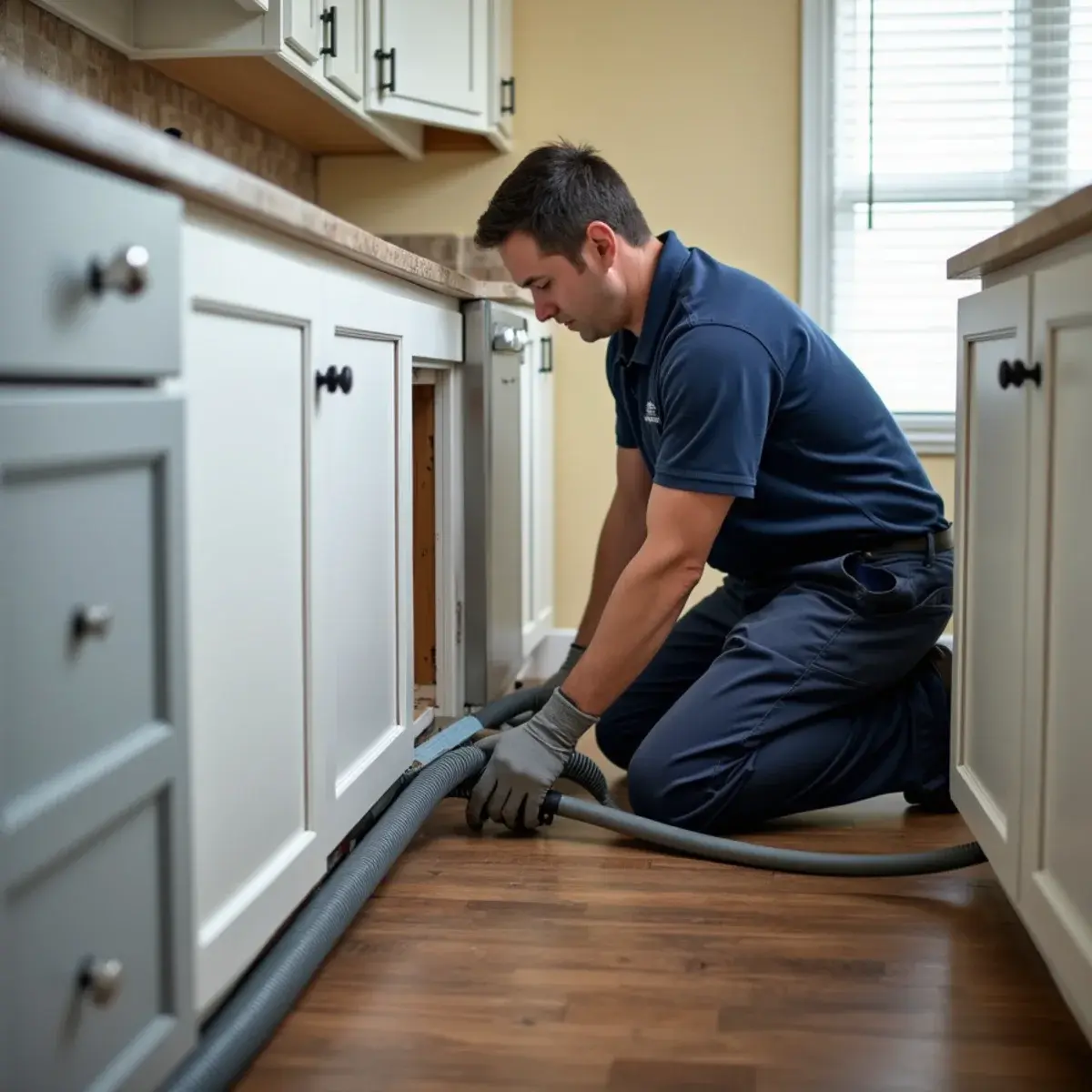
The toe-kick trim comes off, opening the cavity. Small ports are drilled through the cabinet floors and the interior end panels — hidden inside the boxes, behind whatever sits on them. Where a run has a sealed end, a port goes through the side panel low down.
Then dry air is pushed through the whole cavity system under pressure, moving from box to box and out through the open toe-kick, while dehumidification handles the released moisture. The countertop stays on, the doors stay hung, the sink stays plumbed, and the kitchen stays usable.
When it's finished, the toe-kick goes back and covers everything. The ports inside the boxes are invisible unless you empty a cabinet and look at the underside of a shelf.
It takes longer than a normal room dry-out — typically seven to ten days, because you're drying dense material in an enclosed space — and it needs daily meter readings on the cabinet floors and the subfloor to confirm it's working.
The subfloor question
Drying the cabinets and ignoring what's under them is the most common half-measure. Water that entered the toe-kick cavity has been sitting on the subfloor or slab underneath, and the cabinets are sitting on top of that.
On a wood subfloor, prolonged moisture causes delamination and rot, and the affected area extends beyond the cabinet footprint. If there's a crawl space below, drying from underneath as well is far more effective and frequently possible.
On a slab, the concrete holds a reservoir and releases it slowly. This matters enormously if flooring is being replaced — laying new floor over a slab that's still emitting moisture destroys it, which is covered in our guide to slab moisture testing.
Meter readings on the subfloor should be part of the daily log alongside the cabinets. If nobody is measuring under the cabinets, nobody knows whether the job is finished.
When replacement is the right call
We're arguing against reflexive demolition, not against replacement. Genuine reasons to replace:
Category 3 water. Sewage backup or storm runoff means every porous material comes out regardless of condition. You cannot decontaminate the interior of a particleboard box.
Swelling has already occurred. Once particleboard has expanded and the surface laminate has bubbled, it's finished. Drying it just leaves you a dry ruined box.
The loss has been running for weeks. Established microbial growth inside an enclosed cabinet cavity is a removal job.
The kitchen was due anyway. If you were planning a remodel, an insured loss that covers the removal is a reasonable moment to do it — though be clear with your carrier about what's covered damage versus what's an upgrade you're funding.
What isn't a good reason: a contractor who hasn't taken a moisture reading telling you on day one that the run has to come out.
The questions to ask
Before anyone starts, ask three things. Will you attempt to dry the cabinets in place through the toe-kick, or is the plan to remove them? What are the moisture readings on the cabinet floors and the subfloor right now? And what will you measure to decide whether the drying worked?
A crew that has a real answer to all three is going to try. A crew that can't answer the second one hasn't measured anything, and their removal recommendation is a guess dressed as expertise.
It's also worth knowing your cabinet material before you're in this situation. Open a drawer, look at the raw edge at the back — if it's a compressed chip pattern rather than layered plies or solid timber, you have particleboard and your window is measured in hours.
Frequently asked questions
Probably. The floor surface dries first while the toe-kick cavity, the cabinet floors and the subfloor stay wet — that's the whole pattern. A ten-minute moisture check settles it, and ours are free.
Most of it. In-place drying leaves the countertop, sink and appliances in position — the only visible change is the toe-kick trim off and equipment running. That's a large part of why it's worth the extra days.
Carriers generally prefer drying because it costs less, so they rarely push for replacement. The pressure usually runs the other way — a contractor recommending removal because it's faster and pays more. Ask for the readings that support the recommendation.
Sometimes, and it depends on age and manufacturer. Stock lines from the last few years often match; anything older or custom rarely does. Where matching fails, replacing boxes while reusing existing doors and drawer fronts is worth exploring.
The bottom line
A wet kitchen isn't automatically a new kitchen. Toe-kick drying saves cabinet runs routinely when someone reaches them early and bothers to measure — and it keeps you cooking in your own kitchen while it happens.
Drycore Restore attempts in-place drying before reaching for a saw. Call +1 (201) 277-9344.
Related services
- Appliance Leak & Overflow Cleanup in Glendale
- Structural Drying & Dehumidification in Glendale
- Water Damage Repair & Reconstruction in Glendale