Mold Testing: When Is It Actually Worth Paying For?
Three good reasons to test, one bad one, and a conflict of interest worth knowing about before you hire anybody.
Mold testing gets sold hard, and a lot of it is unnecessary. It also gets dismissed by contractors who'd rather not have their work independently checked, and some of that dismissal is self-serving.
Here's an honest read on when it's worth the money — including a conflict of interest that applies to us and that you should know about.
Dealing with this right now? We answer 24/7.
Free assessment · 60-minute emergency response · We bill your insurance carrier directly
The bad reason to test
"I want to know what species it is so I know how worried to be."
Under the professional standards this industry works to, the response to indoor mold growth is the same regardless of species: contain the area, put it under negative pressure, remove affected porous materials, clean what remains, and fix the moisture that caused it.
Knowing that a sample came back as *Stachybotrys* rather than *Aspergillus* does not change the containment, the removal, the disinfection or the verification. It changes how frightened you feel, and it adds a line to an invoice.
The fixation on "black mold" specifically causes real harm — it drives spending on tests that don't alter the plan, and it leads homeowners to shrug at growth that isn't the right color. Our guide to how fast mold grows after water damage covers why the response is the same either way.
Reason one: confirming whether a problem exists at all
This is the strongest case. You have a persistent musty smell, or symptoms that improve when you leave the house, but nothing visible and no known water event.
Here testing is genuinely diagnostic. Air sampling compares indoor spore counts and species distribution against an outdoor control taken the same day — the outdoor sample is the baseline, and what matters is whether indoor readings are elevated relative to it and whether species appear indoors that aren't outside.
Combined with a moisture survey using meters and thermal imaging, that will usually settle whether you have a hidden problem or whether the smell is something else. It's a few hundred dollars against the alternative of opening walls speculatively.
Worth noting: a single air sample is a snapshot. Spore counts fluctuate with activity, ventilation and weather, so a competent inspector takes multiple samples and interprets them alongside physical evidence rather than treating one number as an answer.
Call +1 (201) 277-9344 — 24/7 in Glendale
Free assessment · 60-minute emergency response · We bill your insurance carrier directly
Reason two: defining the boundary of something you can't see into
You know there's growth — it's visible in one spot — but you don't know how far it extends behind the finishes.
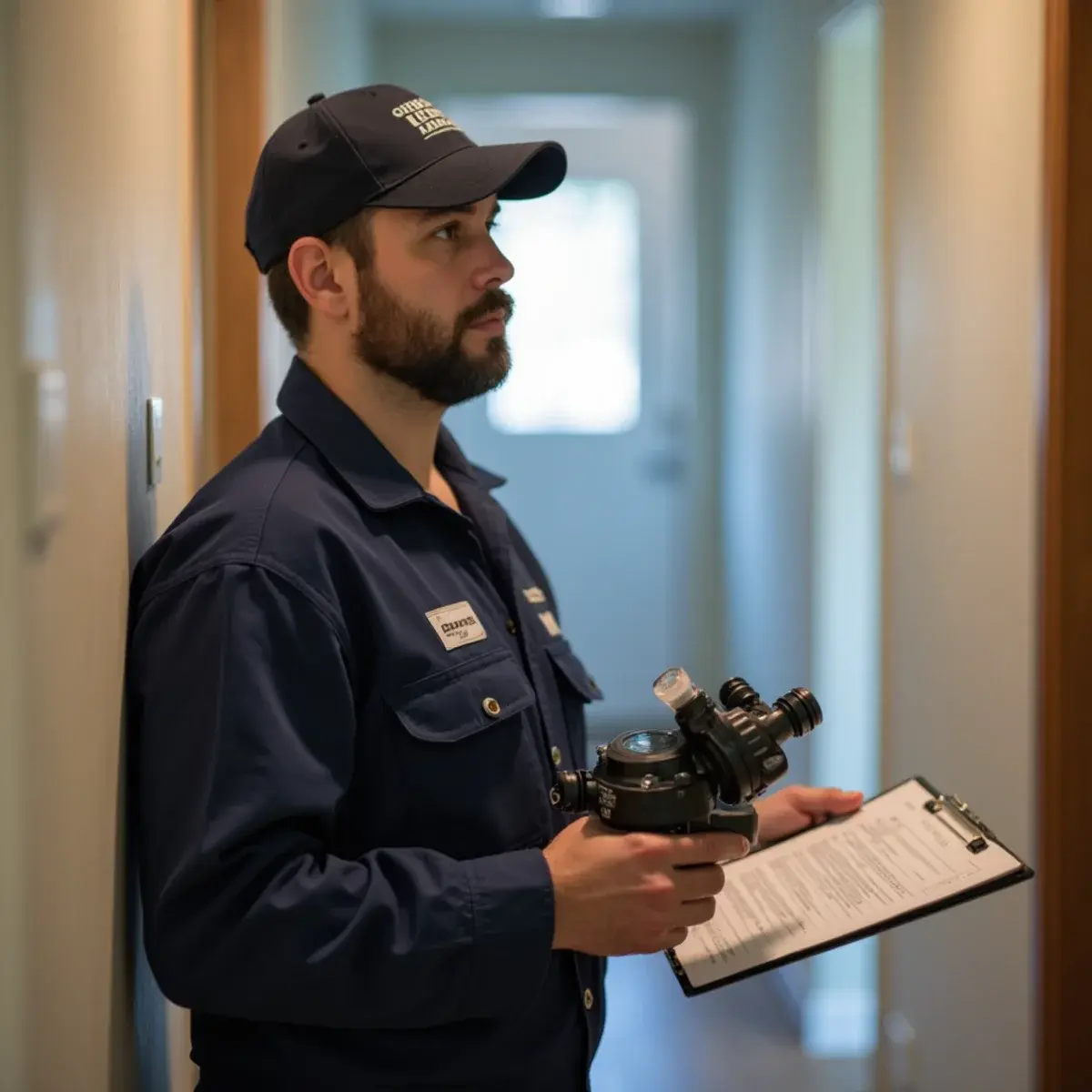
Here the useful tools are less about species and more about mapping. Moisture meters and thermal imaging find the wet area, which is where growth will be. Where the cavity genuinely can't be assessed any other way, a borescope through a small hole gives you eyes inside the wall for the cost of a patch.
This matters commercially because remediation is priced by area. Guessing large wastes money; guessing small means opening it again in three months. An hour of investigation ahead of a multi-thousand-dollar remediation is straightforwardly good economics.
Reason three: post-remediation verification
This is the one we recommend most consistently, and it's the one homeowners most often skip because they're tired and want their house back.
Post-remediation verification (PRV) is an independent check that the work succeeded — a visual inspection of the cleared containment, moisture readings confirming the source is resolved, and air or surface sampling compared against an outdoor baseline.
It matters for three reasons. You find out whether it actually worked before the walls close. You have documentation if a health question or a dispute arises later. And if you sell the property, a clearance report from an independent hygienist is a genuine asset — "we had mold and remediated it, here's the clearance" is a far better disclosure conversation than "we had mold and the contractor said it was fine."
On a small, contained, obvious job — a cabinet base, a single wall section from a known clean-water leak — it's arguably optional. On anything of scale, in a bedroom, or where anyone in the household has asthma or a compromised immune system, we'd push for it.
The conflict of interest, including ours
Any company that both tests for mold and remediates it has a financial incentive to find a problem. That's not an accusation about anyone in particular — it's structural, and it applies to us as much as to anybody.
It's why we recommend that testing on jobs of consequence is done by an independent industrial hygienist who isn't doing the remediation and doesn't benefit from the scope. Their fee is a fraction of the remediation cost and it makes the result mean something.
It's also why we're happy to work alongside a hygienist we didn't hire and didn't choose. If a company reacts badly to independent verification of their own work, that reaction is information.
The corollary: be skeptical of free mold inspections offered by remediation companies. Not because they're always dishonest, but because the incentive is pointing one direction and you should know that going in. Our mold remediation page sets out the standard the work should meet regardless of who tests it.
What testing costs and what you get
A basic air sampling assessment with an outdoor control and a couple of indoor samples plus a written report sits in the low hundreds. A comprehensive inspection with moisture mapping, thermal imaging and multiple samples is more. Post-remediation verification is typically similar to the initial assessment.
What you should receive is a written report with the sampling methodology, the lab results, the outdoor baseline for comparison, an interpretation, and photographs. Lab results without interpretation are close to useless to a homeowner — spore counts mean nothing without the control and the context.
What you shouldn't accept: a verbal "it's fine", a result with no outdoor comparison, or a report that recommends a specific remediation contractor.
On insurance — mold coverage in most California policies is capped at a sublimit, and testing may or may not fall inside it. Worth asking your adjuster before you commission anything, and worth knowing that California policies exclude mold from long-term seepage entirely.
- A written report, not a verbal 'it's fine' — with the sampling methodology stated.
- Lab results with an outdoor control taken the same day. Indoor spore counts are meaningless without the baseline to compare them against.
- An interpretation, not just numbers. Raw counts are close to useless to a homeowner.
- Photographs of sampling locations and any visible growth.
- No recommendation of a specific remediation contractor — that is the tell that the assessment is a sales call.
Frequently asked questions
Not if the growth is visible and the moisture source is identified — at that point you know what you need to know and testing delays the work. Test beforehand when you suspect a problem you can't see, or when you need the extent defined to price it properly.
The settle-plate kits sold in hardware stores will grow something from essentially any indoor air sample, because spores are always present. Without an outdoor control and a methodology, a positive result tells you nothing. They generate anxiety more reliably than information.
An independent industrial hygienist or certified indoor environmental professional with no financial interest in the remediation. Ask directly whether they perform remediation — if they do, their assessment carries less weight regardless of their competence.
It's evidence, not a guarantee. It confirms that at the time of sampling, the cleared area's air and surfaces compared acceptably to the outdoor baseline. If the moisture source wasn't actually fixed, growth returns regardless of what the clearance said — which is why source correction is the part that matters most.
The bottom line
Test to find out whether you have a problem, to define one you can't see, or to verify that remediation worked. Don't test to learn a species name. And when it matters, have someone independent do it.
Drycore Restore remediates to IICRC S520 and works alongside third-party hygienists rather than grading our own homework. Call +1 (201) 277-9344.
Related services
- Mold Remediation in Glendale
- Crawl Space & Basement Water Removal in Glendale
- Structural Drying & Dehumidification in Glendale