Cast Iron Drain Pipes: The Leak You Won't See Coming
Everyone worries about the supply side. In pre-war buildings it's the drain pipe that quietly destroys a wall over eight months.
When people worry about old plumbing they think about supply lines — the pressurised pipes that burst dramatically and flood a house in an afternoon. Those are real, and they're covered in our guide to preventing burst pipes in older homes.
The drain side is different and, in some ways, worse. It doesn't burst. It seeps, quietly, inside a wall or a floor assembly, for months — and in the pre-1970 buildings that make up so much of central Los Angeles, it's the single most under-diagnosed source of water damage we deal with.
Dealing with this right now? We answer 24/7.
Free assessment · 60-minute emergency response · We bill your insurance carrier directly
Why cast iron fails from the inside
Cast iron was the standard drain, waste and vent material in American buildings from the late 1800s until plastic took over in the 1970s. It's genuinely durable — commonly quoted service life is fifty to a hundred years — and a lot of it has outlasted that.
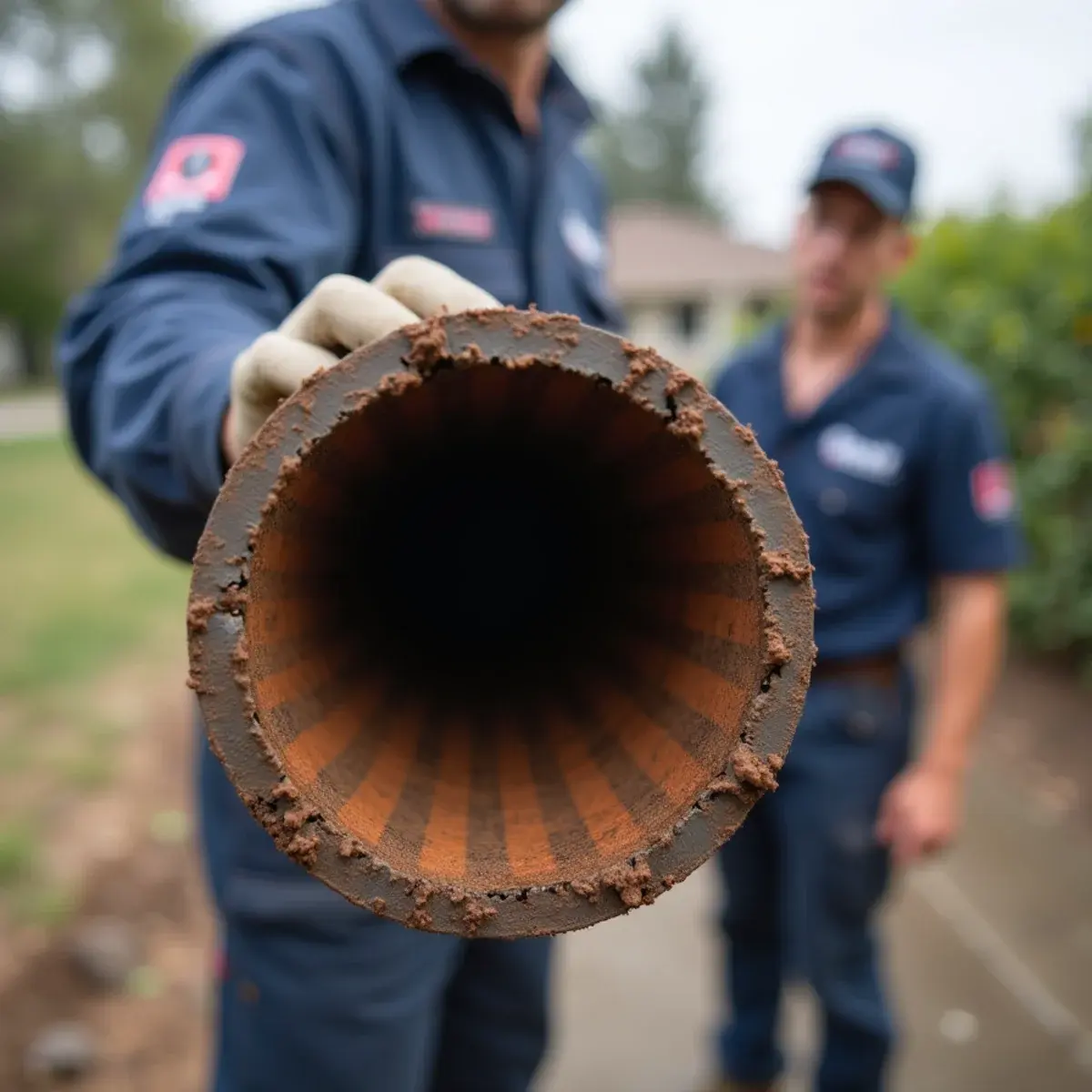
The failure mechanism is internal corrosion. Wastewater is mildly acidic, and it sits in the bottom of horizontal runs rather than filling the pipe. Over decades that constant contact eats the pipe wall from the inside along the invert — the bottom of the pipe — while the top stays comparatively sound.
The result is a pipe that looks perfectly fine from outside, right up until the invert perforates. Cut a section out of a ninety-year-old horizontal run and you'll often find the bottom third simply gone, replaced by a channel of rust and scale.
Vertical stacks fail differently and usually later, most often at the base where the vertical turns horizontal and flow slams into the fitting. That's why the bottom floor of an old apartment building is where stack failures tend to surface.
What it looks like when it goes
Not like a burst pipe. A cast iron failure is a seep — a small volume of contaminated water escaping continuously into an enclosed cavity where nobody can see it.
For weeks, nothing. Then a persistent musty smell that nobody can locate, strongest in one room or one closet. Then, eventually, a soft spot in a floor, a stain that seems to come from nowhere, or paint blistering at the base of a wall.
In a multi-storey building it's worse, because the water travels. A stack failure on the third floor can surface as a damp ceiling on the first, and the tenant who reports it isn't the one whose plumbing failed. We've opened walls in Hollywood and Koreatown buildings and found framing that had been wet for the better part of a year.
There's also a contamination dimension. This is waste water, which makes it category 3 — so what looks like a modest damp patch is a biohazard remediation, not a dry-out. Our page on the water damage categories covers why that distinction drives the entire scope.
Call +1 (201) 277-9344 — 24/7 in Glendale
Free assessment · 60-minute emergency response · We bill your insurance carrier directly
The signs worth acting on
Cast iron gives you warnings if you know what they look like:
- Recurring slow drains that clear and then return — internal scale narrowing the pipe.
- Dark brown or rust-coloured water backing into a tub or shower.
- A musty or sewage odor in a room with no plumbing fixture in it.
- Visible flaking, scaling or a rough rusty texture on any exposed cast iron in a basement, crawl space or utility area.
- Pipe that sounds dull rather than sharp when tapped with a screwdriver handle, or that flakes when scraped.
- Unexplained damp at the base of a wall on the lowest floor of a multi-storey building.
- Pest activity — roaches and rodents follow the cracks in a compromised waste line, which is why an infestation with no obvious food source is sometimes a plumbing symptom.
How it gets diagnosed properly
A camera inspection of the drain system is the primary tool, exactly as it is for a sewer lateral. It shows the interior condition of the pipe — scale build-up, perforation, cracking — and it locates problems so a repair can be targeted.
From the restoration side, thermal imaging and moisture meters map how far the seep has travelled through the assembly, which is nearly always further than the visible symptom suggests. Water in a wall cavity moves along the bottom plate and can present three rooms away from its source.
If you're in a building of this age and something smells wrong with no explanation, those two inspections together will settle it. Our guide to hidden water damage signs covers the wider detection picture.
Repair options, honestly compared
Spot repair. Cut out the failed section and replace it with plastic joined by shielded couplings. Reasonable when a camera shows one bad run in a system that's otherwise sound. On a system where the whole thing is the same age and condition, it's a temporary answer.
Epoxy lining. A coating is applied to the interior of the existing pipe, forming a new surface inside the old one. Less disruptive than replacement and genuinely useful in buildings where opening walls and slabs is prohibitive — which describes most occupied apartment buildings. It requires the host pipe to still have structural integrity, so a badly perforated line isn't a candidate.
Full repipe of the drain system. Replace with ABS or PVC. The most disruptive and most expensive option and the last one you'll ever do. In a single-family house it's a defined project. In an occupied multi-unit building it's a major undertaking that has to be phased around residents.
The decision belongs to the camera footage, not to a price list. What we'd push back on is spot-repairing a ninety-year-old system for the third time — at that point you're funding repeated restoration work alongside repeated plumbing work.
If you own or manage an older building
Two pieces of practical advice. First, get the drain system camera-inspected before you need to. In a pre-1970 building it's a reasonable thing to do proactively, and knowing the condition lets you plan a repipe rather than react to a failure at two in the morning.
Second, if the building is undergoing a soft-story seismic retrofit — which applies to a very large share of older Los Angeles apartment stock — that's the moment to look. Walls and floors are already open, access is as good as it will ever be, and the incremental cost of addressing plumbing at the same time is a fraction of doing it separately.
We're regularly called to buildings where a loss surfaced during or shortly after retrofit work, simply because construction disturbed a pipe that had been quietly failing for years. Taking moisture readings before walls close back up costs almost nothing and catches exactly this.
Frequently asked questions
Commonly quoted at fifty to a hundred years, with the real number depending on what has gone down it and how much the horizontal runs hold. Buildings from the 1920s and 1930s are at or past the end of that range now, which is why Central Los Angeles produces so many of these failures.
It depends heavily on whether it reads as sudden or gradual. A pipe that has been seeping for months is the textbook gradual exclusion. That said, the failure itself may be sudden even if discovery was late, and documentation of when it was found matters. We record the evidence carefully because that framing decides these claims.
Partially. Tap any exposed cast iron with a screwdriver handle — sound pipe rings, badly corroded pipe sounds dull and may flake when scraped. That's a useful screening test, but it tells you nothing about the buried horizontal runs where failures actually happen.
Because the escaping water is waste water, and because microbial growth begins in the wet cavity within days. Odor is produced long before enough material has degraded to show a stain on the finished side of a wall.
The bottom line
Cast iron doesn't announce itself. It corrodes from the inside, seeps into a cavity, and gives you a smell months before it gives you a stain — and because it's waste water, the cleanup is a biohazard job rather than a dry-out.
If something smells wrong in an older building and nobody can find it, Drycore Restore will map it with meters and thermal imaging. Call +1 (201) 277-9344.
Related services
- Sewage Backup Cleanup in Glendale
- Mold Remediation in Glendale
- Water Damage Repair & Reconstruction in Glendale